

Archive position — measured, not model output
0 likes on Devpost
2,263 of the 7,850 archived projects have more likes, and 5,587 share exactly 0 — so this project's #4,903 place in the like-ranked listing is a tie-break inside that group, not a ranking.
Projects (log scale)
Likes on Devpost. ▲ marks this project's group.
Show the figures
| Likes | Projects | Share of archive |
|---|---|---|
| 0 | 5,587 | 71.2% |
| 1 | 1,758 | 22.4% |
| 2 | 284 | 3.6% |
| 3–4 | 132 | 1.7% |
| 5–9 | 75 | 1.0% |
| 10+ | 14 | 0.2% |
 User Stories BotA demo video on every pull request
Get a demo video on every new feature
GitHub App that watches your pull requests and records a narrated, captioned demo.
Save time on demo prep and make informed decisions faster with a video walkthrough of every new feature.
Executive Summary
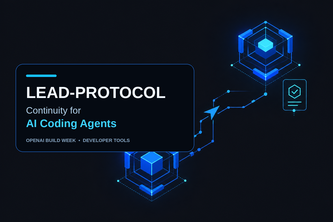
The description states that Lead-Protocol is a vendor-neutral, file-based session lifecycle for AI coding agents. The author describes it as a coordination layer that preserves context, ownership, checkpoints, and handoffs across coding tools without relying on hosted services or proprietary chat history. It operates through a CLI with session open, checkpoint, and session close functions, using SHA-256 hashes and canonical file paths.
The project appears to be an early-stage technical prototype built during a hackathon, with no evidence of revenue, customers, or traction beyond the author's own development work. The author claims to have used Codex and GPT-5.6 for development and adversarial review, but there is no independent verification of these claims or their outcomes.
The single most important open question is: What is the actual commercial use case or market need that this solution addresses, and how does it differ from existing alternatives?
What The Product Actually Is
The description states that Lead-Protocol is a vendor-neutral, file-based continuity layer for AI coding agents. It provides:
- A durable handoff mechanism between (actor, agent) pairs
- Canonical file paths plus SHA-256 hashes for session registration
- Timestamped shared snapshots without overwriting another agent's state
- Session lifecycle validation with checklist and stable handoff
- Support for local operation across Windows, macOS, or Linux
- Integration with Git for readable state
The product is described as a CLI tool that can be installed via npx @leadsolutions/lead-protocol@2.1.4 init --yes and includes lifecycle regression tests and smoke coverage.
Positioning & Claim Evolution
The description states the author's inspiration was to solve the problem of AI coding agents losing operational context between sessions. The positioning is that Lead-Protocol offers a vendor-neutral, file-based solution that works across coding tools without depending on hosted services or proprietary chat history.
The claim evolution shows:
- Initial idea: "I wanted a simple coordination layer"
- Development focus: "session open, checkpoint, and session close"
- Technical scope: "canonical receipts and SHA-256 evidence", "ownership, concurrency, peer-session preservation, and transactional rollback safeguards"
- Validation: "GPT-5.6 Sol performed an independent public adversarial review"
The author claims this is a solution for coordination between AI agents in coding environments, but does not articulate how it would be adopted or monetized.
Target Customer & ICP
Not evidenced. The description does not identify specific customer segments, target industries, or personas. It only describes the technical problem (context loss in AI coding agents) and the proposed solution without specifying who would use it or why.
Business Model & Pricing Evidence
Not evidenced. There is no mention of pricing models, revenue streams, licensing terms, or commercial arrangements in the description. The author does not describe any monetization strategy or business approach beyond the technical implementation.
Technical & Delivery Signals
The description states:
- Built with: actions, codex, github, gpt-5.6, json, node.js, npm, powershell, python, schema, typescript
- Version: v2.1.4
- Development process: Used Codex for implementation and fault-injection tests
- Adversarial review: GPT-5.6 Sol performed independent public adversarial review
- Testing: Lifecycle regression tests and installed-package smoke coverage
- Deployment: Published package available via npx
The author claims to have used GPT-5.6 as an engineering collaborator, not a runtime dependency.
Traction & Maturity Signals
Not evidenced. There is no evidence of revenue, customers, user adoption, or market traction beyond the author's own development work. The project appears to be a hackathon submission with no indication of ongoing usage or commercial deployment.
Competitive Context
Not evidenced. The description does not mention any competitors, existing solutions in this space, or how Lead-Protocol would position itself relative to other tools for AI agent coordination or session management.
Open Questions & Risks
- The project is described as a hackathon submission with no evidence of commercial traction
- No revenue, customer, or adoption data provided
- The author claims GPT-5.6 was used as an engineering collaborator but does not specify how this impacts the actual product
- The solution appears to be a CLI tool for developers, but there is no indication of market demand or user need beyond the author's own problem
- No evidence of any business model or monetization strategy
Questions the description leaves open
- What specific problem in AI agent coordination are you solving, and how does this solution address it?
- Who are your target users, and what is their current approach to managing session continuity?
- How do you plan to monetize or commercialize this tool?
- What evidence do you have that there's a market need for this solution beyond your own use case?
- How does this product differ from existing tools for managing AI agent sessions or state?
- What are the technical limitations of the current implementation, and how do you plan to address them?
Overall Assessment
Not evidenced. The description provides no information about financials, funding rounds, valuation, or partnership opportunities. There is insufficient evidence to assess whether this represents a viable investment opportunity or potential partnership target. The project appears to be an early-stage technical prototype with no demonstrated commercial traction or market validation.
User Stories BotA demo video on every pull request
Get a demo video on every new feature
GitHub App that watches your pull requests and records a narrated, captioned demo.
Save time on demo prep and make informed decisions faster with a video walkthrough of every new feature.
Source
Submitted to the OpenAI 2026 hackathon on Devpost. Project home on Devpost. Back to the full gallery on Devpost.
This competitive analysis was produced by top-founders.com (opens in a new tab)
Generated by a language model from this project's public Devpost page — its tagline, the author's own write-up and any built-with tags listed there — as captured in August 2026. Short quotations are the author's words. It is an opinion on the idea as a business, not on the people behind it, and it reflects the description as published then. If the project has moved on, request a correction below. The analysis is not independent research and contains no verified traction, revenue or customer data.
An independent guide by KFG International LLC — not affiliated with, endorsed by, or connected to Devpost or OpenAI.