

Archive position — measured, not model output
0 likes on Devpost
2,263 of the 7,850 archived projects have more likes, and 5,587 share exactly 0 — so this project's #4,887 place in the like-ranked listing is a tie-break inside that group, not a ranking.
Projects (log scale)
Likes on Devpost. ▲ marks this project's group.
Show the figures
| Likes | Projects | Share of archive |
|---|---|---|
| 0 | 5,587 | 71.2% |
| 1 | 1,758 | 22.4% |
| 2 | 284 | 3.6% |
| 3–4 | 132 | 1.7% |
| 5–9 | 75 | 1.0% |
| 10+ | 14 | 0.2% |
 User Stories BotA demo video on every pull request
Get a demo video on every new feature
GitHub App that watches your pull requests and records a narrated, captioned demo.
Save time on demo prep and make informed decisions faster with a video walkthrough of every new feature.
Executive Summary
Project: LaunchProof Station
Self-reported basis: Author's own description of a hackathon submission to the OpenAI 2026 hackathon
Commercial due-diligence read: The project is a self-contained front-end prototype that claims to help builders assess alignment between project pitch, demo, documentation and evidence. It does not appear to have any revenue, customers or traction beyond its own author's submission. The single most important open question is whether the tool has any commercial viability or adoption potential beyond its author’s own use case.
What The Product Actually Is
The description states that LaunchProof Station is a pre-launch readiness helper for builders. It allows users to enter project details including:
- Project name
- Pitch
- Repo link
- Demo link
- README summary
- Built-with tools
- Safety notes
- Claim-evidence notes
It then checks alignment across several areas such as:
- Repository and demo links
- Pitch clarity
- README and setup notes
- Codex and GPT-5.6 attribution
- Safety and privacy boundaries
- Claim/evidence alignment
- Risky overclaiming language
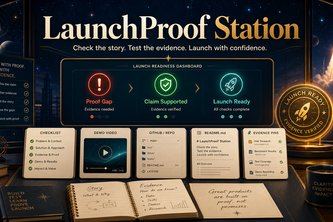
If a claim is unsupported, it flags a Proof Gap; if aligned, it marks the project as Launch Ready and generates a LaunchProof Report, which includes readiness status, judge clarity score, proof gaps, suggested fixes, and a final checklist.
The system uses sample data only. It has no login, backend, database, or personal data collection.
Inference: The tool is described as a front-end prototype built with HTML, CSS, JavaScript, and supported by GPT-5.6 and Codex for concept definition and development.
Positioning & Claim Evolution
The author states that LaunchProof Station was built around the question:
“Can a builder check the story, test the evidence, and catch proof gaps before a project goes public?”
It is positioned as a pre-launch readiness helper, not an official eligibility checker or compliance tool.
Key claims:
- It helps builders identify misalignment between pitch, demo, README, and evidence.
- It makes “gaps easier to see” before a human makes the final decision.
- It focuses on alignment instead of just completion.
- It emphasizes transparency about AI contribution (e.g., GPT-5.6 and Codex).
The author also notes that it was originally designed for hackathon submissions but aims to apply more broadly — to projects, demos, stakeholder presentations, creator releases, etc.
Inference: The positioning evolved from a narrow hackathon use case into a broader readiness-checking framework, though no evidence of expansion beyond the prototype exists.
Target Customer & ICP
The description states that LaunchProof Station is intended for builders, particularly those preparing submissions for events like Build Week or hackathons. It also suggests application to:
- Projects
- Product pages
- Demos
- Stakeholder presentations
- Creator releases
- Public prototypes
However, there is no indication of specific buyer personas, customer segments, or target industries.
Inference: The ICP appears to be technical creators or developers preparing public-facing work, but the description does not define who these users are beyond general terms like “builders.”
Business Model & Pricing Evidence
There is no evidence in the description of a business model, pricing strategy, monetization plan, or any commercial offering.
The tool is described as a standalone front-end prototype with no backend, database, or login, and it uses only sample data.
Inference: No business model or pricing is evident. The project seems to be a proof-of-concept rather than a product with a monetization path.
Technical & Delivery Signals
The tool was built as a front-end prototype using:
- HTML
- CSS
- JavaScript
- GPT-5.6 (for concept refinement)
- Codex (for building, debugging, testing, and packaging)
It is described as having:
- No login
- No backend
- No database
- No project storage
- No personal data collection
Inference: The delivery signal points to a minimal viable prototype, likely intended for demonstration or internal use only.
Traction & Maturity Signals
There is no evidence of traction, revenue, customers, or adoption beyond the author’s own submission. The tool:
- Is a v1 prototype
- Uses sample data only
- Has no login, backend, or database
- Was submitted to a hackathon (Devpost)
Inference: No signs of market traction or product maturity are evident.
Competitive Context
The description does not mention any competitors. It is unclear whether similar tools exist in the market for checking alignment between project pitch, demo, documentation and evidence.
Inference: There is no competitive context provided, nor any indication that this space is already crowded or has established players.
Open Questions & Risks
- The tool is described as a v1 prototype with no backend or data storage, suggesting limited scalability or long-term utility.
- It is not an official eligibility checker, and the author explicitly states it does not guarantee judging results or launch success.
- There is no evidence of commercial viability or monetization strategy.
- The tool’s scope appears to be narrowly defined (e.g., for hackathons) and may not translate into broader use cases without further development.
- It relies heavily on AI tools like GPT-5.6 and Codex, which may raise concerns about reproducibility or dependency risks.
Questions the description leaves open
- What specific problems are you trying to solve for builders beyond hackathon submissions?
- How do you plan to scale this from a prototype into a product with real users?
- Are there any plans to integrate with existing platforms (e.g., GitHub, Devpost, etc.)?
- Is there any intention to monetize or offer paid tiers in the future?
- What are your assumptions about how builders will adopt and pay for this tool?
- How do you intend to validate that the proof gap detection is accurate or useful beyond the author’s own use case?
Overall Assessment
Not evidenced: There is no evidence of revenue, customers, traction, or commercial viability.
The project is described as a self-contained prototype, built by one person (abigail Prophete), submitted to a hackathon. It does not appear to have moved beyond the idea stage or gained any adoption.
Confidence level: Low — based entirely on self-reported information with no external validation or evidence of traction, customers, or monetization.
Assessment: The project is a conceptual prototype, not a product ready for investment or partnership. It may be interesting as an idea but lacks commercial due-diligence signals at this stage.
User Stories BotA demo video on every pull request
Get a demo video on every new feature
GitHub App that watches your pull requests and records a narrated, captioned demo.
Save time on demo prep and make informed decisions faster with a video walkthrough of every new feature.
Source
Submitted to the OpenAI 2026 hackathon on Devpost. Project home on Devpost. Back to the full gallery on Devpost.
This competitive analysis was produced by top-founders.com (opens in a new tab)
Generated by a language model from this project's public Devpost page — its tagline, the author's own write-up and any built-with tags listed there — as captured in August 2026. Short quotations are the author's words. It is an opinion on the idea as a business, not on the people behind it, and it reflects the description as published then. If the project has moved on, request a correction below. The analysis is not independent research and contains no verified traction, revenue or customer data.
An independent guide by KFG International LLC — not affiliated with, endorsed by, or connected to Devpost or OpenAI.