

Archive position — measured, not model output
0 likes on Devpost
2,263 of the 7,850 archived projects have more likes, and 5,587 share exactly 0 — so this project's #4,875 place in the like-ranked listing is a tie-break inside that group, not a ranking.
Projects (log scale)
Likes on Devpost. ▲ marks this project's group.
Show the figures
| Likes | Projects | Share of archive |
|---|---|---|
| 0 | 5,587 | 71.2% |
| 1 | 1,758 | 22.4% |
| 2 | 284 | 3.6% |
| 3–4 | 132 | 1.7% |
| 5–9 | 75 | 1.0% |
| 10+ | 14 | 0.2% |
 User Stories BotA demo video on every pull request
Get a demo video on every new feature
GitHub App that watches your pull requests and records a narrated, captioned demo.
Save time on demo prep and make informed decisions faster with a video walkthrough of every new feature.
Executive Summary
What the company appears to be
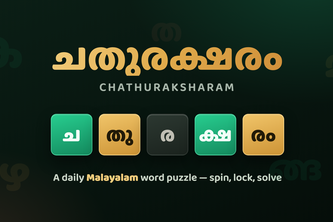
The project described as "Language Word Game" (also known as Chathuraksharam) is a self-reported multilingual word puzzle game built during an OpenAI hackathon. It presents a slot-machine-style interface for solving five-letter words in Malayalam, English, and Spanish, with support for multiple categories (e.g., Everyday, Arts, Sports). The author states that it uses GPT-5.6 for content generation and custom validation logic to ensure gameplay fidelity across scripts.
What changed
The project evolved from a single daily Malayalam puzzle into a reusable multilingual system with category-based rounds, localized clues, and dictionary-aware mechanics. It was built using Next.js, React, TypeScript, and integrates AI tools like OpenAI’s Responses API for structured content authoring.
Single most important open question — the commercial due-diligence read
Is there any evidence of product-market fit or user traction beyond the hackathon submission? The description does not indicate whether this has moved beyond prototype or received feedback from users outside the development team.
What The Product Actually Is
The description states that Chathuraksharam is a word puzzle game where players solve five-letter words using a slot-machine interface, with one letter revealed at the start. Players can pull a lever to spin remaining reels, lock promising letters, or tap specific letters directly.
It supports:
- Malayalam, English, and Spanish
- Three categories per language: Everyday, Arts, Sports
- 27 playable puzzles and 151 validated dictionary words
- Touch, mouse, keyboard, sound, sharing, and responsive mobile play
The game uses Intl.Segmenter to handle grapheme clusters correctly across languages and integrates GPT-5.6 for generating puzzle candidates via the OpenAI Responses API.
This is a self-reported product, not independently verified. The author describes its functionality but does not provide data on usage, retention, or monetization.
Positioning & Claim Evolution
The author claims that most word games are designed around English and Latin scripts, often feeling like lessons or translations. They state their goal was to create a native-language playful experience, avoiding learner modes and explanatory text.
They describe the evolution from:
- A single daily Malayalam puzzle
- To a reusable multilingual system with category-based rounds
- To a deterministic validation pipeline using AI-generated content reviewed by humans
This suggests an intent to build a language-first, culturally localized game engine rather than just another word game. However, no evidence is provided that this positioning has been tested or validated in the market.
Target Customer & ICP
The description does not clearly define target customers or ideal customer profiles (ICP). It implies a global audience interested in multilingual word games, particularly those who value native-language experiences and cultural relevance.
It mentions support for Malayalam, English, and Spanish — suggesting interest in non-English-speaking users seeking culturally relevant puzzles. But there is no indication of user segmentation or targeting beyond language preference.
No evidence exists regarding:
- Demographics
- Geographic focus
- User motivations beyond entertainment
- Specific use cases
Business Model & Pricing Evidence
There is no evidence in the description of a business model or pricing strategy. The project appears to be a hackathon submission with no mention of monetization, subscriptions, ads, or paid features.
The author does not state whether they plan to offer the game for free, charge for access, or sell additional content packs.
Technical & Delivery Signals
Key technical elements mentioned:
- Built with Next.js, React, TypeScript
- Uses Intl.Segmenter for grapheme cluster handling
- Integrates GPT-5.6 via OpenAI Responses API for structured content generation
- Content is generated asynchronously and validated before being used in gameplay
- Game mechanics include touch/mouse/keyboard support, responsive layout, mobile reliability fixes
The author notes that:
- AI is used upstream (content creation), not during gameplay
- Deterministic validation ensures consistent experience
- Codex helped with architecture, testing, and debugging
These are self-reported technical details, not independently verified. No evidence of scalability, performance metrics, or production deployment is provided.
Traction & Maturity Signals
There is no evidence of traction or user adoption beyond the hackathon submission. The project was created during Build Week and submitted to Devpost — no data on downloads, active users, retention, or engagement is shared.
The author mentions:
- 27 playable puzzles
- 151 validated dictionary words
- Commit history documenting development progress
But none of these indicate real-world usage or product maturity beyond prototype stage.
Competitive Context
The description does not provide information about competitors or market positioning. It does not reference existing word games, puzzle apps, or similar products in the space.
It is unclear if this project competes with:
- Wordle
- Other daily word puzzles
- Language learning platforms
- Mobile game engines
No competitive analysis or differentiation strategy is evident.
Open Questions & Risks
Several risks and open questions are present based on self-reported information:
- Unproven market demand: No evidence of user traction, feedback, or commercial viability.
- Over-reliance on AI for content creation: While the author says AI is used upstream, there’s no clarity on how scalable or reliable this process might be at scale.
- Limited language support: Only three languages are supported; expansion may require significant effort and local expertise.
- Prototype nature: The project was built during a hackathon and lacks evidence of long-term development or product-market fit.
- No monetization strategy: No indication of how revenue would be generated, which raises questions about sustainability.
Questions the description leaves open
- What is the current status of the product — is it live, in beta, or still a prototype?
- Have you tested this with real users outside the development team? If so, what were the results?
- How do you plan to expand beyond the three supported languages?
- Is there any intention to monetize the game or generate revenue from it?
- What is your long-term vision for the product — are you aiming for a standalone app or a platform for others to create games?
- How do you ensure quality control when using AI-generated content at scale?
- Do you have plans for community contributions or user-generated content?
Overall Assessment
There is no evidence of commercial traction, revenue, or customer adoption beyond the hackathon submission.
The project appears to be a proof-of-concept built during a short development period, with no indication that it has moved past prototype stage or achieved product-market fit.
Given:
- No stated business model
- No user data or engagement metrics
- No clear path to monetization
- Prototype-level implementation
This is not a viable investment or partnership opportunity at this time. The description offers no signal of commercial viability, and the author has not demonstrated any traction or market validation.
Assessment: Not evidenced as a commercial opportunity.
User Stories BotA demo video on every pull request
Get a demo video on every new feature
GitHub App that watches your pull requests and records a narrated, captioned demo.
Save time on demo prep and make informed decisions faster with a video walkthrough of every new feature.
Source
Submitted to the OpenAI 2026 hackathon on Devpost. Project home on Devpost. Back to the full gallery on Devpost.
This competitive analysis was produced by top-founders.com (opens in a new tab)
Generated by a language model from this project's public Devpost page — its tagline, the author's own write-up and any built-with tags listed there — as captured in August 2026. Short quotations are the author's words. It is an opinion on the idea as a business, not on the people behind it, and it reflects the description as published then. If the project has moved on, request a correction below. The analysis is not independent research and contains no verified traction, revenue or customer data.
An independent guide by KFG International LLC — not affiliated with, endorsed by, or connected to Devpost or OpenAI.