

Archive position — measured, not model output
3 likes on Devpost
128 of the 7,850 archived projects have more likes, and 93 share exactly 3 — so this project's #171 place in the like-ranked listing is a tie-break inside that group, not a ranking.
Projects (log scale)
Likes on Devpost. ▲ marks this project's group.
Show the figures
| Likes | Projects | Share of archive |
|---|---|---|
| 0 | 5,587 | 71.2% |
| 1 | 1,758 | 22.4% |
| 2 | 284 | 3.6% |
| 3–4 | 132 | 1.7% |
| 5–9 | 75 | 1.0% |
| 10+ | 14 | 0.2% |
 User Stories BotA demo video on every pull request
Get a demo video on every new feature
GitHub App that watches your pull requests and records a narrated, captioned demo.
Save time on demo prep and make informed decisions faster with a video walkthrough of every new feature.
Executive Summary
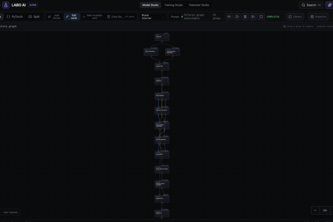
LABO AI is a self-reported desktop application for designing neural network architectures visually, built as an Electron-based tool using React, TypeScript, Python, and PyTorch. The product allows users to compose models from over 100 typed cards, connect them through elastic ports, inspect synchronized Pytorch code, and execute or replay graphs locally. It includes an OpenAI-powered agent that can inspect the current graph, search a card catalog, select compatible components, and execute plans without modifying user work.
The author states that LABO AI is intended to make neural architecture design more visual, executable, and accessible—without hiding the underlying PyTorch. The tool supports local execution, workspace persistence, and export of diagrams as SVG or models as Python code.
Key commercial due-diligence read: There is no evidence of revenue, customers, or adoption beyond the self-reported project description. The product appears to be a prototype or early-stage tool built for a hackathon, with no indication of market traction or business model. The single most important open question is whether LABO AI has moved beyond a proof-of-concept into actual usage by developers or researchers.
What The Product Actually Is
The description states that LABO AI is an agentic desktop laboratory for designing neural architectures visually, built with Electron, React, TypeScript, Python, and PyTorch. It allows users to:
- compose models from more than 100 atomic cards;
- connect cards through typed elastic ports;
- inspect synchronized Pytorch code;
- execute, replay, reset, or step through a graph locally;
- compare multiple architectures side by side;
- create reusable PyTorch cards with a visual builder;
- save custom workspaces and presets;
- export the complete diagram as SVG or the generated model as Python.
It also includes an OpenAI-powered Ask LABO agent that can inspect graphs, search card catalogs, select components, connect ports, arrange branches, run architectures, and report missing capabilities. The agent operates in either Review mode (where mutations are inspected before application) or Auto apply mode (where valid plans execute immediately).
The tool uses a typed intermediate graph representation to describe cards, ports, connections, architecture groups, and tensor contracts. It also features a topology-aware layout engine for reducing cable crossings and local execution via a narrow Electron bridge.
Inference: The product is described as a desktop application with visual modeling capabilities for neural networks, integrating AI agent assistance in model construction.
Positioning & Claim Evolution
The author states that LABO AI started from the question: “What if a neural model could be assembled and understood as a graph of small, typed, executable cards—and what if an AI agent had to use the same explicit tools as a human?”
This suggests a positioning around visualizing and simplifying complex neural architectures, with an emphasis on transparency and interpretability. The tool is positioned to help users understand how models are built, rather than abstracting away complexity.
The claim evolution shows a shift from a conceptual idea (a visual lab for neural models) to a functional prototype that includes:
- Visual composition of models;
- Real-time PyTorch code generation;
- AI agent assistance in model building;
- Execution and validation within the tool.
There is no evidence of prior positioning or evolution beyond this single project description, which was submitted to a hackathon.
Target Customer & ICP
The description does not explicitly identify target customers or an ICP (Ideal Customer Profile). However, based on the stated use case and technology stack, it appears aimed at:
- Developers or researchers working with neural networks;
- Users who want to visualize and understand complex model architectures;
- Individuals seeking a more intuitive way to build PyTorch models.
The tool is built for desktop use, suggesting a technical user base—likely those already familiar with Python and PyTorch. The inclusion of an AI agent implies a desire to assist users in building models without requiring full code editing.
Inference: LABO AI likely targets developers or researchers who want to build neural networks visually but still need access to the underlying code.
Business Model & Pricing Evidence
There is no evidence of any business model, pricing structure, or monetization strategy in the description. The project is described as a hackathon submission and does not mention:
- Revenue streams;
- Customer acquisition plans;
- Subscription models;
- Licensing or usage fees.
The tool is built for local execution and includes features like workspace persistence and export capabilities, but no indication of commercial use or monetization.
Inference: No business model or pricing evidence is provided. The project appears to be a prototype with no commercial intent evident in the description.
Technical & Delivery Signals
The product is described as an Electron desktop application, built using:
- React
- TypeScript
- Vite
- Python
- PyTorch
It uses a typed intermediate graph representation that drives visual libraries, validation, code generation, execution, and agent tools. The system includes:
- A topology-aware layout engine;
- Local execution via a narrow Electron bridge;
- IndexedDB for persistence;
- Encrypted OpenAI API keys using Electron safeStorage.
The tool supports:
- Visual composition of models from over 100 atomic cards;
- Typed elastic ports;
- Synchronized PyTorch code generation;
- Execution and replay capabilities;
- Export as SVG or Python.
Inference: The technical stack suggests a developer-focused desktop tool, with strong integration between visual design, code generation, and execution. It is built for local use and includes some safety mechanisms around data handling.
Traction & Maturity Signals
There is no evidence of traction, adoption, or user feedback beyond the self-reported project description. The product was submitted to a hackathon and has no mention of:
- Customers;
- Revenue;
- Usage metrics;
- Product-market fit;
- Beta testing or user groups.
The team size is listed as one person (Peyriguere Boris), and the tool appears to be a single-person prototype. There are no signs of product maturity beyond its initial development phase.
Inference: The project shows no signs of traction or market validation, and is likely in an early-stage prototype phase.
Competitive Context
The description does not mention any competitors or direct comparisons. However, based on the stated functionality—visual neural architecture design, PyTorch integration, and AI agent assistance—it may compete with:
- Tools for visualizing and building neural networks;
- AI-assisted development platforms;
- Desktop-based model-building tools.
No evidence of existing competitive products is provided in the description.
Inference: LABO AI appears to be a novel or niche tool in a space that includes general-purpose neural network design tools, but no specific competitive landscape is described.
Open Questions & Risks
Key risks and open questions include:
- No commercial traction or revenue evidence;
- Single-person team, which may limit scalability or long-term development;
- Prototype nature—submitted to a hackathon, not yet validated in production use;
- Limited user feedback or testing;
- No mention of monetization or business model;
- Highly technical and niche use case, potentially limiting market reach.
There is also a risk that the AI agent functionality may be limited by the scope of its tools (e.g., only inspect, search, add, connect, etc.), which could restrict its usefulness in complex scenarios.
Inference: The lack of traction, commercialization, and team size raises concerns about scalability and long-term viability.
Questions the description leaves open
- What is the intended user base for LABO AI beyond developers or researchers?
- Has the tool been tested with real users or in practical use cases?
- Are there any plans to monetize or commercialize the product?
- How does the agent’s limited set of actions (inspect, search, add, connect, etc.) affect its utility in complex model building?
- What are the technical limitations or scalability issues that have been encountered during development?
- Is there a plan for collaboration features or sharing workspaces beyond local use?
- What is the roadmap for future development and product maturity?
Overall Assessment
There is no evidence of revenue, customers, or adoption to support an investment or partnership decision. LABO AI appears to be a single-person hackathon project, with no indication of traction, commercialization, or market validation.
The tool is described as a visual neural architecture design tool with AI agent assistance, built for local execution and code generation using PyTorch. It has not demonstrated any business model or monetization strategy.
Assessment: Not ready for investment or partnership at this stage. The project lacks evidence of product-market fit, traction, or commercial viability. It is a prototype that may evolve into something more substantial, but no such evolution is evident in the current description.
User Stories BotA demo video on every pull request
Get a demo video on every new feature
GitHub App that watches your pull requests and records a narrated, captioned demo.
Save time on demo prep and make informed decisions faster with a video walkthrough of every new feature.
Source
Submitted to the OpenAI 2026 hackathon on Devpost. Project home on Devpost. Back to the full gallery on Devpost.
This competitive analysis was produced by top-founders.com (opens in a new tab)
Generated by a language model from this project's public Devpost page — its tagline, the author's own write-up and any built-with tags listed there — as captured in August 2026. Short quotations are the author's words. It is an opinion on the idea as a business, not on the people behind it, and it reflects the description as published then. If the project has moved on, request a correction below. The analysis is not independent research and contains no verified traction, revenue or customer data.
An independent guide by KFG International LLC — not affiliated with, endorsed by, or connected to Devpost or OpenAI.