

Archive position — measured, not model output
0 likes on Devpost
2,263 of the 7,850 archived projects have more likes, and 5,587 share exactly 0 — so this project's #4,097 place in the like-ranked listing is a tie-break inside that group, not a ranking.
Projects (log scale)
Likes on Devpost. ▲ marks this project's group.
Show the figures
| Likes | Projects | Share of archive |
|---|---|---|
| 0 | 5,587 | 71.2% |
| 1 | 1,758 | 22.4% |
| 2 | 284 | 3.6% |
| 3–4 | 132 | 1.7% |
| 5–9 | 75 | 1.0% |
| 10+ | 14 | 0.2% |
 User Stories BotA demo video on every pull request
Get a demo video on every new feature
GitHub App that watches your pull requests and records a narrated, captioned demo.
Save time on demo prep and make informed decisions faster with a video walkthrough of every new feature.
Executive Summary
What the company appears to be
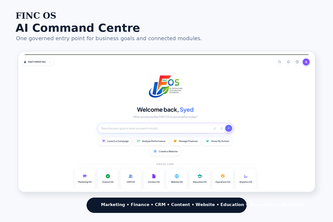
FINC OS is described as a self-contained, organization-scoped AI operating system for business. The author states it unifies marketing, finance, operations, commerce and education into one platform with policy-controlled AI, approvals, audit evidence and real database-backed workflows.
What changed
The project was extended from an earlier foundation to a “unified, database-backed operating system” during Build Week. It now includes 29 migrations producing 245 SQLite tables, 452 routes, 252 Laravel tests with 1,282 assertions passing, and demonstration chains across Marketing, Commerce, Operations, Finance and Education.
The single most important open question
Is there sufficient evidence of real-world use or traction to support claims about business impact and commercial viability?
What The Product Actually Is
The description states that FINC OS is an organization-scoped AI operating system for businesses and institutions. It unifies modules including:
- Core governance, goals, plans, approvals, audit evidence and AI infrastructure
- Marketing campaigns, leads, conversions and attribution
- Finance journals, receivables, payables, payments and reports
- Operations procurement, inventory, production, fulfillment, returns and maintenance
- Website and Commerce publishing, catalogue, pricing, checkout, orders, payments and analytics
- Education SIS, LMS, attendance, assessments, report cards, transcripts, fees and controlled AI support
Modules are not isolated demonstrations but share the same organization boundary, approval service, activity history, secured outbox and integration contracts.
The system is implemented as a modular Laravel application using PHP 8.3, SQLite for local runtime, Blade, JavaScript and Vite. It separates user and organization interfaces, application services and domain workflows, approval and policy controls, and external provider contracts.
Not evidenced: actual functionality beyond the author's description; no evidence of live use or integration with real systems.
Positioning & Claim Evolution
The author positions FINC OS as a unified platform that solves fragmentation across business functions. It is described as:
- An “organization-scoped” system
- A governed AI operating system
- One platform where goals become authorized workflows
- Where operational activity creates traceable evidence
- Where AI remains controlled by policy, budgets and human approval
It also claims to be more than a static interface — it demonstrates real database-backed workflows connecting:
- Marketing → Commerce → Finance → Operations
- Education → Finance → Approvals → Evidence
The system is said to preserve strict boundaries around financial transactions, inventory, provider credentials, AI execution and organization data.
Inferred: the positioning implies a move toward integrated business process automation with governance and auditability as key features. However, no evidence of market validation or customer feedback exists in the description.
Target Customer & ICP
The author states that FINC OS is designed for:
- Small businesses
- Growing enterprises
- Schools
- Academies
- Social organizations
These are described as entities needing one coordinated operating platform.
Not evidenced: no specific customer segments, personas or use cases beyond general categories. No evidence of target market size, adoption rate or competitive positioning within these segments.
Business Model & Pricing Evidence
The author lists potential commercial models including:
- Implementation and data-migration services
- Monthly organization subscriptions
- AI usage plans
- Training and support
- Industry-specific packages
- Connector configuration
- Marketplace commissions
- Managed workflow services
No pricing information, revenue model details or monetization strategy are provided.
Inferred: the business model appears to be subscription-based with additional service offerings. However, no evidence of actual sales, pricing tiers or customer acquisition costs exists in the description.
Technical & Delivery Signals
The system is built using:
- PHP 8.3
- Laravel framework
- SQLite for verified local runtime
- Blade templating engine
- JavaScript and Vite
- Git with isolated worktrees
Key technical features mentioned include:
- Double-entry journal engine
- Append-only stock ledger
- Immutable published page versions
- Encrypted provider credentials
- Provider-neutral AI and connector contracts
- Configured external providers remain disabled until explicitly authorized
The author reports:
- 29 migrations producing 245 SQLite tables
- 452 uniquely named routes
- 252 Laravel tests with 1,282 assertions passing
- 1,384 PHP files passing syntax validation
- A successful Vite production build
- Balanced Trial Balance and Balance Sheet
- 30 authenticated runtime screenshots
Not evidenced: no live deployment, performance metrics, scalability data or integration with third-party systems.
Traction & Maturity Signals
The author describes:
- Phase 1–6 runtime completed and verified
- Demonstration chains across Marketing, Commerce, Operations, Finance and Education
- Workstreams for Phase 7 (governed autonomous improvement) and Phase 8 (Marketplace) currently in progress
No evidence of actual users, customers, revenue, or product adoption beyond the author's own development work.
Inferred: this is a prototype or early-stage system built during a hackathon. There is no indication of real-world usage or market traction.
Competitive Context
The description does not mention any direct competitors or competitive landscape.
Not evidenced: no evidence of existing solutions in this space, nor how FINC OS differentiates from them.
Open Questions & Risks
- Unverified claims: All descriptions are self-reported and unverified. No third-party validation or customer feedback.
- No traction or revenue: The system is described as a prototype built during a hackathon with no evidence of live use or monetization.
- Single-person team: The project has only one member, which raises questions about scalability and execution capability.
- Limited scope: While the system claims to integrate many modules, it is not clear whether these are fully functional or merely simulated.
- Unclear commercial viability: No pricing, customer acquisition strategy or monetization model is described beyond general business models.
Questions the description leaves open
- What specific problems do you observe in small businesses or institutions that FINC OS aims to solve?
- How does the system ensure data integrity and prevent manipulation across modules?
- Can you provide examples of how AI integration works within the platform, especially with regard to governance?
- What is your plan for scaling beyond a single developer?
- Are there any existing customers or pilot programs using this system?
- How do you intend to monetize the platform and what are your go-to-market strategies?
- What are the main challenges in integrating different modules like Finance, Operations, and Education?
- How does the system handle compliance with financial regulations such as double-entry accounting?
Overall Assessment
The description indicates that FINC OS is a hackathon project built by one developer, with no evidence of traction, revenue or customer adoption.
Confidence Level Low
Assessment Not ready for investment or partnership. The system appears to be an early prototype with strong technical execution but lacks real-world validation, commercial viability and market demand signals. It requires further development, testing and proof-of-concept before any meaningful due diligence can proceed.
User Stories BotA demo video on every pull request
Get a demo video on every new feature
GitHub App that watches your pull requests and records a narrated, captioned demo.
Save time on demo prep and make informed decisions faster with a video walkthrough of every new feature.
Source
Submitted to the OpenAI 2026 hackathon on Devpost. Project home on Devpost. Back to the full gallery on Devpost.
This competitive analysis was produced by top-founders.com (opens in a new tab)
Generated by a language model from this project's public Devpost page — its tagline, the author's own write-up and any built-with tags listed there — as captured in August 2026. Short quotations are the author's words. It is an opinion on the idea as a business, not on the people behind it, and it reflects the description as published then. If the project has moved on, request a correction below. The analysis is not independent research and contains no verified traction, revenue or customer data.
An independent guide by KFG International LLC — not affiliated with, endorsed by, or connected to Devpost or OpenAI.