

Archive position — measured, not model output
0 likes on Devpost
2,263 of the 7,850 archived projects have more likes, and 5,587 share exactly 0 — so this project's #4,843 place in the like-ranked listing is a tie-break inside that group, not a ranking.
Projects (log scale)
Likes on Devpost. ▲ marks this project's group.
Show the figures
| Likes | Projects | Share of archive |
|---|---|---|
| 0 | 5,587 | 71.2% |
| 1 | 1,758 | 22.4% |
| 2 | 284 | 3.6% |
| 3–4 | 132 | 1.7% |
| 5–9 | 75 | 1.0% |
| 10+ | 14 | 0.2% |
 User Stories BotA demo video on every pull request
Get a demo video on every new feature
GitHub App that watches your pull requests and records a narrated, captioned demo.
Save time on demo prep and make informed decisions faster with a video walkthrough of every new feature.
Executive Summary
What the company appears to be
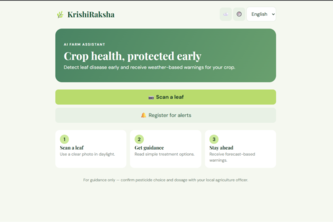
KRISHI RAKSHA is a self-reported AI-powered platform for Indian farmers that combines image-based crop disease detection with proactive weather-driven early warnings. It uses a TensorFlow Lite model trained on PlantVillage data, supports multilingual guidance (Marathi, Hindi, English), and includes voice support via ElevenLabs. The system also features SMS/WhatsApp alert delivery through Twilio, and is built to run locally without cloud credentials.
What changed
The project description indicates an evolution from a basic image classifier to a full-stack platform integrating diagnosis with proactive advisory capabilities. It emphasizes explainability, localization of guidance, and accessibility for low-literacy users.
Single most important open question
Is there any evidence of real-world deployment or user feedback beyond the author’s own account?
What The Product Actually Is
The description states that KRISHI RAKSHA is a platform enabling farmers to upload images of plant leaves for instant disease classification using a TensorFlow Lite model trained on PlantVillage data. It also includes a weather-triggered early warning system based on known agronomic thresholds, and provides multilingual (Marathi, Hindi, English) guidance with optional voice support via ElevenLabs.
It is described as having:
- A 38-class disease classification model
- Explainable predictions using Grad-CAM visualization
- Farmer registration and profile management
- Scan history tracking for longitudinal monitoring
- Daily weather risk sweeps for early alerts
- Optional SMS/WhatsApp delivery through Twilio
The backend uses FastAPI, DynamoDB (single-table design), and integrates with OpenWeatherMap API. The frontend is built in React.
Evidence
- Author’s own write-up
- Technology tags: amazon-dynamodb, amazon-web-services, codex, elevenlabs-(marathi-voice), fastapi, openweathermap-api, react, tensorflow-lite, twilio
Inference The system appears designed to be lightweight and accessible, with local development support built-in.
Positioning & Claim Evolution
The description states that KRISHI RAKSHA evolved from a simple leaf diagnosis tool into a proactive platform focused on early warning before symptoms appear. It positions itself not just as a diagnostic tool but as a "digital companion" for crop health, aiming to help farmers catch problems earlier and understand what to do next.
Key claims:
- The system warns farmers before there's a leaf to diagnose.
- Diagnosis is paired with actionable, localized guidance.
- Weather-triggered alerts are used proactively rather than reactively.
- Multilingual support and voice guidance are core features for accessibility.
Evidence
- Author’s own write-up
Inference This suggests the product has moved beyond a basic ML classifier to a workflow-integrated solution that attempts to bridge technical output with practical actionability.
Target Customer & ICP
The description identifies Indian farmers, particularly those in Vidarbha, as the primary users. These are described as lacking easy access to agricultural experts and often unable to distinguish between disease, pest damage, nutrient deficiency, or weather stress from visual inspection alone.
Farmer profiles include:
- Location
- Crop selection
- Language preference
Evidence
- Author’s own write-up
Inference The ICP appears to be smallholder farmers in rural India with limited digital literacy and connectivity, who benefit from localized, multilingual support and early warnings.
Business Model & Pricing Evidence
Not evidenced. The description does not mention any pricing model, monetization strategy, or business model.
Evidence
- Author’s own write-up
Inference No commercial structure is described; the project appears to be a prototype or hackathon submission with no stated revenue or customer acquisition plans.
Technical & Delivery Signals
The system uses:
- TensorFlow Lite for inference (no GPU required)
- Keras model for explainability (Grad-CAM)
- FastAPI backend
- React frontend
- DynamoDB single-table design for persistence
- OpenWeatherMap API for weather data
- ElevenLabs for Marathi voice support
- Twilio for SMS/WhatsApp alerts
Key technical decisions:
- Dual model export (TFLite + Keras) to preserve explainability without sacrificing speed
- Zero-config in-memory mode for local development
- Rule-based agronomy engine for alerting
- Cloud-ready architecture with optional third-party integrations
Evidence
- Author’s own write-up
- Technology tags
Inference The technical stack shows a focus on lightweight, scalable, and accessible deployment, especially for low-connectivity environments.
Traction & Maturity Signals
Not evidenced. There is no mention of users, customers, revenue, or adoption metrics beyond the author’s own account.
Evidence
- Author’s own write-up
Inference No traction signals are present; this is a self-reported prototype or proof-of-concept.
Competitive Context
Not evidenced. The description does not reference competitors or market positioning relative to existing tools in the agricultural tech space.
Evidence
- Author’s own write-up
Inference The author notes that most comparable projects stop at photo classification, implying a differentiation from basic image classifiers — but no explicit competitive landscape is described.
Open Questions & Risks
- No real-world validation or user feedback: The entire description is self-reported and unverified.
- Unclear scalability of weather rules: Rule-based agronomy engines may not generalize well across diverse regions or changing climate conditions.
- Limited dataset coverage: PlantVillage data is lab-conditioned; accuracy in field conditions is unknown.
- No monetization strategy: No indication of how the platform will be funded or scaled beyond a hackathon project.
- Single-person team: A single developer may limit execution capacity and product maturity.
Evidence
- Author’s own write-up
Inference These risks are inferred from the lack of evidence for traction, scalability, or business model — all standard concerns in early-stage AI products.
Questions the description leaves open
- Has the system been tested with actual farmers in the field?
- What is the accuracy of the model on real-world (not lab) images?
- How are the agronomic thresholds for alerts derived and validated?
- Are there plans to expand beyond PlantVillage’s dataset or include more crops?
- Is there any plan for monetization or long-term sustainability?
- What is the expected user base, and how will you scale beyond one developer?
Overall Assessment
Not evidenced.
Evidence
- Author’s own write-up
Inference This project appears to be a hackathon submission or prototype with no evidence of traction, revenue, or commercial viability. It lacks key signals for investment or partnership interest at this stage.
User Stories BotA demo video on every pull request
Get a demo video on every new feature
GitHub App that watches your pull requests and records a narrated, captioned demo.
Save time on demo prep and make informed decisions faster with a video walkthrough of every new feature.
Source
Submitted to the OpenAI 2026 hackathon on Devpost. Project home on Devpost. Back to the full gallery on Devpost.
This competitive analysis was produced by top-founders.com (opens in a new tab)
Generated by a language model from this project's public Devpost page — its tagline, the author's own write-up and any built-with tags listed there — as captured in August 2026. Short quotations are the author's words. It is an opinion on the idea as a business, not on the people behind it, and it reflects the description as published then. If the project has moved on, request a correction below. The analysis is not independent research and contains no verified traction, revenue or customer data.
An independent guide by KFG International LLC — not affiliated with, endorsed by, or connected to Devpost or OpenAI.