

Archive position — measured, not model output
0 likes on Devpost
2,263 of the 7,850 archived projects have more likes, and 5,587 share exactly 0 — so this project's #4,841 place in the like-ranked listing is a tie-break inside that group, not a ranking.
Projects (log scale)
Likes on Devpost. ▲ marks this project's group.
Show the figures
| Likes | Projects | Share of archive |
|---|---|---|
| 0 | 5,587 | 71.2% |
| 1 | 1,758 | 22.4% |
| 2 | 284 | 3.6% |
| 3–4 | 132 | 1.7% |
| 5–9 | 75 | 1.0% |
| 10+ | 14 | 0.2% |
 User Stories BotA demo video on every pull request
Get a demo video on every new feature
GitHub App that watches your pull requests and records a narrated, captioned demo.
Save time on demo prep and make informed decisions faster with a video walkthrough of every new feature.
Executive Summary
Project: KreoFlow
Self-reported basis: The description is entirely from the author’s own write-up, submitted to the OpenAI 2026 hackathon on Devpost. No external verification or historical data are available.
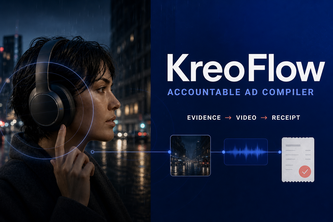
KreoFlow appears to be a prototype tool that compiles structured product evidence and approved media into vertical video advertisements with traceable claims and QA receipts. It is built as a technical demonstration for a hackathon, not yet proven in commercial use.
The author states KreoFlow treats advertising production as an accountable compiler rather than a prompt-to-video lottery. Its core functionality includes schema-driven composition, strict QA checks, and artifact traceability via SHA-256 hashes.
Key open question: Does this tool have a viable commercial model or path to traction beyond the hackathon demo?
What The Product Actually Is
The description states that KreoFlow converts structured product evidence and approved media into:
- A typed CreativeSpec;
- A schema-driven vertical video composition;
- An exact-output render receipt;
- A technical QA receipt;
- An explicit human approval record.
It also produces a real 12-second 1080×1920 H.264 advertisement with audio, and a public proof page exposing scene plans, claim sources, technical measurements, hashes, and limitations.
The system uses:
- Zod schemas for validation;
- GPT-5.6 with Structured Outputs for creative planning;
- Remotion for rendering;
- FFmpeg/ffprobe for QA checks;
- A server-only OpenAI Responses API adapter;
- Codex for research, architecture design, testing, and adversarial reviews.
It is described as a technical prototype built for a hackathon, not yet deployed in production or used by customers.
Inference: The tool is a proof-of-concept that combines AI planning with deterministic rendering and QA to produce ad-like outputs from structured inputs. It is not a commercial product but a demonstration of how such a system might work.
Positioning & Claim Evolution
The author states KreoFlow explores a different approach to AI video workflows: treating advertising production as an accountable compiler rather than a prompt-to-video lottery.
It emphasizes:
- Factual overlays must reference source-attributed evidence;
- Blocked, unapproved, missing, or text-mismatched claims are rejected before rendering;
- The system is designed to preserve product truth, claim provenance, timing, and delivery quality.
The tagline: “KreoFlow turns product evidence into review-ready vertical ads—with traceable claims and QA receipts.”
Claim: KreoFlow aims to improve accountability in AI-generated ad production by enforcing schema-driven composition and traceability.
Inference: The positioning is that of a tool for product teams or agencies seeking to automate ad creation with verifiable outputs, not just aesthetic results. It is not positioned as a general-purpose video editing tool or an AI assistant for creative direction.
Target Customer & ICP
The description does not identify specific customer segments or personas.
It implies the target is product teams who can provide structured product evidence and approved media, and who may want to automate or standardize ad creation workflows.
The system is described as producing “review-ready vertical ads,” suggesting a focus on digital advertising (e.g., social media, in-app, or mobile-first formats).
It also mentions the need for “human approval record” and “commercial review,” implying that final decisions are still made by humans — not fully automated.
Inference: The ICP likely includes product teams or agencies working with structured content and seeking to reduce manual effort in ad creation while maintaining quality control and traceability.
Business Model & Pricing Evidence
The description does not contain any information about pricing, monetization, or business model.
It states that the commercial test is “not another technical receipt” but whether a real customer will pay for the resulting advertising pack.
Inference: The business model is unknown. It may be B2B SaaS, or an ad-tech tool, but there is no evidence of pricing, revenue streams, or customer acquisition plans.
Technical & Delivery Signals
The system uses:
- Zod schemas for validation;
- GPT-5.6 with Structured Outputs for creative planning;
- Remotion for rendering;
- FFmpeg/ffprobe for QA checks;
- A server-only OpenAI Responses API adapter;
- Codex for research, architecture design, testing, and adversarial reviews.
It includes:
- 13 blocking technical QA checks;
- SHA-256 hash-based artifact traceability;
- Fail-closed artifact lifecycle and deployment provenance gate;
- 98 automated tests;
- Responsive proof page verified at desktop, tablet, and mobile sizes.
The system is described as a hackathon demo that deliberately replays a labelled fixture, not a live model response.
Inference: The tool is built with strong technical rigor, including schema validation, QA gates, artifact traceability, and automated testing. It is not a simple AI video generator but a structured, deterministic workflow.
Traction & Maturity Signals
The description does not provide any evidence of traction or commercial adoption.
It is described as a hackathon submission with no revenue, customers, or usage data.
The author states that the “commercial test is not another technical receipt” — implying that real-world use has not yet occurred.
Inference: No traction or maturity indicators are evident. The project is in early prototype form, not yet proven in production or customer-facing environments.
Competitive Context
The description does not mention any competitors or direct market context.
It positions itself as a tool that improves upon typical AI video workflows by enforcing accountability and traceability.
Inference: KreoFlow likely competes with AI video tools (e.g., Runway, Pika, Synthesia) or ad-tech platforms that automate creative production. However, no specific competitive landscape is described.
Open Questions & Risks
- Unproven commercial viability: No evidence of revenue, customers, or market traction.
- Limited scope: The tool is a hackathon demo, not a production-ready product.
- No pricing or monetization model: Unclear how the tool would be monetized.
- High technical dependency: Relies on GPT-5.6 and proprietary adapters — may not scale or be accessible to others.
- No customer feedback or use cases: No evidence of real-world application or user input.
Questions the description leaves open
- What is the intended commercial model for KreoFlow?
- How does it plan to scale beyond a hackathon demo?
- Has there been any customer feedback or pilot testing?
- What are the key assumptions about product-market fit?
- How does it handle rights clearance for product footage?
- What are the limitations of the current GPT-5.6 adapter in real-world use?
Overall Assessment
Not evidenced: There is no evidence of revenue, customers, or traction to assess commercial viability.
The tool is a technical prototype built as part of a hackathon submission. It demonstrates strong engineering and design principles but has not yet proven its value in a real-world setting.
Confidence level: Low — based on self-reported evidence only, with no external validation or historical data.
Assessment: Not ready for investment or partnership at this stage. The tool shows promise as a technical solution but lacks commercial traction or clarity around monetization and market fit.
User Stories BotA demo video on every pull request
Get a demo video on every new feature
GitHub App that watches your pull requests and records a narrated, captioned demo.
Save time on demo prep and make informed decisions faster with a video walkthrough of every new feature.
Source
Submitted to the OpenAI 2026 hackathon on Devpost. Project home on Devpost. Back to the full gallery on Devpost.
This competitive analysis was produced by top-founders.com (opens in a new tab)
Generated by a language model from this project's public Devpost page — its tagline, the author's own write-up and any built-with tags listed there — as captured in August 2026. Short quotations are the author's words. It is an opinion on the idea as a business, not on the people behind it, and it reflects the description as published then. If the project has moved on, request a correction below. The analysis is not independent research and contains no verified traction, revenue or customer data.
An independent guide by KFG International LLC — not affiliated with, endorsed by, or connected to Devpost or OpenAI.