

Archive position — measured, not model output
1 like on Devpost
505 of the 7,850 archived projects have more likes, and 1,758 share exactly 1 — so this project's #1,298 place in the like-ranked listing is a tie-break inside that group, not a ranking.
Projects (log scale)
Likes on Devpost. ▲ marks this project's group.
Show the figures
| Likes | Projects | Share of archive |
|---|---|---|
| 0 | 5,587 | 71.2% |
| 1 | 1,758 | 22.4% |
| 2 | 284 | 3.6% |
| 3–4 | 132 | 1.7% |
| 5–9 | 75 | 1.0% |
| 10+ | 14 | 0.2% |
 User Stories BotA demo video on every pull request
Get a demo video on every new feature
GitHub App that watches your pull requests and records a narrated, captioned demo.
Save time on demo prep and make informed decisions faster with a video walkthrough of every new feature.
Executive Summary
What the company appears to be
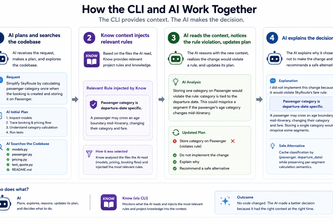
The project described as "Know - Active Memory System" is a self-reported Rust-based CLI tool that stores and surfaces code-related constraints (rules) in a repository using TOML files. It integrates with AI agents like Codex via a pre-edit hook to inject relevant rules into the agent's context before code changes are made, aiming to prevent regressions by making implicit knowledge explicit.
What changed
The author states that this is an MVP built during a 90-minute hackathon period (Build Week), using GPT-5.6 and Codex as engineering partners. It includes a working CLI, SQLite read model, TOML-based rule storage, and a demo showing how the system prevents unsafe refactors.
Single most important open question
Is there any evidence of real-world usage or adoption beyond the demo? The description does not indicate whether Know has been used in production environments or by teams outside of its creator’s immediate context.
What The Product Actually Is
The description states that Know is an Active Memory system for code, implemented as a Rust CLI tool. It stores project rules in versioned TOML files within the repository, and uses a SQLite read model to track rule-to-code relationships. A repository hook injects relevant rules into AI agents (e.g., Codex) before edits are made, helping prevent unintended consequences of code changes.
- The system supports:
- Rule constraints with rationale
- Links to files or globs it protects
- Verification state tracking
- Advisory behavior: rules are surfaced but not enforced automatically
Inference: This is a developer tool aimed at improving AI-assisted coding workflows by providing context-aware constraint information.
Positioning & Claim Evolution
The author positions Know as a solution to the problem of implicit knowledge in codebases, where important architectural decisions or business rules live only in senior engineers' heads or stale documentation. The system aims to make these constraints visible before changes are made, rather than discovering them after a regression.
- Claims:
- "Know provides rules, decisions, and constraints that apply to code before a human or AI agent changes it."
- "It makes those constraints visible before the change, rather than discoverable only after the regression."
Inference: The positioning is focused on developer experience, AI agent alignment, and risk mitigation in codebases. It does not claim market traction, revenue, or adoption beyond its own demo.
Target Customer & ICP
The description states that Know targets developers working with AI agents (like Codex) who are about to edit code. The system is designed to help prevent unsafe refactors by surfacing constraints at the point of change.
- It supports:
- AI-assisted coding workflows
- Developers who want to avoid breaking business logic or architectural decisions
Inference: The primary customer is likely technical teams using AI agents for code modification, especially those with large, complex codebases where implicit knowledge causes issues.
Business Model & Pricing Evidence
Not evidenced.
The description does not mention any pricing model, monetization strategy, or business model.
Technical & Delivery Signals
- Built in Rust CLI
- Uses SQLite for read model
- Stores rules in TOML files
- Integrates with Codex via repository hooks
- Includes:
- Automated tests
- Checksum-verified installer
- Demo script (
./demo.sh) - Fast path installation:
git clone,./install.sh,./demo.sh
Inference: The tool is built for developers and integrates into existing workflows. It’s designed to be lightweight, reproducible, and focused on immediate utility.
Traction & Maturity Signals
Not evidenced.
There is no mention of:
- Customers
- Revenue
- Usage metrics
- Adoption beyond the author's own demo
- Product iteration or feedback loops
The project is described as an MVP built in a 90-minute hackathon, with no indication of ongoing development or user base.
Competitive Context
Not evidenced.
No comparison to existing tools or platforms is provided in the description.
Open Questions & Risks
- No evidence of real-world usage or adoption — all activity appears limited to a demo.
- Single-person team — only one member listed (Emanuel Lindström).
- Self-reported, unverified claims — no external validation or third-party data.
- Limited scope — the MVP is explicitly described as small and focused on core functionality.
- No pricing or monetization strategy — unclear if this will ever become a commercial product.
Questions the description leaves open
- Has Know been tested in any real-world codebases beyond the demo?
- What are the plans for expanding beyond the current CLI and repository hook integration?
- Are there any partnerships or early adopters already using Know?
- How does Know handle scalability or performance with large repositories?
- Is there a plan to support IDE integrations (e.g., VS Code, JetBrains)?
- What is the long-term vision for Know beyond the current MVP?
Overall Assessment
Not evidenced.
There is no indication of any investment interest, partnership discussions, or funding status.
The project is described as a self-contained MVP built during a hackathon, with no evidence of traction, revenue, or commercialization plans. It appears to be an experimental tool focused on AI-agent integration and developer workflow improvement.
Confidence level: Low — based entirely on self-reported description, with no external validation or data points.
User Stories BotA demo video on every pull request
Get a demo video on every new feature
GitHub App that watches your pull requests and records a narrated, captioned demo.
Save time on demo prep and make informed decisions faster with a video walkthrough of every new feature.
Source
Submitted to the OpenAI 2026 hackathon on Devpost. Project home on Devpost. Back to the full gallery on Devpost.
This competitive analysis was produced by top-founders.com (opens in a new tab)
Generated by a language model from this project's public Devpost page — its tagline, the author's own write-up and any built-with tags listed there — as captured in August 2026. Short quotations are the author's words. It is an opinion on the idea as a business, not on the people behind it, and it reflects the description as published then. If the project has moved on, request a correction below. The analysis is not independent research and contains no verified traction, revenue or customer data.
An independent guide by KFG International LLC — not affiliated with, endorsed by, or connected to Devpost or OpenAI.