

Archive position — measured, not model output
0 likes on Devpost
2,263 of the 7,850 archived projects have more likes, and 5,587 share exactly 0 — so this project's #3,261 place in the like-ranked listing is a tie-break inside that group, not a ranking.
Projects (log scale)
Likes on Devpost. ▲ marks this project's group.
Show the figures
| Likes | Projects | Share of archive |
|---|---|---|
| 0 | 5,587 | 71.2% |
| 1 | 1,758 | 22.4% |
| 2 | 284 | 3.6% |
| 3–4 | 132 | 1.7% |
| 5–9 | 75 | 1.0% |
| 10+ | 14 | 0.2% |
 User Stories BotA demo video on every pull request
Get a demo video on every new feature
GitHub App that watches your pull requests and records a narrated, captioned demo.
Save time on demo prep and make informed decisions faster with a video walkthrough of every new feature.
Executive Summary
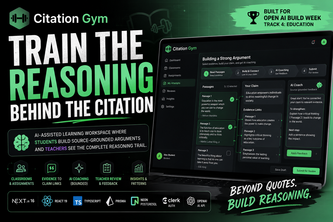
What the company appears to be: Citation Gym is a role-based learning platform designed for source-grounded reasoning in educational settings. The author states it focuses on helping students develop defensible claims, select relevant evidence, and explain how that evidence supports their claim — with an emphasis on teacher insights into recurring reasoning patterns.
What changed: The project was developed as part of the OpenAI 2026 hackathon. It represents a self-reported prototype built using Next.js, LangGraph, Clerk, and OpenAI APIs. No commercial traction or revenue is evidenced.
Single most important open question: Is there any evidence that teachers or students are currently using this platform in real classrooms, or that it has been tested beyond the hackathon context?
This analysis is based entirely on the self-reported project description provided by the author. It contains no verified data about customers, revenue, usage, or market traction.
What The Product Actually Is
The description states that Citation Gym is a role-based learning platform for source-grounded reasoning. It includes:
- A system where teachers can create classrooms and assign readings.
- Students can read assigned passages, build claims supported by selected evidence, and explain the connection between their claim and evidence.
- Teachers can review submissions, add feedback, mark work as reviewed or returned, and see assignment-level insights into recurring reasoning issues.
- An AI Coach that evaluates student work for source grounding, generates focused coaching, and provides plain-language guidance.
- Versioned revision history to preserve original submissions.
The author describes the product as a controlled AI coaching workflow, not a general-purpose writing assistant. The AI pipeline is structured through LangGraph with steps including evidence verification, claim–evidence alignment evaluation, coaching generation, and grounding/sanitization.
This is a self-reported description of a prototype tool built for an educational hackathon. No independent validation or production deployment details are provided.
Positioning & Claim Evolution
The author claims that Citation Gym addresses a gap in current writing tools: most focus on grammar or polished prose, but fail to teach the reasoning step between selecting a quote and making an argument.
They state it was built to solve both student practice needs and teacher insight challenges — turning individual coaching results into actionable classroom insights.
The positioning appears to be:
- A tool for teaching source-grounded reasoning.
- A platform that bridges individual feedback with pattern recognition across classes.
- A role-aware system designed specifically for educators and students in structured learning environments.
These are claims made by the author. There is no evidence of market testing, user feedback, or adoption beyond the hackathon context.
Target Customer & ICP
The description identifies two main roles:
- Teachers, who use the platform to create assignments, monitor student progress, and gain insights into recurring reasoning issues.
- Students, who engage with prompts, read sources, build claims, and receive AI coaching and teacher feedback.
The author notes that teachers need pattern recognition, not just individual feedback — suggesting a focus on classroom-level usage rather than individual learners.
No specific customer segments or personas are defined beyond these roles. No evidence of target market size, segmentation strategy, or competitive positioning in the education space is provided.
The ICP is inferred from the stated user roles and use cases; no explicit targeting or validation data is available.
Business Model & Pricing Evidence
There is no evidence in the description of any business model or pricing structure. The author does not mention monetization, subscriptions, licensing, or sales channels.
The project was built as a hackathon submission and deployed using open-source tools (Next.js, Clerk, LangChain, etc.). No indication exists that it has moved beyond prototype stage or into commercial operation.
Not evidenced — no information on how the product would generate revenue or be sold.
Technical & Delivery Signals
The author reports building with:
- Frontend: Next.js 16 (App Router), TypeScript, shadcn/ui, Tailwind CSS
- Backend: Clerk for auth and roles, Neon PostgreSQL, Prisma ORM
- AI/ML Stack: LangGraph, LangChain, OpenAI-compatible API (GPT-5.6, Codex)
- Deployment: Vercel
The AI pipeline is described as a controlled workflow with distinct steps:
- Student claim + selected evidence
- Verify evidence
- Evaluate claim–evidence alignment
- Generate focused coaching
- Ground and sanitize response
- Persist feedback + reasoning signature
The system uses immutable attempt versions, role-aware routing, and versioned submission history.
The technical stack is detailed, but the description does not include performance metrics, scalability assumptions, or production stability data.
Traction & Maturity Signals
There is no evidence of any traction or maturity beyond the hackathon prototype. The project was submitted to a hackathon and has no stated customer base, revenue, or usage statistics.
The author mentions:
- Deployment on Vercel
- Use of production-ready tools (Clerk, Prisma, Neon)
- A complete workflow including drafting, AI coaching, teacher review, and revision
But none of this constitutes proof of real-world adoption or product-market fit.
Not evidenced — no data on users, retention, or commercial viability.
Competitive Context
The author does not name competitors or describe the competitive landscape. They state that most writing tools focus on grammar or rewriting, but do not identify specific platforms or products in this space.
No mention of existing solutions for source-grounded reasoning or educational AI coaching is made.
Not evidenced — no competitive analysis or positioning against other tools.
Open Questions & Risks
- Unproven market demand: The platform was built as a hackathon project with no evidence of real classroom usage.
- Limited scope: No indication that the product has moved beyond prototype or tested in actual educational settings.
- Dependency on AI quality: Reliance on controlled AI workflows may not scale without further refinement or human oversight.
- No commercialization path: No pricing, monetization, or go-to-market strategy is evident.
- Single founder team: The project was built by one person (Talha Tahir), which raises questions about scalability and long-term maintenance.
These are inferences based on the lack of evidence for traction, market fit, or business model.
Questions the description leaves open
- Has Citation Gym been tested with real teachers and students beyond the hackathon?
- What is the current status of the product — is it live, in beta, or still a prototype?
- Are there any plans to monetize or scale this platform beyond its current scope?
- How does the AI coach handle edge cases or ambiguous student inputs?
- What are the key assumptions about user behavior and adoption that underpin the design?
- Have you considered integrating with existing LMS platforms (e.g., Google Classroom, Canvas)?
- Is there any internal data or feedback from teachers regarding the usefulness of the insights dashboard?
These questions aim to probe for evidence of real-world usage, product-market fit, and commercial viability.
Overall Assessment
There is no evidence that Citation Gym has achieved any level of traction, revenue, or customer adoption. It remains a self-reported hackathon prototype with no indication of market readiness or commercial potential.
The author describes a clear vision for an educational tool focused on reasoning skills and teacher insights, but the product has not yet demonstrated its ability to function outside of a controlled development environment.
Assessment: Not ready for investment or partnership. Requires significant validation through real-world testing and evidence of user engagement before any commercial consideration can be made.
User Stories BotA demo video on every pull request
Get a demo video on every new feature
GitHub App that watches your pull requests and records a narrated, captioned demo.
Save time on demo prep and make informed decisions faster with a video walkthrough of every new feature.
Source
Submitted to the OpenAI 2026 hackathon on Devpost. Project home on Devpost. Back to the full gallery on Devpost.
This competitive analysis was produced by top-founders.com (opens in a new tab)
Generated by a language model from this project's public Devpost page — its tagline, the author's own write-up and any built-with tags listed there — as captured in August 2026. Short quotations are the author's words. It is an opinion on the idea as a business, not on the people behind it, and it reflects the description as published then. If the project has moved on, request a correction below. The analysis is not independent research and contains no verified traction, revenue or customer data.
An independent guide by KFG International LLC — not affiliated with, endorsed by, or connected to Devpost or OpenAI.