

Archive position — measured, not model output
0 likes on Devpost
2,263 of the 7,850 archived projects have more likes, and 5,587 share exactly 0 — so this project's #4,741 place in the like-ranked listing is a tie-break inside that group, not a ranking.
Projects (log scale)
Likes on Devpost. ▲ marks this project's group.
Show the figures
| Likes | Projects | Share of archive |
|---|---|---|
| 0 | 5,587 | 71.2% |
| 1 | 1,758 | 22.4% |
| 2 | 284 | 3.6% |
| 3–4 | 132 | 1.7% |
| 5–9 | 75 | 1.0% |
| 10+ | 14 | 0.2% |
 User Stories BotA demo video on every pull request
Get a demo video on every new feature
GitHub App that watches your pull requests and records a narrated, captioned demo.
Save time on demo prep and make informed decisions faster with a video walkthrough of every new feature.
Executive Summary
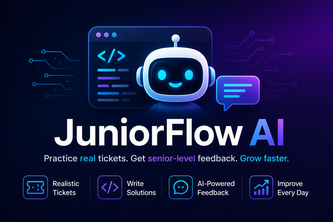
What the company appears to be: JuniorFlow AI is a self-reported AI-powered work simulator for aspiring junior developers. The author states it generates realistic software tickets with business context, requirements, and acceptance criteria, then provides structured feedback from a virtual senior developer.
What changed: This project was submitted as part of the OpenAI 2026 hackathon. The description indicates it evolved from an idea to a "complete production experience" rather than a prototype, with features like bilingual support, structured outputs, and automated testing.
Single most important open question: Does the author's self-reported product actually help aspiring junior developers practice realistic software workflows, or is this a demonstration of technical capability without proven user impact?
Analysis basis: This report is based entirely on the self-reported project description provided by the caller. No external verification, traction data, revenue figures, customer names or independent sources are available. All claims are treated as stated by the author and not independently confirmed.
What The Product Actually Is
- The description states that JuniorFlow AI is a "bilingual AI-powered work simulator for aspiring software developers."
- It generates realistic development tickets containing business context, requirements, acceptance criteria, suggested files, practical guidance, and common mistakes.
- Learners configure a profile with role, experience level, time availability, tech stack, and project context.
- GPT-5.6 generates these tickets and responds to learner submissions with structured senior reviews covering strengths, improvement priorities, bugs, security, acceptance criteria, ideal solutions, and personalized learning plans.
- The system includes Practice History for completed simulations.
- It uses Next.js, React, TypeScript, Tailwind CSS, shadcn/ui, Zod, OpenAI Responses API, GPT-5.6, Vitest, Playwright, and Vercel.
- Structured Outputs are used to return validated bilingual ticket and review objects.
Evidence: All of this is self-reported by the author in the project write-up. No independent confirmation or demonstration of actual functionality beyond the description exists.
Positioning & Claim Evolution
- The author claims that JuniorFlow AI bridges the gap between learning syntax and understanding how software work actually happens.
- It is positioned as not just a generic chatbot or coding exercise generator, but as a simulator of the complete professional workflow: Profile → Ticket → Reasoning → Submission → Senior Review → Learning Plan.
- The product differentiates itself by simulating the full professional workflow and offering bilingual support without doubling API calls or latency.
- It is described as having evolved from an idea into a "complete production experience" rather than a technical prototype.
Inference: The claim of being a "work simulator" implies a shift from learning code to practicing real-world job tasks. However, this is not substantiated with evidence of user adoption or effectiveness.
Target Customer & ICP
- The primary target customer is described as “aspiring junior developers.”
- These users are said to be those who know programming languages and frameworks but lack experience in approaching real tickets, interpreting acceptance criteria, communicating technical decisions, or responding to senior reviews.
- The system allows learners to configure profiles based on role, experience level, available time, technology stack, and project context.
Evidence: This is stated by the author. No data about actual users, their demographics, or usage patterns is provided.
Business Model & Pricing Evidence
- Not evidenced.
Absence of evidence: There is no mention in the description of any pricing model, monetization strategy, or business model. The project appears to be a hackathon submission with no indication of commercial intent or revenue streams.
Technical & Delivery Signals
- Built using Next.js, React, TypeScript, Tailwind CSS, shadcn/ui, Zod, OpenAI Responses API, GPT-5.6, Vitest, Playwright, and Vercel.
- Uses Structured Outputs for validated bilingual ticket and review objects.
- Includes signed HttpOnly access sessions, server-side validation, rate limiting, idempotency protection, explicit loading and error states, responsive design, keyboard accessibility, a static demonstration, and local Practice History.
- The application is described as passing 94 Vitest tests, 6 Playwright tests, TypeScript validation, ESLint, the production build, and a runtime dependency audit with zero identified vulnerabilities.
- GPT-5.6 is used to adapt each ticket to learner profile parameters and evaluate reasoning.
Evidence: All technical details are self-reported by the author. No external verification or performance metrics beyond test results are included.
Traction & Maturity Signals
- Not evidenced.
Absence of evidence: There is no mention of users, customers, downloads, engagement, retention, or any form of traction. The project is described as a hackathon submission and a "complete production experience," but without data to support maturity or adoption.
Competitive Context
- Not evidenced.
Absence of evidence: No information about competitors, market landscape, or competitive positioning is provided in the description.
Open Questions & Risks
- The entire project is self-reported and unverified. There is no independent validation of its functionality or impact.
- The author is a single individual (team size: 1). This raises questions about scalability, long-term maintenance, and resource allocation.
- No evidence of monetization, pricing, or customer acquisition strategy.
- The product is described as a "hackathon submission" — implying it may not have been designed for long-term commercial viability.
- The use of GPT-5.6 suggests dependency on an external AI service that could change or become unavailable.
Inference: While the author claims to have built a production-ready system, there is no evidence of real-world usage or validation of its effectiveness in helping developers.
Questions the description leaves open
- What specific user problems does JuniorFlow AI solve, and how do you know?
- How many aspiring junior developers have used the platform, if any?
- What is your plan for monetization or revenue generation?
- Can you demonstrate actual usage of the platform beyond the static demo?
- How do you ensure that feedback from GPT-5.6 aligns with real-world senior developer practices?
- What are the key assumptions behind the product’s design, and how might they be wrong?
- How will you scale beyond a single developer's capacity?
Note: These questions are based on the lack of evidence in the description and aim to probe deeper into unverified claims.
Overall Assessment
- Not evidenced.
Absence of evidence: No information is provided about valuation, funding rounds, investor interest, or partnership potential. The project appears to be a hackathon submission with no indication of commercial readiness or strategic value for investment or partnership.
User Stories BotA demo video on every pull request
Get a demo video on every new feature
GitHub App that watches your pull requests and records a narrated, captioned demo.
Save time on demo prep and make informed decisions faster with a video walkthrough of every new feature.
Source
Submitted to the OpenAI 2026 hackathon on Devpost. Project home on Devpost. Back to the full gallery on Devpost.
This competitive analysis was produced by top-founders.com (opens in a new tab)
Generated by a language model from this project's public Devpost page — its tagline, the author's own write-up and any built-with tags listed there — as captured in August 2026. Short quotations are the author's words. It is an opinion on the idea as a business, not on the people behind it, and it reflects the description as published then. If the project has moved on, request a correction below. The analysis is not independent research and contains no verified traction, revenue or customer data.
An independent guide by KFG International LLC — not affiliated with, endorsed by, or connected to Devpost or OpenAI.