

Archive position — measured, not model output
0 likes on Devpost
2,263 of the 7,850 archived projects have more likes, and 5,587 share exactly 0 — so this project's #4,701 place in the like-ranked listing is a tie-break inside that group, not a ranking.
Projects (log scale)
Likes on Devpost. ▲ marks this project's group.
Show the figures
| Likes | Projects | Share of archive |
|---|---|---|
| 0 | 5,587 | 71.2% |
| 1 | 1,758 | 22.4% |
| 2 | 284 | 3.6% |
| 3–4 | 132 | 1.7% |
| 5–9 | 75 | 1.0% |
| 10+ | 14 | 0.2% |
 User Stories BotA demo video on every pull request
Get a demo video on every new feature
GitHub App that watches your pull requests and records a narrated, captioned demo.
Save time on demo prep and make informed decisions faster with a video walkthrough of every new feature.
Executive Summary
What the company appears to be
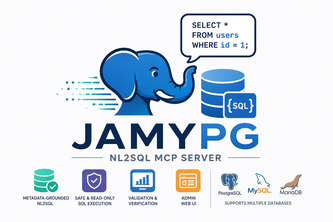
JAMYPG NL2SQL MCP is a self-reported metadata-grounded natural-language-to-SQL (NL2SQL) server for PostgreSQL, MySQL, and MariaDB. It is built as a single Go binary with support for the Model Context Protocol (MCP), REST APIs, and an admin UI. The system aims to improve accuracy and safety of NL2SQL generation by grounding it in verified metadata, enforcing read-only execution, and validating SQL against database schemas and dialects.
What changed
The author states that JAMYPG was created to address common issues with NL2SQL systems such as hallucinated tables/columns, incorrect joins, and unsafe SQL execution. It introduces a structured metadata catalog, validation layers, and support for multiple database engines through a unified abstraction layer.
Single most important open question
Is there any evidence of real-world usage or adoption beyond the author’s own development work?
What The Product Actually Is
The description states that JAMYPG is a metadata-grounded NL2SQL MCP server. It supports PostgreSQL, MySQL, and MariaDB and uses Go for implementation.
It includes:
- A metadata catalog managing databases, schemas, tables, columns, relationships, business terms, metrics, and example queries.
- An NL2SQL context preparation system that retrieves relevant metadata based on user input.
- SQL validation including read-only checks, dialect compliance, and query-plan analysis.
- Support for both MCP (via stdio and HTTP) and REST APIs with Swagger UI and a web-based admin interface.
- Multi-database execution via a dialect abstraction layer.
It is described as a single executable binary built in Go.
Claim
JAMYPG is an NL2SQL server that enforces metadata grounding, read-only SQL execution, and validation.
Evidence The author's own write-up.
Positioning & Claim Evolution
The description states that the goal was not to build a simple SQL generator but a safe, metadata-grounded NL2SQL MCP server. It positions itself as addressing problems like hallucination, join path errors, and unsafe SQL execution.
It also claims that:
- It provides verified search results, join graphs, and SQL skeletons.
- It supports the Model Context Protocol (MCP) to integrate with AI clients such as Codex, Claude, Qwen Code, and OpenCode.
- It is designed for enterprise use cases where safety and governance are critical.
Claim
JAMYPG aims to be a governance layer between AI agents and enterprise data.
Evidence The author’s own write-up.
Target Customer & ICP
The description does not explicitly name target customers or define an ideal customer profile (ICP). However, it implies that the product is aimed at:
- Developers or data teams who want to safely integrate AI with enterprise databases.
- Organizations using PostgreSQL, MySQL, or MariaDB and seeking secure NL2SQL capabilities.
- Users of AI tools that support MCP for database access.
Claim
The target audience includes developers and data professionals working with enterprise databases and AI agents.
Evidence Inferred from the product’s architecture and use case description.
Business Model & Pricing Evidence
There is no evidence in the description of a business model or pricing structure. The project is presented as a self-developed tool, not a commercial offering.
Claim
No business model or pricing information is provided.
Evidence Not evidenced.
Technical & Delivery Signals
The system is built in Go and designed for fast startup, efficient resource usage, and simple deployment. It supports:
- Metadata cataloging via JSON
- In-memory structures for search indexes, join graphs, and business glossaries
- Multi-database support through dialect abstraction
- MCP transport methods (stdio, HTTP)
- REST APIs with Swagger UI and admin UI
- Docker-based integration testing
Claim
JAMYPG is a deployable single-binary Go application supporting multiple databases and protocols.
Evidence The author’s own write-up.
Traction & Maturity Signals
There is no evidence of revenue, customers, or adoption beyond the author's development work. The project is described as a hackathon submission and has not been independently verified for traction.
Claim
No traction or maturity signals are evident.
Evidence Not evidenced.
Competitive Context
The description does not mention direct competitors or competitive positioning. However, it implies that existing NL2SQL tools suffer from issues like hallucination and lack of safety mechanisms — which JAMYPG aims to solve.
Claim
The product addresses shortcomings in current NL2SQL systems.
Evidence Inferred from the problem statement and solution description.
Open Questions & Risks
Key risks include:
- Lack of real-world usage or customer feedback.
- No evidence of commercial viability or monetization strategy.
- Self-reported nature of all claims; no independent verification.
- The project is a solo effort, suggesting limited scalability or team capacity for growth.
Claim
Risk of unproven market demand and lack of traction.
Evidence Inferred from absence of evidence of adoption or revenue.
Questions the description leaves open
- Has the system been tested in real-world environments with actual enterprise data?
- What is the current level of metadata management automation (e.g., automatic schema extraction)?
- Are there any plans to support additional database engines beyond PostgreSQL, MySQL, and MariaDB?
- How does the system handle large-scale or complex query scenarios?
- Is there a plan for monetization or commercial deployment?
Claim
These questions are necessary due to lack of evidence around usage, scalability, and business model.
Evidence Inferred from absence of traction and business details.
Overall Assessment
There is no evidence that JAMYPG has reached a stage where it could be considered for investment or partnership. It is described as a hackathon project with no revenue, customers, or verified adoption.
Claim
No basis for investment or partnership consideration at this time.
Evidence Not evidenced.
User Stories BotA demo video on every pull request
Get a demo video on every new feature
GitHub App that watches your pull requests and records a narrated, captioned demo.
Save time on demo prep and make informed decisions faster with a video walkthrough of every new feature.
Source
Submitted to the OpenAI 2026 hackathon on Devpost. Project home on Devpost. Back to the full gallery on Devpost.
This competitive analysis was produced by top-founders.com (opens in a new tab)
Generated by a language model from this project's public Devpost page — its tagline, the author's own write-up and any built-with tags listed there — as captured in August 2026. Short quotations are the author's words. It is an opinion on the idea as a business, not on the people behind it, and it reflects the description as published then. If the project has moved on, request a correction below. The analysis is not independent research and contains no verified traction, revenue or customer data.
An independent guide by KFG International LLC — not affiliated with, endorsed by, or connected to Devpost or OpenAI.