

Archive position — measured, not model output
0 likes on Devpost
2,263 of the 7,850 archived projects have more likes, and 5,587 share exactly 0 — so this project's #4,685 place in the like-ranked listing is a tie-break inside that group, not a ranking.
Projects (log scale)
Likes on Devpost. ▲ marks this project's group.
Show the figures
| Likes | Projects | Share of archive |
|---|---|---|
| 0 | 5,587 | 71.2% |
| 1 | 1,758 | 22.4% |
| 2 | 284 | 3.6% |
| 3–4 | 132 | 1.7% |
| 5–9 | 75 | 1.0% |
| 10+ | 14 | 0.2% |
 User Stories BotA demo video on every pull request
Get a demo video on every new feature
GitHub App that watches your pull requests and records a narrated, captioned demo.
Save time on demo prep and make informed decisions faster with a video walkthrough of every new feature.
Executive Summary
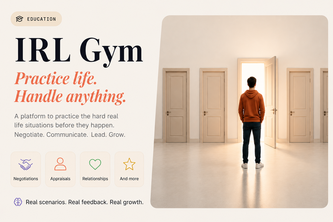
IRL Gym is a self-reported AI-powered conversation simulator for real-life scenarios, built as a single-page Next.js application with server-side OpenAI integration. The author describes it as a tool to practice difficult conversations such as negotiations, feedback delivery, and boundary-setting — targeting students and early-career professionals.
The product is presented as a three-layered system: experience (browser), server (Next.js route handlers), and intelligence (OpenAI modules). It includes features like adaptive roleplay, live coaching, psychological room read, and structured outreach drafting. The AI components are described as specialized modules using GPT-5.6 Terra, with Zod validation and deterministic fallbacks for reliability.
Key claims include:
- A safe, repeatable practice environment for high-stakes conversations.
- Integration of Field (research + outreach) and Gym (practice) workflows.
- Use of structured outputs from OpenAI to avoid brittle parsing.
- Server-side API key handling for security.
What changed: The project is a self-contained prototype submitted to the OpenAI 2026 hackathon. No evidence of prior traction, funding or customer data exists beyond the author's description.
Single most important open question: Is there any evidence that users actually engage with IRL Gym beyond its initial development phase? If not, what are the implications for commercial viability?
What The Product Actually Is
The description states that IRL Gym is a simulator for real-life conversations, built using:
- Next.js (App Router)
- React + TypeScript
- Tailwind CSS
- OpenAI APIs (GPT-5.6 Terra)
- Zod validation
- Server-Sent Events (SSE) for streaming responses
It operates as a single-page application with three main sections:
- Story landing (/) – Visual narrative from academic mastery to real-life pressure.
- Gym (/gym) – Live conversation practice with adaptive counterpart, move-by-move coaching, live resistance, optional hints, and debriefs.
- Field (/field) – Research opportunities, draft outreach, and handoff into matching Gym scenarios.
Modules include:
- Roleplay + Coach
- Psychologist
- Guide
- Scenario builder
- Scout
- Writer
- Editor
- Watcher
All modules interact with the OpenAI Responses API via server-side calls, ensuring no client-side exposure of API keys. The system uses structured JSON outputs from GPT-5.6 Terra and falls back to deterministic logic when needed.
The author also notes that:
- The app runs in deterministic practice mode without an API key.
- It supports custom scenario creation.
- It integrates live feedback, including emotional subtext analysis, tactical suggestions, and coaching cues.
- It is designed for students and early-career professionals who need to negotiate, give feedback, set limits, ask for help, and make career moves.
Positioning & Claim Evolution
The author positions IRL Gym as a safe, repeatable practice environment for high-stakes conversations that are often missed in traditional education or self-help resources. The core claim is:
"School rewards knowing the answer. Real life rewards saying it when your manager pushes back..."
This suggests a shift from theory-based learning to experiential preparation.
The positioning evolves through:
- Problem framing: Students and early-career people struggle with real-life conversations despite academic success.
- Solution proposition: A simulator that allows safe, repeatable practice under pressure.
- Differentiation: Not just advice or theory, but live resistance and coaching in simulated environments.
- Use case expansion: From negotiation to feedback delivery, asking for help, setting boundaries, etc.
There is no indication of prior positioning evolution or market testing beyond the hackathon submission.
Target Customer & ICP
The description states that IRL Gym is built for:
- Students
- Early-career professionals
These users are described as needing to:
- Negotiate
- Give feedback
- Set limits
- Ask for help
- Make career moves
No further segmentation or persona details are provided. The target audience appears to be broad — not specifically defined by industry, geography, or job function.
There is no evidence of customer interviews, surveys, or usage data beyond the author’s own account.
Business Model & Pricing Evidence
The description does not contain any information about:
- Revenue model
- Pricing strategy
- Monetization approach
- Customer acquisition costs
- Unit economics
No mention of subscriptions, freemium tiers, enterprise licensing, or other commercial structures is evident.
Technical & Delivery Signals
Key technical elements reported:
- Built with Next.js 16 (App Router)
- Uses React 19 + TypeScript
- Styled with Tailwind CSS 4
- Client state managed via Zustand
- Validated using Zod
- AI powered by OpenAI Responses API (GPT-5.6 Terra)
- Server-side only credentials to prevent exposure of API keys
- Structured outputs for reliability and performance
- Deterministic fallback logic for resilience
Delivery signals:
- Live feedback via SSE streaming
- Modular architecture with specialized AI modules
- Secure deployment on Render (Node web service)
- Local development support with environment variables
- Verification tools including type checking, evaluation suite, and production builds
The system is described as:
- Designed for speed and reliability
- Capable of running in practice mode without API key
- Built to be transparent and respectful by design
Traction & Maturity Signals
There is no evidence of:
- Revenue
- Customers
- Usage metrics
- Product-market fit
- Iteration history or versioning beyond the hackathon submission
- Any form of traction or adoption data
The project is presented as a single-person prototype, built for a hackathon, with no indication of prior user engagement or commercial activity.
Competitive Context
The description does not mention:
- Competitors
- Existing solutions in the space
- Market size or growth trends
- Competitive advantages or differentiation strategies
No reference is made to similar tools such as:
- Conversation coaching apps
- AI-based negotiation simulators
- Career development platforms
- Roleplay training software
Open Questions & Risks
Several risks and open questions are evident from the self-reported description:
- Lack of traction or validation – No evidence of users, customers, or revenue.
- Single-person development – Limited team capacity may hinder scalability or feature depth.
- Unproven commercial viability – The business model is entirely absent from the description.
- No external validation – No third-party reviews, testimonials, or partnerships.
- High dependency on AI quality and availability – Reliance on GPT-5.6 Terra implies potential performance or cost risks if API changes occur.
- Limited scope for monetization – Without clear pricing or revenue models, the project lacks commercial clarity.
Questions the description leaves open
- What is your definition of success for IRL Gym? Is it user engagement, retention, or conversion?
- Have you conducted any form of user testing or feedback collection beyond personal use?
- How do you plan to scale beyond a single developer and hackathon prototype?
- What are the key assumptions about the market demand for this type of tool?
- Are there any competitors currently operating in this space, and how does IRL Gym differ?
- What is your roadmap for monetization or commercialization?
- How do you intend to ensure consistent AI quality and reduce hallucinations?
- Do you have plans for integrating real-world feedback loops or data analytics?
Overall Assessment
Not evidenced
There is no evidence of:
- Revenue
- Customers
- Product-market fit
- Funding rounds
- Valuation
- Team traction or prior experience
- Commercial viability
The project is presented as a single-developer hackathon submission, with no indication of commercial readiness or traction.
Given the lack of any measurable outcomes, and the absence of any business model or market validation, this project cannot be evaluated for investment or partnership potential at this time. It remains in an exploratory phase, lacking the data required to assess its commercial viability or strategic fit.
The author's description is self-reported, unverified, and limited in scope — it does not provide sufficient evidence to support a due-diligence conclusion.
User Stories BotA demo video on every pull request
Get a demo video on every new feature
GitHub App that watches your pull requests and records a narrated, captioned demo.
Save time on demo prep and make informed decisions faster with a video walkthrough of every new feature.
Source
Submitted to the OpenAI 2026 hackathon on Devpost. Project home on Devpost. Back to the full gallery on Devpost.
This competitive analysis was produced by top-founders.com (opens in a new tab)
Generated by a language model from this project's public Devpost page — its tagline, the author's own write-up and any built-with tags listed there — as captured in August 2026. Short quotations are the author's words. It is an opinion on the idea as a business, not on the people behind it, and it reflects the description as published then. If the project has moved on, request a correction below. The analysis is not independent research and contains no verified traction, revenue or customer data.
An independent guide by KFG International LLC — not affiliated with, endorsed by, or connected to Devpost or OpenAI.