

Archive position — measured, not model output
0 likes on Devpost
2,263 of the 7,850 archived projects have more likes, and 5,587 share exactly 0 — so this project's #4,663 place in the like-ranked listing is a tie-break inside that group, not a ranking.
Projects (log scale)
Likes on Devpost. ▲ marks this project's group.
Show the figures
| Likes | Projects | Share of archive |
|---|---|---|
| 0 | 5,587 | 71.2% |
| 1 | 1,758 | 22.4% |
| 2 | 284 | 3.6% |
| 3–4 | 132 | 1.7% |
| 5–9 | 75 | 1.0% |
| 10+ | 14 | 0.2% |
 User Stories BotA demo video on every pull request
Get a demo video on every new feature
GitHub App that watches your pull requests and records a narrated, captioned demo.
Save time on demo prep and make informed decisions faster with a video walkthrough of every new feature.
Executive Summary
What the company appears to be
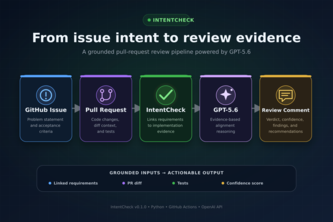
IntentCheck is a self-reported GitHub Action and CLI tool that uses AI (specifically GPT-5.6) to verify whether code changes in a pull request align with the requirements specified in the linked GitHub issue.
What changed
The project was built as part of an OpenAI 2026 hackathon submission, with no evidence of prior traction or commercial activity. It is described as a v0.1.0 release that has been tested end-to-end in a separate repository and includes both GitHub Action and local CLI functionality.
Single most important open question
Is there any evidence of actual usage by teams beyond the author’s own testing, or any indication of product-market fit or adoption?
What The Product Actually Is
The description states that IntentCheck is a Python-based GitHub Action designed to review pull requests against their linked GitHub issues. It uses GPT-5.6 for reasoning and comparison between issue requirements and code changes.
It also includes:
- A command-line interface (CLI) for local testing.
- Integration with the GitHub API to retrieve PRs, linked issues, diffs, and changed files.
- Structured output in the form of review comments on pull requests.
- Use of Codex and Python for development, including automated testing and debugging.
Inference The tool is built as a reusable GitHub Action, suggesting it can be integrated into CI/CD workflows. However, no evidence exists that this integration has been adopted or scaled beyond the author’s own testing.
Positioning & Claim Evolution
The author states:
- IntentCheck was not built to be a general-purpose AI code reviewer.
- It focuses specifically on verifying whether pull requests fulfill the intent of the linked GitHub issue.
- The tool aims to prevent technically correct but semantically incorrect changes.
Inference This positioning reflects an attempt to carve out a niche within the broader AI-assisted development space, focusing on intent alignment rather than code quality or correctness alone. However, no claims are made about market demand, competitive differentiation, or user feedback.
Target Customer & ICP
The description does not explicitly define a target customer segment or ideal customer profile (ICP). It implies that the tool is aimed at developers working with GitHub and pull requests, particularly those who want to ensure their code aligns with issue requirements.
Inference The likely users are software teams using GitHub for collaboration and CI/CD. The tool may appeal to organizations seeking to reduce misaligned PRs or improve code review rigor. However, no evidence of actual customers or user personas is provided.
Business Model & Pricing Evidence
There is no evidence in the description of any business model or pricing structure. The project is described as a hackathon submission and a v0.1.0 release with no mention of monetization, subscriptions, or paid features.
Inference The tool appears to be open-source or freeware at this stage, possibly hosted on GitHub Marketplace if it is released there (see “What’s next” section). No commercialization strategy is evident.
Technical & Delivery Signals
- Built using Python and GitHub Actions.
- Uses GPT-5.6 for reasoning and comparison.
- Integrates with GitHub API to fetch PRs, issues, diffs, and files.
- Includes a CLI for local testing.
- Developed using Codex for planning, implementation, debugging, and release preparation.
- The author resolved challenges related to package paths, permissions, secrets, and API quotas.
Inference The technical stack is straightforward and well-suited to GitHub workflows. However, no evidence exists of production-grade infrastructure or scalability beyond the author’s own use case.
Traction & Maturity Signals
- Released a v0.1.0 version.
- Tested end-to-end in a separate demo repository.
- Successfully demonstrated:
- Finding linked GitHub issues.
- Reading issue requirements.
- Reviewing PR implementation.
- Calling GPT-5.6.
- Posting structured review comments.
- The author notes that the tool works both as a GitHub Action and CLI.
Inference The product is at an early stage of development, with limited real-world usage or adoption data. No metrics on user engagement, retention, or feedback are available.
Competitive Context
The description does not mention any competitors or existing tools in this space. It emphasizes that IntentCheck is not a general-purpose AI code reviewer but a focused tool for intent verification.
Inference There is no evidence of competitive analysis or awareness of similar tools. The author’s positioning suggests a niche within the AI-assisted development ecosystem, but no clear market context is provided.
Open Questions & Risks
- No revenue, customer, or traction data.
- Product is described as a hackathon submission with no commercial history.
- No evidence of user feedback, usage metrics, or product-market fit.
- The tool is limited to GitHub and may not scale beyond that platform.
- GPT-5.6 is used for reasoning, but there’s no indication of how accuracy or reliability are measured or improved over time.
Inference The project lacks commercial traction or validation, raising questions about its viability as a product or business. The lack of evidence around adoption or feedback makes it difficult to assess risk or opportunity.
Questions the description leaves open
- Has the tool been used by any teams beyond your own testing?
- What is the current level of accuracy and reliability of GPT-5.6 in identifying intent alignment?
- Are there plans to support other platforms (e.g., GitLab, Bitbucket)?
- How do you plan to monetize or scale this tool?
- Have you considered how to handle false positives/negatives from AI reasoning?
- What is the roadmap for expanding beyond GitHub Actions and CLI?
Overall Assessment
Not evidenced.
There is no evidence of revenue, customers, traction, or commercial viability beyond the author’s own testing and hackathon submission. The tool is described as a v0.1.0 release with no indication of product-market fit, scalability, or monetization strategy.
Confidence Low. This is a self-reported, unverified project with no external validation or data to support its commercial potential.
User Stories BotA demo video on every pull request
Get a demo video on every new feature
GitHub App that watches your pull requests and records a narrated, captioned demo.
Save time on demo prep and make informed decisions faster with a video walkthrough of every new feature.
Source
Submitted to the OpenAI 2026 hackathon on Devpost. Project home on Devpost. Back to the full gallery on Devpost.
This competitive analysis was produced by top-founders.com (opens in a new tab)
Generated by a language model from this project's public Devpost page — its tagline, the author's own write-up and any built-with tags listed there — as captured in August 2026. Short quotations are the author's words. It is an opinion on the idea as a business, not on the people behind it, and it reflects the description as published then. If the project has moved on, request a correction below. The analysis is not independent research and contains no verified traction, revenue or customer data.
An independent guide by KFG International LLC — not affiliated with, endorsed by, or connected to Devpost or OpenAI.