

Archive position — measured, not model output
0 likes on Devpost
2,263 of the 7,850 archived projects have more likes, and 5,587 share exactly 0 — so this project's #4,633 place in the like-ranked listing is a tie-break inside that group, not a ranking.
Projects (log scale)
Likes on Devpost. ▲ marks this project's group.
Show the figures
| Likes | Projects | Share of archive |
|---|---|---|
| 0 | 5,587 | 71.2% |
| 1 | 1,758 | 22.4% |
| 2 | 284 | 3.6% |
| 3–4 | 132 | 1.7% |
| 5–9 | 75 | 1.0% |
| 10+ | 14 | 0.2% |
 User Stories BotA demo video on every pull request
Get a demo video on every new feature
GitHub App that watches your pull requests and records a narrated, captioned demo.
Save time on demo prep and make informed decisions faster with a video walkthrough of every new feature.
Executive Summary
What the company appears to be
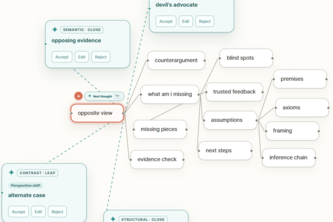
Infinite Graph — Human-Led AI is a self-reported visual thinking workspace designed for idea development with AI assistance. The product allows users to build ideas on an open graph canvas, where AI suggests possible connections as temporary "ghost nodes" that must be explicitly accepted before becoming part of the persistent graph. It emphasizes human agency in decision-making and cognitive process preservation.
What changed
The description presents a new approach to AI integration in creative or analytical tools — one that positions AI not as an answer generator but as a possibility generator, with clear boundaries around what AI can propose versus what the user decides to include.
Single most important open question
Is there evidence of any traction, revenue, or user behavior beyond the prototype and self-reported claims?
What The Product Actually Is
The description states that Infinite Graph is an AI cognitive workspace for visually developing ideas without surrendering authorship. It is built as a local-first web application using React, TypeScript, Vite, and React Flow, with data persistence via IndexedDB.
Key features include:
- An open node-and-edge canvas
- Node creation and keyboard editing
- AI-generated branching suggestions presented as temporary ghost nodes
- Explicit acceptance required for AI content to become part of the graph
- Provenance tracking for manually created vs. AI-assisted content
- JSON import/export capabilities
- Undo/redo functionality
The system uses a centralized operation pipeline rather than decentralized mutations, supporting predictable undo/redo and consistent persistence.
It is described as a prototype, not yet fully implemented in its long-term architecture.
Claimed function: AI suggests directions; user decides what belongs.
Inferred structure: A cognitive tool with human-AI interaction loop focused on preserving unexplained connections and decision history.
Positioning & Claim Evolution
The description makes a strong claim about the product’s positioning:
“AI can suggest a path. It cannot decide why that path matters to someone.”
This suggests a shift from traditional AI tools that generate answers to those that generate possibilities while maintaining human control over meaning-making.
It also positions itself as:
- A tool for preserving uncertain processes (not just final outputs)
- One that reduces the number of meaningful traces that disappear before recognition
- Not decorative or authoritative, but useful without taking over
There is no indication of prior versions or evolution from earlier products — this appears to be a first-time launch in prototype form.
Claimed value proposition: AI expands ideas without taking over.
Inferred positioning: A cognitive workspace for idea exploration with AI as facilitator, not executor.
Target Customer & ICP
The description does not name specific customer segments or personas. However, it implies a target audience interested in:
- Idea development
- Cognitive thinking tools
- Visual graph-based organization
- Preserving thought processes and connections
It is framed for individuals who may be working on complex projects where meaning emerges over time, such as researchers, writers, strategists, or creative professionals.
Claimed customer type: Users engaged in exploratory or iterative thinking.
Inferred ICP: Early adopters of experimental cognitive tools; possibly academic or research-oriented users.
Business Model & Pricing Evidence
No business model or pricing information is provided in the description.
The project is presented as a prototype and not yet commercialized.
Claimed model: Not stated.
Inferred: Likely free-to-use or early-stage SaaS, pending further development.
Technical & Delivery Signals
The product is built using:
- React
- TypeScript
- Vite
- IndexedDB for local persistence
- OpenAI APIs (specifically GPT-5 mentioned)
- Local-first architecture
It uses a centralized pipeline for graph operations and implements:
- Ghost nodes as approval boundaries
- Provenance tracking at data level
- Undo/redo support
- JSON import/export
The system distinguishes between:
- Manually created content
- AI suggestions accepted without editing
- AI suggestions edited before acceptance
It also separates the final state from the decision history, which is a deliberate architectural choice.
Claimed tech stack: Local-first web app with React + TypeScript + IndexedDB
Inferred delivery approach: Prototype focused on core interaction loop; future append-only event history planned
Traction & Maturity Signals
There is no evidence of traction, revenue, customers, or adoption beyond the prototype.
The project was submitted to a hackathon and described as a first iteration. It includes:
- Onboarding presets
- Basic functionality (node creation, editing, grouping)
- AI suggestion system with ghost nodes
No mention of users, usage metrics, or product-market fit indicators.
Claimed maturity: Prototype
Inferred status: Pre-revenue, pre-user base
Competitive Context
The description does not reference competitors or market positioning beyond its own claims. It is unclear whether similar tools exist in the marketplace.
It focuses on:
- Visual graph thinking
- AI integration without authorship takeover
- Preservation of cognitive process
No comparison to existing tools like Notion, Roam Research, Obsidian, or other idea management systems is made.
Claimed differentiation: AI as possibility generator; human control enforced through data structure
Inferred context: Likely in niche space of experimental cognitive tools or AI-augmented thinking platforms
Open Questions & Risks
- No traction evidence: No users, revenue, or adoption metrics.
- Prototype-only status: Product is not yet commercialized or tested at scale.
- Unproven user behavior: The author describes intentions but does not show how people actually interact with the tool.
- Limited scope of AI use: Only one model (GPT-5) is mentioned; no indication of multi-stage pipelines or advanced recommendation systems.
- Browser interaction reliability issues: Mentioned as a challenge, suggesting potential UX friction in real-world usage.
Risk factor: High risk due to lack of real-world validation and user feedback.
Questions the description leaves open
- What is the expected timeline for moving from prototype to product?
- Are there any early users or pilot programs already underway?
- How do you plan to scale beyond a single developer (team size = 1)?
- What are the key assumptions about user behavior that underpin your design decisions?
- Do you have plans to integrate with existing tools or platforms (e.g., Notion, Obsidian)?
- How will you measure success once launched — what KPIs do you expect?
- What is the long-term vision for AI integration beyond current prototype?
Overall Assessment
This project is currently a self-reported prototype submitted to a hackathon. There is no evidence of traction, revenue, or customer adoption.
The description shows strong conceptual clarity and design philosophy around human agency in AI-assisted thinking, but lacks any indication that this has been validated by users or markets.
Assessment: Not ready for investment or partnership at this stage.
Confidence level: Low — based entirely on self-reported claims with no external validation.
User Stories BotA demo video on every pull request
Get a demo video on every new feature
GitHub App that watches your pull requests and records a narrated, captioned demo.
Save time on demo prep and make informed decisions faster with a video walkthrough of every new feature.
Source
Submitted to the OpenAI 2026 hackathon on Devpost. Project home on Devpost. Back to the full gallery on Devpost.
This competitive analysis was produced by top-founders.com (opens in a new tab)
Generated by a language model from this project's public Devpost page — its tagline, the author's own write-up and any built-with tags listed there — as captured in August 2026. Short quotations are the author's words. It is an opinion on the idea as a business, not on the people behind it, and it reflects the description as published then. If the project has moved on, request a correction below. The analysis is not independent research and contains no verified traction, revenue or customer data.
An independent guide by KFG International LLC — not affiliated with, endorsed by, or connected to Devpost or OpenAI.