

Archive position — measured, not model output
0 likes on Devpost
2,263 of the 7,850 archived projects have more likes, and 5,587 share exactly 0 — so this project's #4,629 place in the like-ranked listing is a tie-break inside that group, not a ranking.
Projects (log scale)
Likes on Devpost. ▲ marks this project's group.
Show the figures
| Likes | Projects | Share of archive |
|---|---|---|
| 0 | 5,587 | 71.2% |
| 1 | 1,758 | 22.4% |
| 2 | 284 | 3.6% |
| 3–4 | 132 | 1.7% |
| 5–9 | 75 | 1.0% |
| 10+ | 14 | 0.2% |
 User Stories BotA demo video on every pull request
Get a demo video on every new feature
GitHub App that watches your pull requests and records a narrated, captioned demo.
Save time on demo prep and make informed decisions faster with a video walkthrough of every new feature.
Executive Summary
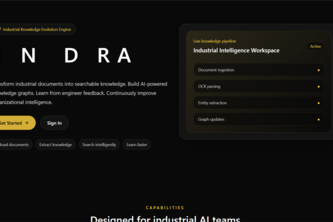
The company appears to be a two-person team building an AI-powered industrial knowledge copilot using Retrieval-Augmented Generation (RAG), vector databases, and knowledge graphs. The product is described as a tool that processes technical documents and enables natural language troubleshooting.
What changed
The project was submitted to the OpenAI 2026 hackathon, indicating it is in an early-stage development or prototype phase.
Single most important open question
Does INDRA have any real-world industrial use cases or customers yet?
Analysis basis
Self-reported and unverified. All information comes from the author’s own description, submitted to Devpost for a hackathon. No evidence of revenue, customers, traction, or commercial adoption is provided.
What The Product Actually Is
The description states that INDRA is an AI-powered industrial knowledge copilot that:
- Processes technical documents (PDFs, manuals)
- Extracts content using tools like PyMuPDF, pdfplumber, python-docx, openpyxl
- Stores document embeddings in Pinecone
- Builds a knowledge graph in Neo4j
- Uses LLMs (Groq Llama 3.1) for troubleshooting and maintenance responses
- Enables semantic search across documents
It is described as using RAG, Sentence Transformers, and hybrid retrieval combining vector search and graph databases.
Inference The product appears to be a document processing and semantic search system tailored for industrial engineering documentation.
Positioning & Claim Evolution
The author states that INDRA was built to help engineers retrieve technical knowledge quickly by understanding documents instead of simply searching them. It is positioned as an AI assistant for troubleshooting and maintenance.
Claim
The product aims to transform industrial technical documents into searchable, intelligent knowledge.
Inference The positioning reflects a move from traditional document search toward AI-enhanced semantic understanding in industrial settings.
Target Customer & ICP
The description states that INDRA is intended for engineers who need to find information quickly in industrial environments. It targets companies with large volumes of technical manuals, maintenance procedures, and inspection reports.
Claim
The target customer is industrial engineers or technicians working with complex documentation.
Inference No specific industry vertical or company size is mentioned; the positioning is generic to “industrial” use cases.
Business Model & Pricing Evidence
No evidence of pricing, monetization strategy, or business model is provided in the description.
Not evidenced.
Technical & Delivery Signals
The project uses:
- Backend: FastAPI, Python
- AI Stack: Sentence Transformers, Pinecone, Neo4j, Groq Llama 3.1
- Document Processing: PyMuPDF, pdfplumber, Pillow, python-docx, openpyxl
- Storage: Supabase PostgreSQL, Supabase Storage
The pipeline includes document upload → text extraction → chunking → embedding → vector storage (Pinecone) → entity extraction → graph storage (Neo4j) → hybrid retrieval → LLM response.
Claim
The system is built with a scalable document processing and semantic search architecture.
Inference The stack suggests a prototype or early-stage product, not a production-ready solution.
Traction & Maturity Signals
The description states that INDRA was built for the OpenAI 2026 hackathon. It includes accomplishments such as:
- Creating a scalable pipeline
- Learning about LLM orchestration and document parsing pipelines
There is no evidence of customers, revenue, or adoption beyond the hackathon submission.
Not evidenced.
Competitive Context
No mention of competitors or market positioning in relation to other industrial AI or knowledge management tools is provided.
Not evidenced.
Open Questions & Risks
- The project is described as a hackathon submission, suggesting it is not yet production-ready.
- No evidence of real-world use cases, customers, or traction.
- The team size is two, which may limit execution speed and scalability.
- The system uses experimental or early-stage tools (e.g., Groq Llama 3.1) without indicating performance or reliability.
- No pricing, monetization, or go-to-market strategy is described.
Inference The project appears to be in a very early stage of development and lacks commercial viability indicators.
Questions the description leaves open
- What specific industrial use cases have you tested INDRA on?
- Have any industrial companies expressed interest or signed up for pilot programs?
- How does INDRA handle large-scale document ingestion and processing in real-world settings?
- What is your plan to scale beyond the current prototype?
- Are there any existing partnerships with industrial equipment vendors or engineering firms?
Overall Assessment
Not evidenced.
The description provides no evidence of revenue, customers, traction, or a clear path to monetization. The project appears to be an early-stage hackathon prototype with no commercial validation.
Inference Without further evidence of product-market fit, customer interest, or business model, it is premature to consider this a viable investment or partnership opportunity at this stage.
User Stories BotA demo video on every pull request
Get a demo video on every new feature
GitHub App that watches your pull requests and records a narrated, captioned demo.
Save time on demo prep and make informed decisions faster with a video walkthrough of every new feature.
Source
Submitted to the OpenAI 2026 hackathon on Devpost. Project home on Devpost. Back to the full gallery on Devpost.
This competitive analysis was produced by top-founders.com (opens in a new tab)
Generated by a language model from this project's public Devpost page — its tagline, the author's own write-up and any built-with tags listed there — as captured in August 2026. Short quotations are the author's words. It is an opinion on the idea as a business, not on the people behind it, and it reflects the description as published then. If the project has moved on, request a correction below. The analysis is not independent research and contains no verified traction, revenue or customer data.
An independent guide by KFG International LLC — not affiliated with, endorsed by, or connected to Devpost or OpenAI.