

Archive position — measured, not model output
0 likes on Devpost
2,263 of the 7,850 archived projects have more likes, and 5,587 share exactly 0 — so this project's #4,613 place in the like-ranked listing is a tie-break inside that group, not a ranking.
Projects (log scale)
Likes on Devpost. ▲ marks this project's group.
Show the figures
| Likes | Projects | Share of archive |
|---|---|---|
| 0 | 5,587 | 71.2% |
| 1 | 1,758 | 22.4% |
| 2 | 284 | 3.6% |
| 3–4 | 132 | 1.7% |
| 5–9 | 75 | 1.0% |
| 10+ | 14 | 0.2% |
 User Stories BotA demo video on every pull request
Get a demo video on every new feature
GitHub App that watches your pull requests and records a narrated, captioned demo.
Save time on demo prep and make informed decisions faster with a video walkthrough of every new feature.
Executive Summary
What the company appears to be
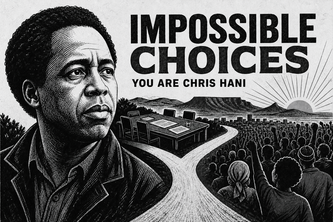
Impossible Choices is a self-reported role-playing game for political history, built with GPT-5.6 as the game master. The first module places players in the shoes of Chris Hani during South Africa’s 1990–93 transition to democracy. It is described as an educational and experiential tool that simulates moral and strategic decision-making under historical pressure.
What changed
The project is presented as a playable prototype, built by one person (team size: 0) using AI tools like Codex, GPT-5.6, and OpenAI APIs. It uses structured outputs, React, TypeScript, and Netlify Functions for deployment and state management.
Single most important open question
Is there any evidence of traction, revenue or customer adoption beyond the author’s own account? The description does not indicate any commercial activity, user base, or monetization strategy.
What The Product Actually Is
The description states that Impossible Choices is a role-playing game for political history. It is described as a generative experience, where GPT-5.6 acts as the game master and presents historically grounded situations. Players make decisions with consequences in an alternate timeline, based on the information available to the historical figure they are portraying.
The first module focuses on Chris Hani’s final years (1990–1993), with eight decisions offering three costly choices each. The player is not shown hidden values or probabilities, and the game uses a hybrid engine combining GPT-5.6 for narrative generation and an application layer for state control, security, and deterministic resolution.
Inference The product is not a static story but a dynamic, AI-generated experience that changes with each playthrough within historical constraints.
Positioning & Claim Evolution
The author positions Impossible Choices as a tool for understanding political history through experiential learning, rooted in personal and historical reflection. The tagline “Impossible Choices is D&D for political history” frames it as a narrative-driven educational experience that uses AI to simulate moral dilemmas.
It is described as an interactive simulation, not a passive story or static game. It is also positioned as a personal project with historical and ethical grounding, rooted in the author’s lived experience of apartheid and personal existential questioning.
Inference The positioning is centered on education, empathy, and moral complexity, not commercial appeal or scalability.
Target Customer & ICP
The description does not state any specific customer segment or target audience beyond “anyone can use” the game. It is described as a playable educational tool for people interested in political history, moral decision-making, or experiential learning.
It is not clear whether the product targets students, educators, history enthusiasts, or general audiences.
Inference The ICP is likely historically curious individuals or educators, but no explicit segmentation or targeting data is provided.
Business Model & Pricing Evidence
There is no evidence of a business model or pricing strategy in the description. The project is described as a personal prototype, and no revenue streams, monetization plans, or pricing tiers are mentioned.
Inference The product appears to be non-commercial at this stage, with no indication of paid access or monetization.
Technical & Delivery Signals
The project is built using:
- Frontend: React, TypeScript, Vite
- Backend: Node.js, Netlify Functions, OpenAI APIs (GPT-5.6, Responses API)
- Security: AES-256-GCM encrypted state tokens, server-side API keys
- Testing: Vitest, React Testing Library, Playwright
- AI Tools: Codex for architecture and development, GPT-5.6 for narrative generation
The system uses:
- Structured outputs via Zod validation
- Seeded resolution for deterministic outcomes
- Idempotent requests and concurrency controls
- Historical constraints and ethical boundaries in dialogue generation
Inference The technical stack is modern and AI-integrated, with attention to security, latency, and reliability. The architecture suggests a hybrid model where the AI generates content but the application enforces rules and state.
Traction & Maturity Signals
There is no evidence of traction or user adoption beyond the author’s own account. The project is described as a single playable module, with no mention of:
- User base
- Revenue
- Customer feedback
- Iteration history
- Public usage metrics
The team size is stated as 0, and there are no mentions of partnerships, marketing, or distribution.
Inference The product is at an early stage, likely a prototype or proof-of-concept, with no demonstrated market traction.
Competitive Context
There is no evidence of competitors in the description. The author does not reference similar tools or platforms for political history simulations or AI-driven narrative games.
It is described as a unique experience, rooted in personal and historical context, but no competitive positioning or market analysis is provided.
Inference The competitive landscape is unknown, but it may overlap with educational games, interactive history platforms, or AI storytelling tools. No direct competitors are named.
Open Questions & Risks
- No commercial traction or revenue: The project is described as a personal prototype with no evidence of monetization.
- Unproven scalability: The use of GPT-5.6 raises questions about cost, latency, and reliability at scale.
- Lack of team or institutional support: Team size is 0, suggesting limited resources for growth or maintenance.
- Ethical concerns around historical representation: While the author notes ethical boundaries, there is no evidence of external review or validation.
- No user feedback or testing data: No mention of player testing, usability studies, or iteration history.
Inference This is a high-risk, early-stage project, with no commercial viability or scalability demonstrated.
Questions the description leaves open
- What is the plan for scaling beyond a single module and one historical figure?
- How do you intend to monetize this product, if at all?
- Have you conducted any user testing or feedback collection from players?
- What are the long-term costs of using GPT-5.6 in this way, and how do you plan to manage them?
- Are there any plans for partnerships with educational institutions or history organizations?
- How do you ensure historical accuracy and ethical representation across different time periods?
Overall Assessment
The description states that the project is a self-reported prototype, built by one person, and not yet commercialized. There is no evidence of traction, revenue, or customer adoption.
Assessment This is an early-stage, non-commercial prototype with no demonstrated market readiness or scalability. It is not suitable for investment or partnership at this time, unless there are plans to expand beyond the current scope and demonstrate traction or a clear path to monetization.
User Stories BotA demo video on every pull request
Get a demo video on every new feature
GitHub App that watches your pull requests and records a narrated, captioned demo.
Save time on demo prep and make informed decisions faster with a video walkthrough of every new feature.
Source
Submitted to the OpenAI 2026 hackathon on Devpost. Project home on Devpost. Back to the full gallery on Devpost.
This competitive analysis was produced by top-founders.com (opens in a new tab)
Generated by a language model from this project's public Devpost page — its tagline, the author's own write-up and any built-with tags listed there — as captured in August 2026. Short quotations are the author's words. It is an opinion on the idea as a business, not on the people behind it, and it reflects the description as published then. If the project has moved on, request a correction below. The analysis is not independent research and contains no verified traction, revenue or customer data.
An independent guide by KFG International LLC — not affiliated with, endorsed by, or connected to Devpost or OpenAI.