

Archive position — measured, not model output
3 likes on Devpost
128 of the 7,850 archived projects have more likes, and 93 share exactly 3 — so this project's #168 place in the like-ranked listing is a tie-break inside that group, not a ranking.
Projects (log scale)
Likes on Devpost. ▲ marks this project's group.
Show the figures
| Likes | Projects | Share of archive |
|---|---|---|
| 0 | 5,587 | 71.2% |
| 1 | 1,758 | 22.4% |
| 2 | 284 | 3.6% |
| 3–4 | 132 | 1.7% |
| 5–9 | 75 | 1.0% |
| 10+ | 14 | 0.2% |
 User Stories BotA demo video on every pull request
Get a demo video on every new feature
GitHub App that watches your pull requests and records a narrated, captioned demo.
Save time on demo prep and make informed decisions faster with a video walkthrough of every new feature.
Executive Summary
What the company appears to be
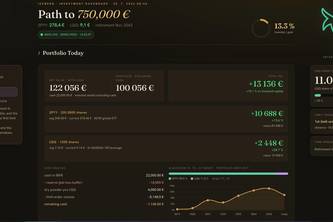
Iceberg is an investment cockpit built as a self-contained web application that integrates with Interactive Brokers (IB) via its API. It supports portfolio monitoring, recurring ETF investing, limit-order tracking, leveraged exposure controls, long-term retirement planning, and behavioral guardrails. The tool includes an interactive panic-sell prevention checklist and a dynamic market-regime sidebar.
What changed
The project was originally a static HTML dashboard built in Python. During OpenAI Build Week, the author used AI tools (Codex, GPT-5.6) to refactor it into a modular, live-updating application with privacy-safe demo mode, while preserving its visual identity and core logic.
Single most important open question
Is there any evidence of real-world usage or user feedback from actual investors using the tool? The description states no revenue, customers, or traction data are available beyond the author’s own account.
What The Product Actually Is
The description states that Iceberg is an investment cockpit designed to support live integration with Interactive Brokers Gateway. It combines:
- Portfolio monitoring
- Recurring ETF investment planning
- Predefined limit-order tracking
- Leveraged-exposure controls
- Long-term retirement scenarios
- Behavioral guardrails
Its most distinctive feature is an interactive pre-sale checklist, which guides users through questions about cash reserves, income stability, risk limits, emotional capacity, and long-term conviction before reducing a leveraged position.
The tool does not place trades or provide financial advice.
Evidence
- The author describes the product as an investment cockpit integrating with IB Gateway.
- It includes portfolio monitoring, recurring ETF investing, limit-order tracking, and leveraged exposure controls.
- The checklist is described as a key feature for guiding users through panic-sell prevention steps.
- No mention of actual trading or advisory functions.
Inference The product appears to be a dashboard-style tool, not a full-fledged investment platform or advisor. It focuses on risk control and behavioral decision-making support rather than execution or advice.
Positioning & Claim Evolution
The author positions Iceberg as a panic-sell prevention cockpit for long-term investors who struggle during market volatility.
Key claims:
- It makes the investment plan visible before panic turns into an impulsive decision.
- It combines automated investing, risk monitoring, long-term planning, and behavioral guardrails.
- It helps reduce panic-driven decisions by guiding users through a checklist and offering visual regime indicators (bull/neutral/bear).
Evidence
- The tagline: “A live Interactive Brokers investment cockpit combining automated investing, risk monitoring, long-term planning, and behavioral guardrails to reduce panic-driven decisions.”
- The author states that the tool supports portfolio monitoring, recurring ETF investing, limit-order tracking, leveraged exposure controls, retirement scenarios, and behavioral guardrails.
- The checklist is described as a core mechanism for preventing emotional decision-making.
Inference The positioning reflects an attempt to address emotional bias in investing, not just technical or financial risk. It suggests a niche in behavioral finance tools for retail investors.
Target Customer & ICP
The description does not explicitly define the target customer or ideal customer profile (ICP). However, it implies that Iceberg is aimed at:
- Long-term investors
- Retail investors who experience panic during market downturns
- Users with access to Interactive Brokers accounts
- Individuals seeking behavioral guardrails in their investment process
Evidence
- The tool supports Interactive Brokers integration.
- It includes a checklist focused on emotional capacity and risk limits.
- It is described as helping users avoid panic-driven decisions.
Inference The ICP likely centers around retail investors with moderate to high exposure to market volatility, who are interested in self-directed investing with structured risk controls. The tool may appeal to those who want to avoid emotional decision-making but still manage their own portfolios.
Business Model & Pricing Evidence
There is no evidence of a business model or pricing structure in the description.
Evidence
- No mention of monetization, subscriptions, fees, or sales channels.
- The author states that Iceberg does not place trades or provide financial advice.
- No indication of whether it’s open-source, freemium, or paid.
Inference The tool is likely non-commercial at this stage, possibly a prototype or personal project. If monetized, the model would probably be based on subscription or usage-based access, but that is speculative.
Technical & Delivery Signals
The author built Iceberg using:
- CSS3, HTML5, JavaScript
- Python (for backend logic)
- Interactive Brokers API (ib-gateway, ib-insync)
- OpenAI tools: Codex, GPT-5.6, GPT-5.5
- Static assets and local server
The project was refactored from a monolithic static HTML dashboard into a modular, live-updating application during Build Week.
Evidence
- The author used AI tools to refactor the codebase.
- It supports live-updating portfolio metrics.
- A privacy-safe demo mode was created.
- The tool preserves visual identity and core logic.
Inference The technical stack suggests a lightweight, web-based dashboard, likely built for personal or prototype use. The use of AI tools indicates an emphasis on rapid development and modularity, but not necessarily scalability or enterprise-grade infrastructure.
Traction & Maturity Signals
There is no evidence of traction, revenue, customers, or adoption beyond the author’s own account.
Evidence
- No mention of users, customers, or real-world usage.
- The tool was built during a hackathon and described as a prototype.
- No data on performance, retention, or engagement.
Inference The product is at an early stage — likely a proof-of-concept or personal project, not yet validated in the market. It has no demonstrated traction or user base.
Competitive Context
There is no evidence of competitors or competitive positioning in the description.
Evidence
- No mention of existing tools, platforms, or similar products.
- The author does not reference any benchmarks or competitive analysis.
Inference
The tool may be unique in its focus on behavioral guardrails and panic-sell prevention, but without evidence of competitors, it’s unclear how it fits into the broader investment ecosystem. It could overlap with tools like:
- Portfolio tracking dashboards
- Risk monitoring platforms
- Behavioral finance apps
But no such overlaps are stated.
Open Questions & Risks
Several risks and open questions emerge from the description:
- No real-world validation: The tool is described as a prototype, not yet used by actual investors.
- Single-person team: Only one developer is involved, which raises concerns about scalability or long-term maintenance.
- AI dependency: Heavy reliance on AI tools (Codex, GPT) for development may indicate fragility or lack of deep technical control.
- No commercialization plan: No evidence of monetization strategy or business model.
- Privacy and security risks: Though a demo mode was created, the tool integrates with live brokerage accounts — raising concerns about data handling and exposure.
Evidence
- The project is described as a hackathon submission.
- Only one team member is listed.
- No mention of user feedback, testing, or real-world deployment.
- No indication of how it would scale beyond a single user or prototype.
Questions the description leaves open
- What are your plans for monetization and commercial viability?
- Have you tested the tool with actual investors? If so, what feedback did you receive?
- How do you plan to handle data privacy and security in live brokerage integrations?
- What is the long-term roadmap for expanding beyond Interactive Brokers?
- Are there any legal or compliance considerations around using AI tools like GPT-5.6 for financial applications?
- How do you intend to build a user base or market traction?
Overall Assessment
Not evidenced
There is no evidence of revenue, customers, traction, or commercial viability beyond the author’s own description.
Confidence Low This is a self-reported, unverified prototype, likely at an early stage of development. It does not show signs of having reached product-market fit or commercial traction.
Inference
If this tool were to evolve into a viable product, it would need:
- Real-world user testing
- A clear monetization model
- Expansion beyond a single-user prototype
- Integration with more brokers or platforms
As described, it is not ready for investment or partnership consideration.
User Stories BotA demo video on every pull request
Get a demo video on every new feature
GitHub App that watches your pull requests and records a narrated, captioned demo.
Save time on demo prep and make informed decisions faster with a video walkthrough of every new feature.
Source
Submitted to the OpenAI 2026 hackathon on Devpost. Project home on Devpost. Back to the full gallery on Devpost.
This competitive analysis was produced by top-founders.com (opens in a new tab)
Generated by a language model from this project's public Devpost page — its tagline, the author's own write-up and any built-with tags listed there — as captured in August 2026. Short quotations are the author's words. It is an opinion on the idea as a business, not on the people behind it, and it reflects the description as published then. If the project has moved on, request a correction below. The analysis is not independent research and contains no verified traction, revenue or customer data.
An independent guide by KFG International LLC — not affiliated with, endorsed by, or connected to Devpost or OpenAI.