

Archive position — measured, not model output
0 likes on Devpost
2,263 of the 7,850 archived projects have more likes, and 5,587 share exactly 0 — so this project's #4,590 place in the like-ranked listing is a tie-break inside that group, not a ranking.
Projects (log scale)
Likes on Devpost. ▲ marks this project's group.
Show the figures
| Likes | Projects | Share of archive |
|---|---|---|
| 0 | 5,587 | 71.2% |
| 1 | 1,758 | 22.4% |
| 2 | 284 | 3.6% |
| 3–4 | 132 | 1.7% |
| 5–9 | 75 | 1.0% |
| 10+ | 14 | 0.2% |
 User Stories BotA demo video on every pull request
Get a demo video on every new feature
GitHub App that watches your pull requests and records a narrated, captioned demo.
Save time on demo prep and make informed decisions faster with a video walkthrough of every new feature.
Executive Summary
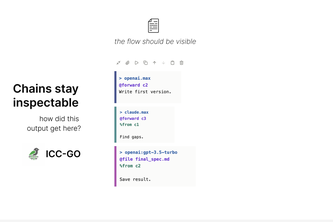
The company appears to be a solo developer project named ICC-GO, which aims to provide a local-first notebook for managing multi-step LLM workflows. The author states that the tool records execution manifests and provenance for each workflow run, including prompts, files, model routes, artifacts, and upstream run IDs.
What changed: The project evolved from an initial idea around "Intent-Cell Coding" during a Build Week hackathon into a more focused implementation of a Run Manifest & Provenance Inspector. This feature records concrete facts behind execution, such as resolved provider/model observations, input attachments, and upstream references.
The single most important open question: Is there any evidence of traction or adoption beyond the author's own development work? The description contains no information about customers, revenue, usage metrics, or market validation.
This analysis is based entirely on self-reported information from the project description. No third-party verification or historical data exists for this project.
What The Product Actually Is
The description states that ICC-GO is:
- A local-first notebook designed for multi-step LLM workflows
- Built with React, TypeScript, Vite, and a local-first workspace model
- Uses an ICC DSL (Domain Specific Language) for authoring workflow intent cells
- Includes a Run Manifest & Provenance Inspector that records execution details after each cell runs
The tool separates workflow authoring from execution through two layers:
- The ICC DSL serves as the readable, compact authoring layer
- Run manifests become the durable record of what was resolved, consumed, produced, and exported
Inferred: The product is a developer tool focused on LLM workflow reproducibility and traceability. It records execution details in a structured way to support inspection and comparison.
Positioning & Claim Evolution
The description states that ICC-GO started from the frustration that "the moment the work becomes multi-step, the transcript stops being a reliable engineering artifact." The author's original idea was around "Intent-Cell Coding" — keeping human-readable intent together with execution details in notebook cells.
Key claims:
- The tool makes each cell rerunnable and inspectable
- It focuses on inspectability and comparability rather than strict reproducibility
- Execution trail is visible enough to support inspection, rerun, comparison, export, and attribution
The positioning evolved from a general "Intent-Cell Coding" concept to a more specific implementation focused on Run Manifest & Provenance Inspector during the Build Week development process.
Inferred: The product positions itself as a solution for developers working with LLM workflows who need traceability and reproducibility without requiring cloud infrastructure or complex setup.
Target Customer & ICP
The description states that ICC-GO is designed for developers working with multi-step LLM workflows. It mentions:
- Developers who start work in chat but then move to multi-step processes
- Users who need to answer questions like "what model route was requested?" or "which file version was used?"
- People wanting to inspect, rerun, compare, export, and attribute workflow results
The author notes that the tool is built for local-first use, suggesting it targets developers who prefer local development environments.
Inferred: The primary customer segment appears to be individual developers or small teams working with LLM workflows in local development settings. The ICP likely includes technical users familiar with LLMs and workflow management.
Business Model & Pricing Evidence
Not evidenced.
The description contains no information about:
- Revenue streams
- Pricing models
- Monetization strategy
- Customer acquisition costs
- Unit economics
No evidence of any business model or pricing structure is provided in the self-reported project description.
Technical & Delivery Signals
The description states that ICC-GO is built with:
- Front-end technologies: React, TypeScript, Vite
- Local-first workspace model
- ICC DSL parsing, runtime planning, run history, artifacts, exports, and inspector UI all live in the front-end codebase
- Codex with GPT-5.6 as the main build partner during development
Key technical signals:
- The app is intentionally split into two layers (authoring vs execution)
- Manifest data model includes concrete facts like resolved provider/model observations, input attachments, and upstream references
- Exportable manifests, artifacts, and attachment indexes are supported
- The tool keeps execution history locally without requiring a hosted backend
Inferred: The technical approach suggests a developer-focused tool with strong local-first capabilities, designed for ease of testing and portability.
Traction & Maturity Signals
Not evidenced.
The description contains no information about:
- Customer base or user adoption
- Revenue or monetization
- Usage metrics or engagement data
- Product maturity or iteration history
- Market traction or validation
The only evidence of activity is the author's own development work during a Build Week hackathon. No external validation or market presence is mentioned.
Competitive Context
Not evidenced.
The description contains no information about:
- Direct competitors
- Market size or growth trends
- Competitive positioning
- Differentiation from existing tools
- Industry landscape
No evidence of competitive analysis or market context is provided in the self-reported project description.
Open Questions & Risks
Key risks identified from the self-reported description:
- Solo developer project: The team size is listed as 1, which raises questions about scalability and long-term maintenance
- No traction evidence: No customers, revenue, or usage data are provided, suggesting limited market validation
- Niche focus: The tool targets a specific subset of LLM workflow management, potentially limiting addressable market
- Local-first approach: While appealing to some developers, this may limit adoption in enterprise settings where centralized solutions are preferred
- Unproven commercial viability: No business model or monetization strategy is described
Inferred: The project appears to be a proof-of-concept or early-stage development effort rather than a mature commercial product.
Questions the description leaves open
- What specific market problem are you solving that existing tools don't address?
- Have you identified any potential customers or use cases beyond your own development work?
- How do you plan to monetize this tool given its local-first nature?
- What is the timeline for product development and when might it be ready for wider adoption?
- Are there any technical limitations of the current implementation that would prevent scaling?
- What are your plans for ongoing maintenance and feature development?
- How do you envision integrating with existing LLM platforms or workflow orchestration tools?
Overall Assessment
Not evidenced.
The description contains no information about:
- Financial performance or projections
- Market opportunity size
- Competitive advantages
- Strategic fit for potential investors or partners
- Exit potential or growth trajectory
No evidence of investment readiness, partnership potential, or commercial viability beyond the author's own development work is provided in the self-reported project description.
User Stories BotA demo video on every pull request
Get a demo video on every new feature
GitHub App that watches your pull requests and records a narrated, captioned demo.
Save time on demo prep and make informed decisions faster with a video walkthrough of every new feature.
Source
Submitted to the OpenAI 2026 hackathon on Devpost. Project home on Devpost. Back to the full gallery on Devpost.
This competitive analysis was produced by top-founders.com (opens in a new tab)
Generated by a language model from this project's public Devpost page — its tagline, the author's own write-up and any built-with tags listed there — as captured in August 2026. Short quotations are the author's words. It is an opinion on the idea as a business, not on the people behind it, and it reflects the description as published then. If the project has moved on, request a correction below. The analysis is not independent research and contains no verified traction, revenue or customer data.
An independent guide by KFG International LLC — not affiliated with, endorsed by, or connected to Devpost or OpenAI.