

Archive position — measured, not model output
0 likes on Devpost
2,263 of the 7,850 archived projects have more likes, and 5,587 share exactly 0 — so this project's #4,571 place in the like-ranked listing is a tie-break inside that group, not a ranking.
Projects (log scale)
Likes on Devpost. ▲ marks this project's group.
Show the figures
| Likes | Projects | Share of archive |
|---|---|---|
| 0 | 5,587 | 71.2% |
| 1 | 1,758 | 22.4% |
| 2 | 284 | 3.6% |
| 3–4 | 132 | 1.7% |
| 5–9 | 75 | 1.0% |
| 10+ | 14 | 0.2% |
 User Stories BotA demo video on every pull request
Get a demo video on every new feature
GitHub App that watches your pull requests and records a narrated, captioned demo.
Save time on demo prep and make informed decisions faster with a video walkthrough of every new feature.
Executive Summary
What the company appears to be
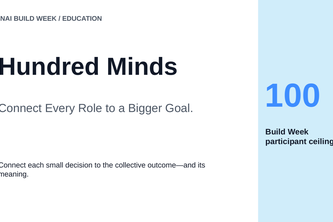
Hundred Minds is a self-reported system designed for group decision-making in events or classes involving up to 100 human participants. It allows participants to submit opinions and rationales via QR code, integrates those inputs using GPT-5.6, and produces a proposal that must be reviewed and approved by a facilitator before becoming public. The system is built with Cloudflare Workers, React, TypeScript, and OpenAI's GPT-5.6.
What changed
The project was developed as part of the OpenAI 2026 hackathon. It demonstrates an end-to-end prototype for aggregating human inputs into a structured AI-generated proposal, with emphasis on preserving individual influence paths and ensuring human oversight.
Single most important open question
Is there evidence that this system can scale beyond its current demo state (100 humans, single facilitator) to support real-world group decision-making processes in larger or more complex environments?
What The Product Actually Is
The description states that Hundred Minds is a system for organizing rationales from up to 100 human participants into common ground, conflicts, constraints, and low-frequency concerns with large consequences. It uses GPT-5.6 to semantically integrate participant inputs and TypeScript to validate the proposal before it becomes public.
- The system allows participants to join via QR code without account creation.
- Participants submit a priority and short rationale.
- A facilitator sets the broad topic and controls admission.
- AI integrates inputs into a proposal, which is then validated by TypeScript and reviewed/approved by a human facilitator.
- Each participant receives only their own influence path from input to outcome.
Evidence The author describes how the system works in detail, including integration of GPT-5.6 with TypeScript validation, use of Cloudflare Workers for deployment, and handling of admission, deadlines, and review processes.
Inference The system appears to be a prototype built for demonstration purposes rather than production use.
Positioning & Claim Evolution
The author states that Hundred Minds is not about gathering exactly 100 people or forcing them into one answer. Instead, it aims to help groups understand how they can move toward a larger goal together and how even small individual roles have meaning within the result.
- The system is positioned as an educational model for reflection, not a predictor of real policy effects.
- It emphasizes collective intelligence without sacrificing individual accountability or human judgment.
- The vision includes dynamic scenario generation from themes, image generation, and AI-generated final judging — but these are future extensions, not implemented features.
Evidence The author explicitly contrasts the system with rigid decision-making tools and positions it as a tool for understanding group dynamics and influence paths.
Inference The positioning suggests an educational or facilitation use case rather than a commercial product.
Target Customer & ICP
The description does not clearly identify a specific target customer or ideal customer profile (ICP). However, the author mentions that the system is intended to support events or classes with roughly 100 people and can be used in settings like mayors, sports managers, idol development, or class environments.
- The primary user roles appear to be facilitators and participants.
- Facilitators control admission, set topics, and approve proposals.
- Participants submit opinions and see their influence paths.
Evidence The author describes the system's intended use cases but does not define a specific customer segment beyond "events or classes with roughly 100 people."
Inference The ICP likely includes event organizers, educators, or facilitators who want to engage groups in structured decision-making processes.
Business Model & Pricing Evidence
There is no evidence of a business model or pricing structure in the description. The project is presented as a hackathon submission with no indication of monetization plans or revenue streams.
Evidence The author focuses on functionality and technical implementation, not commercial viability.
Inference No clear business model is evident from the provided information.
Technical & Delivery Signals
The system is built using:
- Frontend: React, Vite, TypeScript
- Backend: Cloudflare Workers (public and management)
- Database: SQLite-backed Durable Objects and D1 archive
- AI Integration: GPT-5.6 via OpenAI API
- Authentication: Signed HttpOnly cookies, Origin/CSRF validation, room-bound join tokens, Cloudflare Turnstile
Evidence The author describes the architecture, including how data flows through the system, how admission is managed, and how AI outputs are validated.
Inference The technical stack suggests a lightweight, serverless approach suitable for prototyping but not necessarily scalable for enterprise use.
Traction & Maturity Signals
There is no evidence of traction or maturity beyond the hackathon demo. The author notes that:
- A live OpenAI public product E2E was completed with one human participant.
- A 100-client load run has not been completed.
- The system has undergone local testing but lacks real-world deployment data.
Evidence The author explicitly states that no public 100-client run has occurred and that the system is in early-stage development.
Inference The system is at a prototype stage with limited evidence of adoption or scaling capability.
Competitive Context
The description does not mention any competitors. However, the concept aligns with group decision-making tools, collaborative platforms, and AI-assisted facilitation systems. The focus on preserving individual influence paths and human oversight sets it apart from purely automated systems.
Evidence No direct competitor comparison is provided.
Inference The competitive landscape likely includes existing collaboration tools or AI-powered facilitation platforms, though none are named.
Open Questions & Risks
- Scalability Concerns: The system has not been tested at full capacity (100 clients), raising questions about performance and reliability.
- Lack of Commercial Viability: No evidence of a business model or pricing strategy.
- Limited Use Case Scope: The demo focuses on a single scenario (mayor simulation) with fixed parameters, limiting generalizability.
- Dependency on AI Output Authority: Despite validation by TypeScript and human approval, the system still relies heavily on AI-generated outputs for structuring inputs.
Evidence The author acknowledges these limitations in the "Challenges" section.
Inference These risks suggest that the system is not yet ready for commercial deployment or widespread adoption.
Questions the description leaves open
- What are your plans for scaling beyond 100 participants?
- How do you intend to monetize this platform if at all?
- Can you provide more details on how the AI integrates with human decision-making in practice?
- Are there any known limitations or edge cases that have not been addressed in the prototype?
- What kind of feedback have you received from potential users during development?
Overall Assessment
There is insufficient evidence to support a commercial investment or partnership decision. The project is presented as a hackathon demo with no demonstrated traction, revenue, or customer base. While technically impressive for a prototype, it lacks clear commercial viability or scalability indicators.
Evidence The description is self-reported and unverified; there are no third-party sources or data points to validate claims.
Inference Without further evidence of market demand, product-market fit, or scalable architecture, this project does not meet the criteria for serious investment consideration.
User Stories BotA demo video on every pull request
Get a demo video on every new feature
GitHub App that watches your pull requests and records a narrated, captioned demo.
Save time on demo prep and make informed decisions faster with a video walkthrough of every new feature.
Source
Submitted to the OpenAI 2026 hackathon on Devpost. Project home on Devpost. Back to the full gallery on Devpost.
This competitive analysis was produced by top-founders.com (opens in a new tab)
Generated by a language model from this project's public Devpost page — its tagline, the author's own write-up and any built-with tags listed there — as captured in August 2026. Short quotations are the author's words. It is an opinion on the idea as a business, not on the people behind it, and it reflects the description as published then. If the project has moved on, request a correction below. The analysis is not independent research and contains no verified traction, revenue or customer data.
An independent guide by KFG International LLC — not affiliated with, endorsed by, or connected to Devpost or OpenAI.