

Archive position — measured, not model output
1 like on Devpost
505 of the 7,850 archived projects have more likes, and 1,758 share exactly 1 — so this project's #647 place in the like-ranked listing is a tie-break inside that group, not a ranking.
Projects (log scale)
Likes on Devpost. ▲ marks this project's group.
Show the figures
| Likes | Projects | Share of archive |
|---|---|---|
| 0 | 5,587 | 71.2% |
| 1 | 1,758 | 22.4% |
| 2 | 284 | 3.6% |
| 3–4 | 132 | 1.7% |
| 5–9 | 75 | 1.0% |
| 10+ | 14 | 0.2% |
 User Stories BotA demo video on every pull request
Get a demo video on every new feature
GitHub App that watches your pull requests and records a narrated, captioned demo.
Save time on demo prep and make informed decisions faster with a video walkthrough of every new feature.
Executive Summary
What the company appears to be
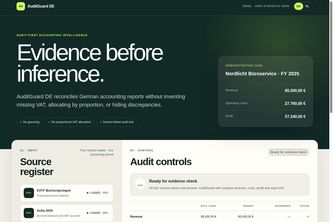
AuditGuard DE is a self-reported prototype system designed to reconcile German accounting reports (EXTF, SuSa, BWA, USt-VA) in an audit-first manner. It does not guess missing values or reconstruct VAT but instead enforces a "hard stop" when discrepancies are detected and identifies the missing evidence.
What changed
The project was submitted as part of the OpenAI 2026 hackathon. The author describes it as a demonstration of how AI can be used to encode expert rules into explicit, testable behavior for accounting reconciliation workflows.
Single most important open question
Is there any evidence that this system has moved beyond a prototype or demonstration stage? The description states it is a "prototype" and a "demo", but does not indicate whether it has been adopted by users or integrated into real-world systems.
Note: This analysis is based solely on the self-reported, unverified project description provided. No independent verification, traction data, revenue figures, or customer information are available.
What The Product Actually Is
The description states that AuditGuard DE is an “interactive, audit-first prototype” for German EÜR and SKR03 workflows. It registers four synthetic source reports—EXTF, SuSa, BWA and USt-VA—and reconciles revenue, operating costs, profit and input VAT.
It enforces a "HARD STOP" when material differences are detected (e.g., EUR 190.00 in input VAT), without estimating or reconstructing missing values. It identifies the missing evidence and withholds final results until all control differences reach zero.
The system is built using React, TypeScript, Next.js, Vite, and uses Codex and GPT-5.6 for development, review and validation.
Inference: The product appears to be a proof-of-concept or demonstration tool, not a production-ready solution. It is described as deterministic and repeatable, with explicit stopping conditions.
Positioning & Claim Evolution
The author positions AuditGuard DE around the principle of “evidence before inference.” This is presented as a core value that distinguishes it from systems that guess missing values or allocate VAT proportionally.
The system is framed as a way to avoid errors caused by unsupported assumptions, unauthorized reconstructions, and guessing. It is described as a method for encoding expert knowledge into explicit rules rather than relying on generative AI alone.
Claim: The system avoids guessing missing VAT or allocating it proportionally.
Inference: This positioning reflects an attempt to address audit risk in German accounting workflows by emphasizing transparency, traceability and compliance over convenience or speed.
Target Customer & ICP
The description does not clearly identify a specific customer segment. However, the system is designed for use within German EÜR (Einnahmen- und Ausgabenrechnung) and SKR03 (Standardkontenrahmen 2003) workflows.
It targets users who work with synthetic or real accounting reports in these formats, particularly those involved in tax audits or compliance processes where accuracy is critical.
Claim: The system supports EXTF, SuSa, BWA and USt-VA reports.
Inference: Based on the context of German accounting standards, potential users may include small-to-medium enterprises (SMEs), accountants or auditors working in Germany.
Business Model & Pricing Evidence
There is no evidence of a business model or pricing structure. The project is described as a public demo and prototype submitted to a hackathon.
Claim: No pricing, monetization or business model details are provided.
Inference: This suggests the project is not yet commercialized or monetized.
Technical & Delivery Signals
The system was built using:
- Frameworks: React, Next.js, TypeScript, Vite
- AI tools: Codex, GPT-5.6
- Deployment: OpenAI Sites
- Interface: Bilingual (English/Polish)
It uses a deterministic workflow to ensure decisions are visible, repeatable and verifiable.
Claim: The system is built with React, TypeScript, Next.js, Vite.
Inference: These technologies suggest a modern web-based prototype, likely intended for demonstration purposes rather than enterprise deployment.
Traction & Maturity Signals
The project is described as a "prototype" and a "demo". It includes downloadable synthetic CSV files and a live interface but lacks any indication of adoption or usage beyond the demo.
Claim: The system is a prototype, not a production-ready tool.
Inference: No evidence of customer base, revenue, or real-world implementation is provided. The project appears to be in early-stage development.
Competitive Context
The description does not mention competitors or existing tools in the German accounting reconciliation space. It focuses on the unique approach of refusing to guess missing values and enforcing strict evidence-based reconciliation.
Claim: No competitive landscape is described.
Inference: The lack of competitor references suggests either limited awareness of existing solutions or that this is a niche or emerging area.
Open Questions & Risks
- Prototype-only status: The system is described as a demo and prototype, with no evidence of real-world adoption or integration.
- No commercialization: No pricing, monetization or business model details are provided.
- Limited scope: It only supports synthetic data and does not yet handle document ingestion or OCR.
- Unverified claims: The author’s own account is self-reported and unverified.
Inference: Without traction, customer feedback, or integration into real systems, the project may be more of a technical experiment than a viable product.
Questions the description leaves open
- Has this prototype been tested with actual users or auditors?
- Are there plans to integrate real document ingestion or OCR capabilities?
- What is the roadmap for moving from prototype to production-ready system?
- How does the system handle edge cases not covered in the demo?
- Is there any interest from accounting firms or tax professionals in adopting this approach?
- Has the author considered regulatory compliance beyond the demonstration?
Overall Assessment
The project is described as a prototype submitted to a hackathon and lacks evidence of traction, revenue, or commercial viability.
Claim: No evidence of investment or partnership interest.
Inference: At this stage, it appears to be an experimental idea rather than a scalable business opportunity. The author’s focus on “evidence before inference” may appeal to compliance-focused users, but without real-world adoption or monetization, the potential for investment or strategic partnership remains unclear.
User Stories BotA demo video on every pull request
Get a demo video on every new feature
GitHub App that watches your pull requests and records a narrated, captioned demo.
Save time on demo prep and make informed decisions faster with a video walkthrough of every new feature.
Source
Submitted to the OpenAI 2026 hackathon on Devpost. Project home on Devpost. Back to the full gallery on Devpost.
This competitive analysis was produced by top-founders.com (opens in a new tab)
Generated by a language model from this project's public Devpost page — its tagline, the author's own write-up and any built-with tags listed there — as captured in August 2026. Short quotations are the author's words. It is an opinion on the idea as a business, not on the people behind it, and it reflects the description as published then. If the project has moved on, request a correction below. The analysis is not independent research and contains no verified traction, revenue or customer data.
An independent guide by KFG International LLC — not affiliated with, endorsed by, or connected to Devpost or OpenAI.