

Archive position — measured, not model output
1 like on Devpost
505 of the 7,850 archived projects have more likes, and 1,758 share exactly 1 — so this project's #1,207 place in the like-ranked listing is a tie-break inside that group, not a ranking.
Projects (log scale)
Likes on Devpost. ▲ marks this project's group.
Show the figures
| Likes | Projects | Share of archive |
|---|---|---|
| 0 | 5,587 | 71.2% |
| 1 | 1,758 | 22.4% |
| 2 | 284 | 3.6% |
| 3–4 | 132 | 1.7% |
| 5–9 | 75 | 1.0% |
| 10+ | 14 | 0.2% |
 User Stories BotA demo video on every pull request
Get a demo video on every new feature
GitHub App that watches your pull requests and records a narrated, captioned demo.
Save time on demo prep and make informed decisions faster with a video walkthrough of every new feature.
Executive Summary
What the company appears to be
HubSpot Blueprint AI is a self-reported tool that uses GPT-5.6 to convert client discovery documents into structured HubSpot implementation blueprints. The author states it aims to reduce hours of manual planning to minutes, and to support consultants in producing consultant-ready deliverables.
What changed
The project description indicates the team built an application using React, TypeScript, TanStack Start, Tailwind CSS, and GPT-5.6 through Lovable AI Gateway. It includes features like structured prompt engineering, runtime validation of AI outputs, and exportable PDFs. The author also notes improvements made via Codex post-initial build.
The single most important open question
Is there any evidence that this tool has been used in real-world consulting engagements or tested with actual clients? The description is entirely self-reported and lacks any traction data, customer feedback, or usage metrics.
What The Product Actually Is
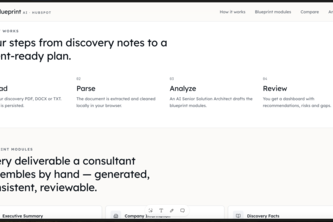
The description states that HubSpot Blueprint AI is an application designed to transform client discovery documents into structured HubSpot implementation blueprints using GPT-5.6. It claims to generate a range of deliverables including:
- Executive Summary
- Discovery Facts
- Business Goals
- Current Challenges
- Recommended HubSpot Hubs
- HubSpot Edition Recommendation
- CRM Architecture
- Sales & Service Pipelines
- Custom Property Recommendations
- Workflow Automation Opportunities
- Integration Recommendations
- Reporting Strategy
- Risks & Assumptions
- Missing Discovery Information
- Implementation Roadmap
- Readiness Score
It also includes an AI Copilot for follow-up questions and a comparison feature for multiple discovery documents. The output can be exported as a professionally formatted PDF.
The application was built using:
- React
- TypeScript
- TanStack Start
- Tailwind CSS
- GPT-5.6 (via Lovable AI Gateway)
- Zod for runtime validation
It sends structured prompts to GPT-5.6 and requests structured JSON responses, which are validated before rendering.
Positioning & Claim Evolution
The author positions HubSpot Blueprint AI as an AI-powered assistant that accelerates the HubSpot implementation process by converting unstructured discovery notes into consultant-ready deliverables.
Key claims:
- It reduces hours of planning to just minutes.
- It produces structured, transparent, and consultant-friendly recommendations.
- It supports real consulting workflows.
- It improves consistency, transparency, and implementation quality.
The project evolved from a personal need identified by the author — the time-consuming nature of manual blueprint creation in HubSpot implementations. The evolution includes:
- Initial development using React and GPT-5.6
- Refactoring with Codex for improved engineering quality
- Introduction of runtime validation to ensure reliability
There is no evidence of prior versions or iterations beyond this single submission.
Target Customer & ICP
The description states that the tool targets consultants working on HubSpot implementations. These are likely:
- HubSpot consultants or agencies
- Individuals or teams responsible for planning CRM architecture and automations
- Professionals who conduct discovery workshops and produce implementation blueprints
The author notes that the tool is designed to support "real consulting engagements" and improve "consultant-friendly recommendations."
No specific customer segments, personas, or buyer roles are detailed beyond this general category.
Business Model & Pricing Evidence
There is no evidence of a business model or pricing structure in the description. The project is presented as a hackathon submission with no mention of monetization, subscriptions, licensing, or revenue streams.
Technical & Delivery Signals
The application was built using:
- React
- TypeScript
- TanStack Start
- Tailwind CSS
- GPT-5.6 (via Lovable AI Gateway)
- Zod for runtime validation
Key technical elements include:
- Structured prompts sent to GPT-5.6
- Requested structured JSON responses
- Runtime validation of AI outputs before rendering
- Use of Codex post-initial build for codebase improvements
The author notes engineering enhancements such as:
- Centralized AI Gateway logic
- Shared upload validation utilities
- Standardized error handling
- Improved TypeScript typing
- Accessibility improvements
- Production-readiness review
Traction & Maturity Signals
There is no evidence of traction, adoption, or usage beyond the project description. The author states that this was submitted to the OpenAI 2026 hackathon and does not provide any data on:
- Number of users
- Customer feedback
- Revenue
- Product usage metrics
- Market validation
The tool appears to be a prototype or proof-of-concept, not yet in production use.
Competitive Context
The description does not mention competitors or similar tools. It is unclear whether there are existing solutions that perform similar functions in the HubSpot implementation space.
No competitive analysis or differentiation strategy is provided.
Open Questions & Risks
- Unverified claims: All stated benefits (e.g., reducing hours to minutes) are self-reported and unverified.
- No traction evidence: No data on usage, customers, or adoption.
- Limited scope: The tool is presented as a single-purpose solution for discovery-to-blueprint conversion.
- Dependency on AI output quality: Reliance on GPT-5.6 with structured prompts may not scale reliably without further validation.
- Hackathon origin: The project was submitted to a hackathon, suggesting it may be early-stage or experimental.
Questions the description leaves open
- Has the tool been tested in real consulting engagements?
- What is the current level of accuracy and reliability of AI-generated outputs?
- Are there any known limitations or edge cases where the tool fails to produce useful results?
- How does the tool handle discrepancies between discovery documents and generated blueprints?
- Is there a plan for integrating directly with HubSpot’s API or other CRM tools?
- What is the intended pricing model, if any?
- Are there any early adopters or pilot users?
Overall Assessment
Not evidenced.
The project description provides no information on:
- Revenue
- Customers
- Traction
- Market size
- Financials
- Team experience
- Product-market fit
This is a self-reported hackathon submission with no evidence of commercial viability or market validation. The tool appears to be an early-stage prototype, and there is no indication that it has moved beyond the idea or proof-of-concept stage.
The author states that the project was submitted to the OpenAI 2026 hackathon — this does not imply any commercial traction or investment interest.
Confidence level Low. The entire analysis is based on a single, unverified self-description.
User Stories BotA demo video on every pull request
Get a demo video on every new feature
GitHub App that watches your pull requests and records a narrated, captioned demo.
Save time on demo prep and make informed decisions faster with a video walkthrough of every new feature.
Source
Submitted to the OpenAI 2026 hackathon on Devpost. Project home on Devpost. Back to the full gallery on Devpost.
This competitive analysis was produced by top-founders.com (opens in a new tab)
Generated by a language model from this project's public Devpost page — its tagline, the author's own write-up and any built-with tags listed there — as captured in August 2026. Short quotations are the author's words. It is an opinion on the idea as a business, not on the people behind it, and it reflects the description as published then. If the project has moved on, request a correction below. The analysis is not independent research and contains no verified traction, revenue or customer data.
An independent guide by KFG International LLC — not affiliated with, endorsed by, or connected to Devpost or OpenAI.