

Archive position — measured, not model output
0 likes on Devpost
2,263 of the 7,850 archived projects have more likes, and 5,587 share exactly 0 — so this project's #4,526 place in the like-ranked listing is a tie-break inside that group, not a ranking.
Projects (log scale)
Likes on Devpost. ▲ marks this project's group.
Show the figures
| Likes | Projects | Share of archive |
|---|---|---|
| 0 | 5,587 | 71.2% |
| 1 | 1,758 | 22.4% |
| 2 | 284 | 3.6% |
| 3–4 | 132 | 1.7% |
| 5–9 | 75 | 1.0% |
| 10+ | 14 | 0.2% |
 User Stories BotA demo video on every pull request
Get a demo video on every new feature
GitHub App that watches your pull requests and records a narrated, captioned demo.
Save time on demo prep and make informed decisions faster with a video walkthrough of every new feature.
Executive Summary
What the company appears to be
Hold Up, as described by its authors, is a tool that creates a durable, source-backed personal context layer for AI agents. It ingests information from sources like GitHub and Gmail, transforms it into structured "Artifacts", and makes this context available via an MCP (Model Context Protocol) server so that AI tools can retrieve it.
What changed
The project description reflects a self-reported development effort focused on solving the problem of AI agents lacking persistent, source-backed context. It was built as part of the OpenAI 2026 hackathon and is presented as a proof-of-concept with a functional dashboard and MCP integration.
Single most important open question
Is there evidence that Hold Up has achieved any meaningful adoption or traction from users beyond its creators? The description does not state whether it has customers, revenue, or even a deployed product in use by others.
What The Product Actually Is
The description states that Hold Up:
- Turns information from GitHub, Gmail, and imported chats into "source-backed Artifacts" such as projects, documents, decisions, tasks, and deadlines.
- Exposes this context through an MCP server so AI agents can retrieve it using tools like
get_context,search_sources,list_artifacts, andlist_conversations. - Stores context in an encrypted local data store as source records, Artifacts, relationships, and activity history.
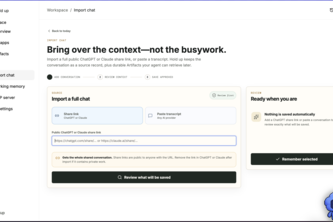
- Allows users to import chat transcripts or public share links, connect apps, review extracted context, and save only the information they approve.
Inference The product appears to be a personal AI context layer that enables agents to access persistent, structured work-related information without re-explaining it each time. It is built with React, TypeScript, Node.js, and Vite for the UI, and includes an MCP server component.
Positioning & Claim Evolution
The description states:
- Hold Up was inspired by the frustration of repeatedly explaining projects, decisions, and past conversations to AI tools.
- It aims to create a "durable personal context layer" so agents can understand your work without starting from zero.
- The authors claim that Hold Up makes AI context "durable, reviewable, and source-backed."
- They also state that good AI context is not about storing everything but preserving what remains useful after the original source has passed.
Inference The positioning appears to be a solution for individuals or teams who want to improve how AI agents interact with their personal or team knowledge. It positions itself as an alternative to AI tools that treat memory as a black box, offering transparency and control over what is stored and retrieved.
Target Customer & ICP
The description states:
- Hold Up targets users who work with AI agents and want to avoid repeating explanations.
- It is designed for people who use GitHub, Gmail, and chat tools and want their AI assistants to understand their context.
Inference The target customer seems to be developers or knowledge workers who use AI tools regularly and are frustrated by the lack of persistent context. The ICP likely includes early adopters of AI agents who value personal productivity and control over their data.
Business Model & Pricing Evidence
The description does not state:
- Whether Hold Up has a business model.
- Whether it charges for its service or is free to use.
- If there are any pricing tiers or monetization strategies.
Not evidenced.
Technical & Delivery Signals
The description states:
- The dashboard was built with React, TypeScript, Vite, and Node.js API.
- Context is stored in an encrypted local data store.
- An MCP server was built so AI tools like Cursor and Claude can use the saved context.
- Users can import chat transcripts or public share links, connect apps, review extracted context, and save only approved information.
- Challenges included synchronizing the dashboard, saved context, and MCP server.
- The team learned that Artifacts must be available to agents through MCP, not just visible in the UI.
Inference The product is a technical prototype with a local-first architecture. It integrates with existing AI tools via MCP, suggesting it's built for developers or advanced users who can work with such protocols. The focus on encryption and user control over what is saved suggests an emphasis on privacy and data sovereignty.
Traction & Maturity Signals
The description states:
- This project was submitted to the OpenAI 2026 hackathon.
- It was built by a team of two (Nachiketh Nandish, Shravan Sithambaram).
- The authors claim accomplishments such as making AI context durable and reviewable.
- They also mention what they learned and what’s next for Hold Up.
Not evidenced No evidence of revenue, customers, or product adoption beyond the hackathon submission. There is no indication that Hold Up has been used by others or deployed in production.
Competitive Context
The description does not state:
- Who the competitors are.
- Whether similar tools exist in the market.
- How Hold Up differentiates from other AI context management solutions.
Not evidenced.
Open Questions & Risks
- No traction: The project is described as a hackathon submission with no evidence of adoption or revenue.
- Limited team size: Only two members, which may limit execution and scalability.
- Self-reported only: All claims are unverified and based on the authors' own account.
- Unclear business model: No indication of monetization or sustainability.
- Technical complexity: The integration with MCP and local data storage suggests a niche audience, possibly limiting market reach.
Questions the description leaves open
- What is the current status of Hold Up beyond the hackathon? Is it being used by others?
- How does Hold Up handle data privacy and user control in practice?
- Are there any plans for monetization or a business model?
- Has the team identified specific users or use cases where Hold Up has been tested?
- What are the technical challenges that remain unresolved, especially around synchronization and deletion reliability?
Overall Assessment
Not evidenced.
The description does not provide sufficient evidence to assess whether Hold Up is a viable investment or partnership opportunity. It lacks data on traction, revenue, customers, or even a clear path to market. The project appears to be an early-stage prototype with no demonstrated commercial viability or user adoption.
User Stories BotA demo video on every pull request
Get a demo video on every new feature
GitHub App that watches your pull requests and records a narrated, captioned demo.
Save time on demo prep and make informed decisions faster with a video walkthrough of every new feature.
Source
Submitted to the OpenAI 2026 hackathon on Devpost. Project home on Devpost. Back to the full gallery on Devpost.
This competitive analysis was produced by top-founders.com (opens in a new tab)
Generated by a language model from this project's public Devpost page — its tagline, the author's own write-up and any built-with tags listed there — as captured in August 2026. Short quotations are the author's words. It is an opinion on the idea as a business, not on the people behind it, and it reflects the description as published then. If the project has moved on, request a correction below. The analysis is not independent research and contains no verified traction, revenue or customer data.
An independent guide by KFG International LLC — not affiliated with, endorsed by, or connected to Devpost or OpenAI.