

Archive position — measured, not model output
1 like on Devpost
505 of the 7,850 archived projects have more likes, and 1,758 share exactly 1 — so this project's #1,191 place in the like-ranked listing is a tie-break inside that group, not a ranking.
Projects (log scale)
Likes on Devpost. ▲ marks this project's group.
Show the figures
| Likes | Projects | Share of archive |
|---|---|---|
| 0 | 5,587 | 71.2% |
| 1 | 1,758 | 22.4% |
| 2 | 284 | 3.6% |
| 3–4 | 132 | 1.7% |
| 5–9 | 75 | 1.0% |
| 10+ | 14 | 0.2% |
 User Stories BotA demo video on every pull request
Get a demo video on every new feature
GitHub App that watches your pull requests and records a narrated, captioned demo.
Save time on demo prep and make informed decisions faster with a video walkthrough of every new feature.
Executive Summary
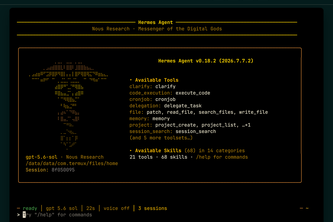
The company appears to be a single-person project (team size: 1) that self-reports building an Android-based version of the Hermes agent, running in a web browser via Termux, using ChatGPT Codex for development assistance. The author states this is a fork of the Hermes web server modified to work on Android, and describes it as self-hosted and on-premise.
The project is described as a hackathon submission (OpenAI 2026 hackathon) with no evidence of revenue, customers, or commercial traction. It is not clear whether this represents an early-stage prototype, a proof-of-concept, or a product in development.
The single most important open question: Is this project intended to be a commercial product or a personal experiment? The description does not clarify if the author intends to build a scalable, monetizable offering or if it is a one-off technical demonstration.
What The Product Actually Is
- The description states that the project is "Hermes Agent Android", which runs a full Hermes agent on Android via a web browser using Termux app.
- It is described as a fork of the Hermes web server, modified to work on Android, and designed to run in a web browser environment.
- The project uses ChatGPT Codex for development assistance.
- The author reports that it is self-hosted and on-premise.
- The system is said to be "connected to ChatGPT Codex 5.6-Sol", though the exact nature of this connection is not specified.
Not evidenced: What the Hermes agent actually does beyond running in a browser, or whether it integrates with other tools or services.
Positioning & Claim Evolution
- The author states that the project "runs full Hermes agent on Android from a web browser using Termux app."
- It is described as a fork of Hermes that modifies the web server to work on Android.
- The author claims it is self-hosted and on-premise, which implies a focus on local execution without cloud dependency.
- The project is positioned as an extension or improvement over existing tools like Pi Agent and OpenClaw, with the author stating:
"The quality is much better than OpenClaw or Pi agent alone."
- It is described as a personal experiment submitted to a hackathon, not as a commercial product.
Not evidenced: Whether this is a repositioning of an existing tool or a new offering. No claims about market fit, competitive differentiation, or strategic positioning beyond personal experimentation.
Target Customer & ICP
- The description does not state the target customer or ideal customer profile (ICP).
- It is described as a personal project by one individual.
- The author mentions running it on Android, suggesting a mobile-first or mobile-focused user base.
- No information is provided about:
- Who would use this product
- What problem it solves for users
- Whether the target audience is developers, end-users, or enterprise customers
Not evidenced: The intended customer segment or use case beyond personal experimentation.
Business Model & Pricing Evidence
- The description does not include any information about a business model.
- No pricing structure, monetization strategy, or revenue streams are mentioned.
- The project is described as self-hosted and on-premise, which may imply no direct monetization via the product itself.
- There is no mention of subscriptions, licensing, or usage fees.
Not evidenced: Business model, pricing, or monetization strategy.
Technical & Delivery Signals
- The system runs in a web browser using Termux app on Android.
- It uses ChatGPT Codex 5.6-Sol for development assistance.
- The author reports that the original xterm js was unusable, and that UI was cleaned up with ChatGPT Codex to provide a more Termux-like experience.
- The UI includes speech-to-text support via Google keyboard.
- It is described as resource-intensive, with memory issues noted.
- The author mentions future plans to connect a local llama cpp server for full sovereign AI computing.
Inferred: The project is technically experimental and built in a constrained environment (mobile). No evidence of scalability, performance optimization, or production-grade delivery.
Traction & Maturity Signals
- This is described as a hackathon submission.
- The author states they have built 3 apps with Hermes agent so far, suggesting iterative development.
- There is no evidence of:
- Customers
- Revenue
- Usage metrics
- Product adoption or retention
- Product maturity beyond prototype stage
Not evidenced: Traction, usage data, or product maturity.
Competitive Context
- The author references Pi Agent and OpenClaw as prior tools they have used.
- It is described as an improvement over these tools, with better quality.
- No mention of other competitors or market positioning beyond comparison to existing agents.
- No evidence of competitive analysis, market share, or differentiation from other AI agent platforms.
Not evidenced: Competitive landscape, market positioning, or differentiation strategy.
Open Questions & Risks
- The project is described as a single-person effort, with no team or organizational structure.
- It is a hackathon submission, suggesting it may be experimental or not intended for commercial use.
- The system is resource-intensive and prone to memory issues, which may limit scalability.
- No evidence of:
- Product-market fit
- Commercial viability
- Long-term roadmap or sustainability
- Technical support or maintenance plans
Inferred: High risk of being a non-commercial prototype with limited scalability or long-term viability.
Questions the description leaves open
- What is the intended use case for this product beyond personal experimentation?
- Is there a plan to monetize or commercialize this project?
- How does it compare to existing AI agent platforms in terms of functionality, performance, and usability?
- Are there any plans for scalability or support for multiple devices or users?
- What are the technical limitations or bottlenecks that prevent broader adoption?
Overall Assessment
- The project is described as a single-person hackathon submission, with no evidence of commercial traction, customers, or revenue.
- It is not clear whether this represents a product in development or an experimental prototype.
- The author's claims are self-reported and unverified; there is no independent validation of performance, scalability, or market demand.
- No evidence of:
- Product-market fit
- Business model
- Team capability or organizational structure
- Long-term vision or roadmap
Assessment: Not suitable for investment or partnership at this stage. The project appears to be an experimental prototype with no demonstrated commercial viability or traction. Further information is needed to assess whether this is a viable product in development or simply a personal experiment.
User Stories BotA demo video on every pull request
Get a demo video on every new feature
GitHub App that watches your pull requests and records a narrated, captioned demo.
Save time on demo prep and make informed decisions faster with a video walkthrough of every new feature.
Source
Submitted to the OpenAI 2026 hackathon on Devpost. Project home on Devpost. Back to the full gallery on Devpost.
This competitive analysis was produced by top-founders.com (opens in a new tab)
Generated by a language model from this project's public Devpost page — its tagline, the author's own write-up and any built-with tags listed there — as captured in August 2026. Short quotations are the author's words. It is an opinion on the idea as a business, not on the people behind it, and it reflects the description as published then. If the project has moved on, request a correction below. The analysis is not independent research and contains no verified traction, revenue or customer data.
An independent guide by KFG International LLC — not affiliated with, endorsed by, or connected to Devpost or OpenAI.