

Archive position — measured, not model output
1 like on Devpost
505 of the 7,850 archived projects have more likes, and 1,758 share exactly 1 — so this project's #1,175 place in the like-ranked listing is a tie-break inside that group, not a ranking.
Projects (log scale)
Likes on Devpost. ▲ marks this project's group.
Show the figures
| Likes | Projects | Share of archive |
|---|---|---|
| 0 | 5,587 | 71.2% |
| 1 | 1,758 | 22.4% |
| 2 | 284 | 3.6% |
| 3–4 | 132 | 1.7% |
| 5–9 | 75 | 1.0% |
| 10+ | 14 | 0.2% |
 User Stories BotA demo video on every pull request
Get a demo video on every new feature
GitHub App that watches your pull requests and records a narrated, captioned demo.
Save time on demo prep and make informed decisions faster with a video walkthrough of every new feature.
Executive Summary
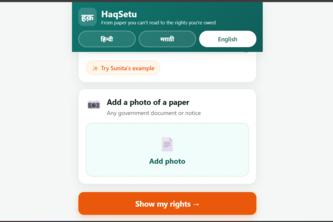
What the company appears to be: HaqSetu is a self-reported AI-powered tool designed for rural poor in India — particularly farmers, widows, daily-wage workers, and first-generation students — to help them claim government benefits (pensions, scholarships, rations) they are legally entitled to but often miss due to literacy barriers. It allows users to speak or type into the system, photograph documents, and receive a filled-out, ready-to-submit claim dossier in their own language.
What changed: The project is presented as an original solution built by one person (Radhika Audichya) for a specific social problem — the gap between legal entitlements and actual access due to illiteracy and lack of understanding of bureaucratic processes. It uses multimodal AI, multi-agent orchestration, and structured output validation to avoid hallucinations and ensure verifiability.
Single most important open question: Is HaqSetu capable of reliably delivering real-world impact at scale, or is it a proof-of-concept that works in controlled conditions but cannot be replicated for millions of users?
Note: This analysis is based entirely on the self-reported project description provided by the author. No external verification, traction data, revenue figures, customer names, or independent sources are available.
What The Product Actually Is
The description states that HaqSetu is a system that:
- Accepts spoken input and photographed documents from users.
- Decodes official government documents in the user’s language.
- Identifies what benefits the user qualifies for, citing specific rules.
- Fills real government PDF forms with verified data.
- Delivers a "Claim Dossier" — a verifiable packet of completed paperwork.
It is not described as a chatbot. Instead, it is built around a multi-agent pipeline with structured outputs and a verifier that enforces citations for every claim.
Inference: The system uses OpenAI Codex + GPT-5.6 in combination with a deterministic rules engine to process inputs and generate outputs. It is designed to avoid hallucinations by structuring model use so that only facts are generated, not opinions or invented data.
Positioning & Claim Evolution
The author positions HaqSetu as:
- A bridge between the user and their legal rights.
- Not a convenience app, but a solution to systemic exclusion.
- Built for rural poor, not general public.
- Designed to close the gap between digitized services and those who can’t access them due to literacy or language.
The project evolved from a personal observation — a widow named Sunita who was denied benefits because she couldn't read forms or understand processes. The author explicitly rejected building a "chatbot" or an app that just tells people they might be eligible; instead, HaqSetu aims to deliver the filled form.
Claim: “No one should lose what they are legally owed simply because they cannot read a form.”
This is a strong positioning statement but not verified in terms of impact or adoption.
Target Customer & ICP
The description identifies the following as primary users:
- Farmers
- Widows
- Daily-wage workers
- First-generation students
These individuals are described as being:
- Poor
- Literate or non-literate
- Often without access to fieldworkers or intermediaries
- Living in rural areas, where digital literacy and language barriers are high
The ICP is defined by:
- Low literacy
- Need for government benefits
- Limited access to formal processes
- Use of basic smartphones (shared within households)
Not evidenced: No explicit segmentation beyond these groups, no customer personas, or demographic breakdowns.
Business Model & Pricing Evidence
There is no evidence in the description of a business model or pricing strategy. The project is described as a hackathon submission and not as a commercial product.
Claim: The system is built for social good, not monetization.
This is stated but not substantiated with any revenue or monetization plan.
Technical & Delivery Signals
Key technical elements mentioned:
- Built using:
- TypeScript + Express
- Multi-agent pipeline (intake → decoder → entitlement → action → verifier)
- pdf-lib for filling real PDFs
- Zod schemas for structured output validation
- OpenAI Codex + GPT-5.6
- Speech recognition and synthesis APIs
- Computer vision for document reading
The system is described as:
- Structured to avoid hallucinations through:
- Rules engine at the core
- Citation invariant (every claim must cite a rule)
- Tool-calling to select form fields rather than generate them
- Schema validation at every boundary
Inference: The architecture is designed with trust and reproducibility in mind, not just performance or scalability.
Traction & Maturity Signals
There is no evidence of traction, customers, usage metrics, or product maturity beyond the single-person development effort. The project is described as a hackathon submission.
Claim: "This is not a convenience app" — implies intent to scale but no data to support it.
No mention of pilot programs, user testing, or real-world deployment.
Competitive Context
The description does not reference any existing competitors. It focuses on the gap in service delivery for rural poor and how AI can help close that gap.
Inference: The space likely includes government digital platforms, NGOs, and possibly other AI-based tools aimed at improving access to benefits — but no direct comparison or competitive analysis is provided.
Open Questions & Risks
- No real-world testing or deployment — only a hackathon prototype.
- Single developer — raises questions about scalability and long-term maintenance.
- High technical constraints — reliance on structured outputs, model limitations, and PDF handling may not scale.
- Dependency on government rule data — if rules change, the system must be updated manually or via API.
- Limited language support — only one language is implied (likely Hindi or local dialects), which could limit reach.
- Trust in model outputs — even with schema validation, there may still be edge cases where hallucination occurs.
Open question: The system is described as a "bridge" but lacks any evidence of being used by real people beyond the author’s own testing.
Questions the description leaves open
- What are the actual government rules and data sources used for eligibility checks?
- How does the system handle changes in benefit schemes or updates to eligibility criteria?
- Has the system been tested with real users in rural settings?
- Are there plans to expand beyond the current set of schemes?
- What is the long-term vision for scaling this solution?
- How will the system be maintained and updated without constant developer involvement?
- What are the legal or compliance risks around using AI to make eligibility determinations?
Overall Assessment
Not evidenced: No financials, no funding history, no traction, no clear path to monetization.
Assessment: This is a compelling idea with strong social intent and technical rigor. However, it remains a proof-of-concept, not a product in the market. It has potential for impact but requires significant development, testing, and validation before any investment or partnership consideration.
The author states that this was built under resource constraints and with a focus on correctness over breadth — which is commendable, but also raises questions about whether it can be scaled to meet real-world demand.
Confidence level: Low. The description is self-reported and unverified; no evidence of traction, revenue, or customer adoption.
User Stories BotA demo video on every pull request
Get a demo video on every new feature
GitHub App that watches your pull requests and records a narrated, captioned demo.
Save time on demo prep and make informed decisions faster with a video walkthrough of every new feature.
Source
Submitted to the OpenAI 2026 hackathon on Devpost. Project home on Devpost. Back to the full gallery on Devpost.
This competitive analysis was produced by top-founders.com (opens in a new tab)
Generated by a language model from this project's public Devpost page — its tagline, the author's own write-up and any built-with tags listed there — as captured in August 2026. Short quotations are the author's words. It is an opinion on the idea as a business, not on the people behind it, and it reflects the description as published then. If the project has moved on, request a correction below. The analysis is not independent research and contains no verified traction, revenue or customer data.
An independent guide by KFG International LLC — not affiliated with, endorsed by, or connected to Devpost or OpenAI.