

Archive position — measured, not model output
1 like on Devpost
505 of the 7,850 archived projects have more likes, and 1,758 share exactly 1 — so this project's #1,174 place in the like-ranked listing is a tie-break inside that group, not a ranking.
Projects (log scale)
Likes on Devpost. ▲ marks this project's group.
Show the figures
| Likes | Projects | Share of archive |
|---|---|---|
| 0 | 5,587 | 71.2% |
| 1 | 1,758 | 22.4% |
| 2 | 284 | 3.6% |
| 3–4 | 132 | 1.7% |
| 5–9 | 75 | 1.0% |
| 10+ | 14 | 0.2% |
 User Stories BotA demo video on every pull request
Get a demo video on every new feature
GitHub App that watches your pull requests and records a narrated, captioned demo.
Save time on demo prep and make informed decisions faster with a video walkthrough of every new feature.
Executive Summary
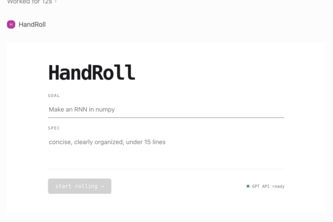
What the company appears to be: HandRoll is a self-reported micro-IDE that runs inside Codex/ChatGPT as a "ChatGPT app". The author describes it as a minimal text editor with agentic feedback and chain-of-thought (COT) capabilities, designed to challenge users to write code directly while providing rich next-line suggestions and expert guidance.
What changed: The project was submitted to the OpenAI 2026 hackathon. It represents an experimental approach to integrating coding tools into large language model interfaces, with a focus on educational or learning-oriented interaction patterns.
Single most important open question: Is there evidence of user engagement or adoption beyond the author's own development and submission? The description does not indicate any actual users, customers or revenue — only the author's own account of building and submitting the tool.
Note: This analysis is based entirely on self-reported information provided by the author. No independent verification or external data has been used. All claims are attributed to the project description supplied.
What The Product Actually Is
The description states that HandRoll is a "micro-IDE that lives inside Codex/ChatGPT as a 'ChatGPT app'". It functions as a minimal, barebones text editor with agentic feedback and chain-of-thought (COT). Unlike other tools that generate code directly, it challenges users to write scripts themselves while offering next-line suggestions and expert guidance.
It was built using Codex over the course of one week and is designed to compose directly into Codex as an MCP app.
Inference: The product appears to be a prototype or proof-of-concept tool for integrating coding environments within chat-based AI interfaces. It is not described as a finished commercial product, but rather as a hackathon submission.
Positioning & Claim Evolution
The author claims that HandRoll "inverts the usual agentic workflow" and promotes direct user engagement with code. Instead of generating code automatically, it encourages users to write scripts and provides intelligent feedback through COT.
It was initially inspired by education/edutech, aiming to create a memorization app using techniques from pretraining and RLHF for individual learners. However, the author pivoted toward building a better tool, retaining only the idea of agentic COT as "teacher" for a human "learner".
Claim: The positioning is educational or learning-oriented, but not yet proven in practice.
Inference: The evolution shows an iterative design process where the original vision was refined into something more focused on usability and interaction within AI interfaces.
Target Customer & ICP
The description does not clearly identify a specific target customer or ideal customer profile (ICP). It implies that users are those who interact with Codex/ChatGPT, particularly those interested in learning or improving their coding skills through direct engagement rather than automated generation.
Claim: The intended audience is likely developers or learners using AI-assisted coding environments.
Absence of evidence: No explicit segmentation, personas or user types are mentioned.
Business Model & Pricing Evidence
There is no evidence of a business model or pricing structure in the description. The project is presented as a hackathon submission and not described as having any monetization strategy or commercial offering.
Not evidenced
Technical & Delivery Signals
The author built the app using Codex over one week, and it is designed to compose directly into Codex as an MCP app. Challenges included perfecting the MCP roundtrip and working with new features in Codex.
Claim: The technical implementation uses Codex and MCP (Model Control Protocol) for integration.
Inference: This suggests a lightweight, API-driven approach to embedding tools within chat interfaces.
Traction & Maturity Signals
There is no evidence of traction or maturity beyond the author’s own development and submission. No customers, users, revenue, or adoption data are provided.
Not evidenced
Competitive Context
The description does not mention competitors or a competitive landscape. It focuses on how HandRoll differs from "vibe coding tools" that directly author generative code, but no comparison to existing products is made.
Not evidenced
Open Questions & Risks
- No traction: The project is described only as a hackathon submission with no evidence of usage or adoption.
- Unproven value proposition: While the idea of combining learning and coding is stated, there is no demonstration of effectiveness or impact.
- Limited scope: Built by one person (team size = 1), suggesting limited resources for scaling or further development.
- Unclear commercial viability: No indication of monetization, market fit, or path to product-market fit.
Inference: The lack of any user data, revenue, or customer feedback raises concerns about whether the tool meets real needs beyond personal experimentation.
Questions the description leaves open
- What specific problem are you solving for users in the context of AI-assisted coding?
- Have you tested this with actual users? If so, what were their reactions?
- How do you plan to scale beyond a single-person development effort?
- Are there any early adopters or pilot programs?
- What is your roadmap for monetization or commercial deployment?
Overall Assessment
There is insufficient evidence to support an investment or partnership decision. The project is presented as a hackathon submission with no demonstrated traction, revenue, or customer base.
Not evidenced
Confidence level: Low — based entirely on self-reported claims without external validation or usage data.
User Stories BotA demo video on every pull request
Get a demo video on every new feature
GitHub App that watches your pull requests and records a narrated, captioned demo.
Save time on demo prep and make informed decisions faster with a video walkthrough of every new feature.
Source
Submitted to the OpenAI 2026 hackathon on Devpost. Project home on Devpost. Back to the full gallery on Devpost.
This competitive analysis was produced by top-founders.com (opens in a new tab)
Generated by a language model from this project's public Devpost page — its tagline, the author's own write-up and any built-with tags listed there — as captured in August 2026. Short quotations are the author's words. It is an opinion on the idea as a business, not on the people behind it, and it reflects the description as published then. If the project has moved on, request a correction below. The analysis is not independent research and contains no verified traction, revenue or customer data.
An independent guide by KFG International LLC — not affiliated with, endorsed by, or connected to Devpost or OpenAI.