

Archive position — measured, not model output
1 like on Devpost
505 of the 7,850 archived projects have more likes, and 1,758 share exactly 1 — so this project's #1,169 place in the like-ranked listing is a tie-break inside that group, not a ranking.
Projects (log scale)
Likes on Devpost. ▲ marks this project's group.
Show the figures
| Likes | Projects | Share of archive |
|---|---|---|
| 0 | 5,587 | 71.2% |
| 1 | 1,758 | 22.4% |
| 2 | 284 | 3.6% |
| 3–4 | 132 | 1.7% |
| 5–9 | 75 | 1.0% |
| 10+ | 14 | 0.2% |
 User Stories BotA demo video on every pull request
Get a demo video on every new feature
GitHub App that watches your pull requests and records a narrated, captioned demo.
Save time on demo prep and make informed decisions faster with a video walkthrough of every new feature.
Executive Summary
What the company appears to be
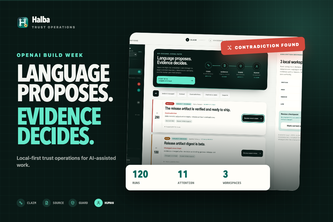
Halba is a self-reported local-first trust operations control plane that processes AI-generated code changes and evaluates their verifiability using deterministic guards and evidence policies. It presents a ranked "Trust Inbox" of claims from agent workspaces, with each item routed to its exact source or proof boundary.
What changed
The project evolved from an initial inspiration around AI agents needing a Slack alternative, into a system that separates inference (model output) from proof authority (deterministic evidence validation). It is described as a dependency-free Node.js application with static browser frontend and local JSON-based storage.
The single most important open question
Does Halba's approach to separating inference from proof authority actually improve trustworthiness in practice, or does it merely shift the problem of verifying AI outputs into a new form of manual review?
Note: This analysis is based solely on the self-reported project description provided by the author. No independent verification, traction data, revenue figures, customer names, or third-party evidence are available.
What The Product Actually Is
The description states that Halba is:
- A local-first trust operations control plane
- A dependency-free Node.js application with static browser frontend
- Designed to turn risky completion claims across local workspaces into a "Trust Inbox"
- Built using openai responses api, gpt-5.6 sol, codex, node.js, html, css, javascript, local json, sqlite, docker, github pages, and remotion for the submission film
Inferred from the description:
- It operates on local workspaces
- It uses deterministic guards to validate claims
- It provides a "Proof Mode" interface for human review
- It processes agent reports and validates source references
- It does not store raw transcripts or arbitrary command output
- It treats model output as untrusted structured input
Not evidenced:
- Specific functionality beyond what is described in the write-up
- Technical architecture details beyond what is stated
- Any actual implementation or runtime behavior outside of the author's account
Positioning & Claim Evolution
The description states that Halba:
- Is an independent interpretation of "I don't have time to build these things, will you?" (inspired by Theo Browne)
- Is not another agent chat surface but the proof layer after the run
- Turns risky completion claims into a Trust Inbox
- Ranks contradictions, unsupported or stale proof, changed evidence, expired decisions, degraded imports, failed guards, and dependency impact
- Does not give model prose ranking or approval authority
Inferred from the description:
- The positioning evolved from an agent chat surface to a post-run verification system
- It emphasizes deterministic evidence over confidence scores
- It separates inference from proof authority as a core design principle
- It aims to reduce channel attention by closing gates when decisions are made
Not evidenced:
- Any market positioning beyond the author's own claims
- Competitor comparisons or differentiation strategies
- Historical evolution of the product concept beyond this single submission
Target Customer & ICP
The description states:
- The target is users working with AI coding agents who need to validate their outputs
- It operates on local workspaces
- It targets those who want to find out which claims are supported, stale, contradicted, or still need a person
- It is designed for agent workspace environments similar to Slack
Inferred from the description:
- The primary user is likely a developer or engineer working with AI agents in code development
- It serves teams that require verification of AI-generated changes
- It targets users who want to reduce false positives and ensure quality control in AI workflows
Not evidenced:
- Specific customer personas beyond what is implied by the author's own description
- Any actual customer base or user feedback
- Market size or segment analysis
- Pricing or adoption strategy
Business Model & Pricing Evidence
The description states:
- No business model or pricing information is provided
- It is a hackathon submission (OpenAI 2026)
- The author built it alone with Codex as implementation partner
- It uses openai responses api, gpt-5.6 sol, codex, node.js, html, css, javascript, local json, sqlite, docker, github pages, and remotion for the submission film
Inferred from the description:
- The product is likely in early development phase (hackathon project)
- It may be intended as a proof-of-concept or prototype
- There's no indication of monetization strategy or revenue model
Not evidenced:
- Any business model, pricing structure, or monetization approach
- Revenue streams or customer acquisition plans
- Commercial viability or scalability considerations
Technical & Delivery Signals
The description states:
- Built with Node.js, HTML, CSS, JavaScript, local JSON, SQLite, Docker, GitHub Pages
- Uses OpenAI Responses API with gpt-5.6-sol, max reasoning, strict Structured Outputs, and store: false
- Proof bundles are local JSON plus source files
- Server rejects absolute paths, traversal, undeclared files, symlinks, oversized inputs, and invalid line ranges
- Workspace contract validates safe ids, channel/agent/thread references, timestamps, typed event names, proof-bundle linkage, and a 64 KB input ceiling
- Bounded Codex-session, CI-manifest, and release-manifest adapters normalize into the same local contract
- Does not store raw transcripts or arbitrary command output
- Uses deterministic guards that can override model overconfidence
Inferred from the description:
- The system is designed to be privacy-focused with local-first principles
- It has strong input validation and security measures
- It separates inference from proof authority through technical design
- It includes a regression corpus for testing different assessments and edge cases
- It supports multiple bounded run adapters (Codex session metadata, CI receipts, release packets)
Not evidenced:
- Any production deployment or scalability metrics
- Performance benchmarks or latency data
- Integration capabilities beyond what is described
- Technical architecture diagrams or detailed system flows
Traction & Maturity Signals
The description states:
- This is a hackathon submission to the OpenAI 2026 hackathon
- The team size is 1 (Omar Turkmani)
- It includes a public demo with synthetic evidence and a clearly labeled structured-inference fixture
- It has a dependency-free product runtime inside a reproducible, privacy-audited public release
- It includes a current captioned 72-second Trust Operations film
Inferred from the description:
- The project is in early development stage (hackathon submission)
- It has been publicly released with documentation and demo materials
- It includes evaluation and testing components (regression corpus, evals)
- It has undergone privacy hardening and packaging checks
Not evidenced:
- Any actual user adoption or customer base
- Revenue figures or financial performance
- Market traction or growth metrics
- Product usage data or engagement statistics
Competitive Context
The description states:
- Inspired by Theo Browne's "I don't have time to build these things, will you?" which called for a Slack alternative that works for agents
- Not affiliated with or endorsed by any existing platform
- Focuses on proof layer after the run rather than another agent chat surface
Inferred from the description:
- It competes in the space of AI agent workspaces and trust operations
- It differentiates itself from traditional agent interfaces by focusing on verification
- It positions itself as a solution for AI-generated code validation
- It operates in the broader ecosystem of AI coding tools and agent platforms
Not evidenced:
- Specific competitors or market positioning relative to them
- Competitive advantages or disadvantages
- Market share or competitive landscape analysis
- Any actual competitive performance data
Open Questions & Risks
The description states:
- The project is a hackathon submission with no revenue, customer or traction data available beyond what they state
- It is built by one person (Omar Turkmani)
- It uses synthetic evidence in public demo rather than live GPT requests
- It treats model output as untrusted structured input and preserves deterministic authority where the source can answer directly
Inferred from the description:
- Risk of over-engineering or premature optimization due to limited team size
- Risk that the separation of inference from proof authority may not be practically effective
- Risk that the public demo is not representative of real-world performance
- Risk that the system's effectiveness depends heavily on the quality of deterministic guards
- Risk that the approach may not scale beyond the current prototype scope
Not evidenced:
- Any actual risks or issues encountered in development
- Market risks or competitive threats
- Technical debt or scalability concerns
- Financial viability or funding requirements
Questions the description leaves open
Based on the description, these are key questions to ask:
- What specific problems do you observe in current AI agent workflows that Halba addresses?
- How does your deterministic guard system handle edge cases not covered in your regression corpus?
- What is your plan for scaling beyond a single-person development team?
- How do you envision integrating with existing CI/CD pipelines or development environments?
- What are the key assumptions about user behavior and decision-making that underlie your Trust Inbox design?
- How do you plan to validate the effectiveness of your approach in real-world usage scenarios?
- What would constitute a successful adoption metric for Halba beyond the current demo?
- How do you handle situations where deterministic evidence is unavailable or ambiguous?
- What are the limitations of your current proof mode interface that you've identified?
- How do you plan to address privacy and security concerns in production environments?
Note: These questions are based on the self-reported information and may not reflect actual implementation details.
Overall Assessment
The description states:
- This is a hackathon submission with no revenue, customer or traction data available beyond what they state
- The team size is 1 (Omar Turkmani)
- It is built using openai responses api, gpt-5.6 sol, codex, node.js, html, css, javascript, local json, sqlite, docker, github pages, and remotion for the submission film
Inferred from the description:
- The project is in very early development stage (hackathon prototype)
- It has strong technical foundations with privacy-focused design
- It addresses a potentially important problem in AI agent verification
- It lacks commercial traction or market validation
- It requires significant further development before any investment consideration
Not evidenced:
- Any financial performance or return on investment projections
- Market opportunity size or competitive positioning
- Team experience or track record beyond this single project
- Commercial viability or scalability assessment
- Specific investment requirements or partnership terms
User Stories BotA demo video on every pull request
Get a demo video on every new feature
GitHub App that watches your pull requests and records a narrated, captioned demo.
Save time on demo prep and make informed decisions faster with a video walkthrough of every new feature.
Source
Submitted to the OpenAI 2026 hackathon on Devpost. Project home on Devpost. Back to the full gallery on Devpost.
This competitive analysis was produced by top-founders.com (opens in a new tab)
Generated by a language model from this project's public Devpost page — its tagline, the author's own write-up and any built-with tags listed there — as captured in August 2026. Short quotations are the author's words. It is an opinion on the idea as a business, not on the people behind it, and it reflects the description as published then. If the project has moved on, request a correction below. The analysis is not independent research and contains no verified traction, revenue or customer data.
An independent guide by KFG International LLC — not affiliated with, endorsed by, or connected to Devpost or OpenAI.