

Archive position — measured, not model output
0 likes on Devpost
2,263 of the 7,850 archived projects have more likes, and 5,587 share exactly 0 — so this project's #3,132 place in the like-ranked listing is a tie-break inside that group, not a ranking.
Projects (log scale)
Likes on Devpost. ▲ marks this project's group.
Show the figures
| Likes | Projects | Share of archive |
|---|---|---|
| 0 | 5,587 | 71.2% |
| 1 | 1,758 | 22.4% |
| 2 | 284 | 3.6% |
| 3–4 | 132 | 1.7% |
| 5–9 | 75 | 1.0% |
| 10+ | 14 | 0.2% |
 User Stories BotA demo video on every pull request
Get a demo video on every new feature
GitHub App that watches your pull requests and records a narrated, captioned demo.
Save time on demo prep and make informed decisions faster with a video walkthrough of every new feature.
Executive Summary
What the company appears to be
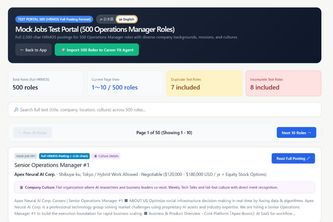
Career Fit Agent is a self-reported tool that uses AI (specifically GPT-5.6) and deterministic crawling to process large volumes of job listings, evaluate them against user-defined career goals, and recommend which roles to apply to—classifying each as Strong Apply, Strategic Bet, Safe Option, or Avoid, with reasoning and evidence.
What changed
The project began as a personal experiment using GPT-5.6 to browse job listings on a platform, then evolved into a reproducible product using Codex to automate the process. It was built for the OpenAI 2026 hackathon and is presented as an end-to-end demonstration of how AI can be used to make career decisions with evidence.
The single most important open question
Is there any evidence that this tool has been used by users beyond the demo, or that it has generated traction, revenue, or customer feedback? The description states no such evidence exists.
What The Product Actually Is
The description states that Career Fit Agent:
- Crawls paginated job listings and their detail pages.
- Tracks processed, unique, duplicate, incomplete, and failed records.
- Structures job information and preserves source evidence.
- Accepts a resume, career history, goals, and constraints.
- Uses GPT-5.6 to classify roles as Strong Apply, Strategic Bet, Safe Option, or Avoid, with reasons, concerns, and supporting evidence.
- Is built using Cloudflare Workers, Next.js, React, Node.js, TypeScript, Tailwind, Vite, OpenAI APIs, and Codex.
It is described as a controlled 500-job test portal to demonstrate the full workflow without scraping live platforms or exposing private data. The tool is not presented as a commercial product but as a proof-of-concept for a career decision-making system.
Evidence
- Self-reported by the authors.
- No independent verification of functionality or performance.
Positioning & Claim Evolution
The description states that Career Fit Agent was inspired by the author's own experience of FOMO while job searching—specifically, not knowing whether they had seen all relevant roles. The tool is positioned to help users avoid missing opportunities by processing and evaluating large numbers of jobs with AI.
It claims to go beyond simple data collection: it shows what was discovered, what failed, and the source behind each result. It then turns that auditable research into a practical career decision.
Inference The positioning suggests a shift from passive job search tools to active decision-support systems powered by AI and structured data.
Evidence
- Self-reported.
- No evidence of prior versions or product evolution beyond this demo.
Target Customer & ICP
The description states that Career Fit Agent is designed for people who are actively searching for jobs, particularly those with defined career goals, experience, and constraints. It is intended to help users make better decisions by understanding what they might have missed in their job search.
Inference The target customer likely includes professionals in Japan or other markets where large job platforms are used, and who are looking for a more structured, evidence-based approach to career decision-making.
Evidence
- Self-reported.
- No evidence of actual users, personas, or segmentation beyond the author’s personal experience.
Business Model & Pricing Evidence
The description does not state anything about pricing, monetization, or business model. It is presented as a hackathon project with no indication of commercial viability or revenue streams.
Evidence
- Not evidenced.
- No mention of subscriptions, usage fees, or B2B vs B2C models.
Technical & Delivery Signals
The description states that:
- The runtime crawler is deterministic code.
- It uses two phases: listing page crawling and detail page extraction.
- It tracks coverage, duplicates, failures, and source evidence.
- GPT-5.6 is used for judgmental tasks like role classification.
- The UI is built with Cloudflare Workers, Next.js, React, and Tailwind.
- The demo avoids live third-party scraping due to privacy and policy concerns.
Evidence
- Self-reported.
- No evidence of scalability, performance metrics, or production deployment beyond the demo.
Traction & Maturity Signals
The description states that this is a demo built for a hackathon. It includes no evidence of:
- Revenue
- Customers
- User adoption
- Product usage data
- Market traction
- Post-demo development or iteration
Evidence
- Not evidenced.
- The project is described as a prototype, not a product in use.
Competitive Context
The description does not mention any competitors. It does not describe how Career Fit Agent compares to existing job-search tools, AI-powered career platforms, or job-matching services.
Evidence
- Not evidenced.
- No competitive analysis or positioning against other tools.
Open Questions & Risks
- No traction or revenue: The project is presented as a hackathon demo with no evidence of real-world usage or monetization.
- Unverified AI performance: While GPT-5.6 was used, there is no demonstration of accuracy or reliability in role classification.
- Limited scope: The demo only covers 500 jobs and avoids live data sources, which may limit its practical utility.
- No commercial viability: No pricing, business model, or customer feedback are mentioned.
- Unproven scalability: The tool is described as a prototype, with no evidence of production readiness or large-scale deployment.
Evidence
- Self-reported.
- No independent validation or performance data.
Questions the description leaves open
- What was the actual outcome of the GPT-5.6 browser experiment that inspired this tool?
- How does the tool handle edge cases in job listing structures, and what percentage of jobs are successfully processed?
- Has the tool been tested with real users beyond the demo?
- Are there any plans to integrate with live job platforms or APIs?
- What is the current roadmap for monetization or product development?
- How does the team plan to scale beyond the 500-job test portal?
Overall Assessment
Not evidenced.
The project is described as a hackathon demo with no evidence of traction, revenue, customers, or commercial viability. The tool is presented as an idea in early development, not a product in use.
Confidence Low.
Assessment This is a self-reported prototype that shows potential but lacks any evidence of real-world adoption or business impact. It is not ready for investment or partnership without further demonstration of traction, user feedback, or commercial viability.
User Stories BotA demo video on every pull request
Get a demo video on every new feature
GitHub App that watches your pull requests and records a narrated, captioned demo.
Save time on demo prep and make informed decisions faster with a video walkthrough of every new feature.
Source
Submitted to the OpenAI 2026 hackathon on Devpost. Project home on Devpost. Back to the full gallery on Devpost.
This competitive analysis was produced by top-founders.com (opens in a new tab)
Generated by a language model from this project's public Devpost page — its tagline, the author's own write-up and any built-with tags listed there — as captured in August 2026. Short quotations are the author's words. It is an opinion on the idea as a business, not on the people behind it, and it reflects the description as published then. If the project has moved on, request a correction below. The analysis is not independent research and contains no verified traction, revenue or customer data.
An independent guide by KFG International LLC — not affiliated with, endorsed by, or connected to Devpost or OpenAI.