

Archive position — measured, not model output
0 likes on Devpost
2,263 of the 7,850 archived projects have more likes, and 5,587 share exactly 0 — so this project's #4,433 place in the like-ranked listing is a tie-break inside that group, not a ranking.
Projects (log scale)
Likes on Devpost. ▲ marks this project's group.
Show the figures
| Likes | Projects | Share of archive |
|---|---|---|
| 0 | 5,587 | 71.2% |
| 1 | 1,758 | 22.4% |
| 2 | 284 | 3.6% |
| 3–4 | 132 | 1.7% |
| 5–9 | 75 | 1.0% |
| 10+ | 14 | 0.2% |
 User Stories BotA demo video on every pull request
Get a demo video on every new feature
GitHub App that watches your pull requests and records a narrated, captioned demo.
Save time on demo prep and make informed decisions faster with a video walkthrough of every new feature.
Executive Summary
What the company appears to be
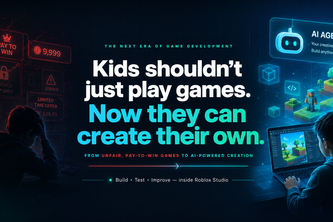
A self-reported project by two young brothers (aged 13 and 12 at time of submission) that claims to build an AI agent capable of turning children's game ideas into playable Roblox experiences. The project is associated with a non-profit organization, Future Tech Foundation.
What changed
The description indicates this was submitted as part of the OpenAI 2026 hackathon on Devpost. No evidence suggests any prior development or commercial activity beyond this submission.
Single most important open question
Is there any evidence of actual product usage, customer feedback, or revenue generation from this tool? The author states it is a prototype for a hackathon submission and part of a non-profit initiative, but provides no data on adoption, traction, or monetization.
What The Product Actually Is
The description states:
- The Hackathon Roblox AI Agent turns a child’s game idea into a playable Roblox experience.
- A creator describes what they want, and the agent reads the live Roblox Studio project, understands its structure, creates a plan, and begins building.
- It can generate environments, mechanics, user interfaces, assets, and Luau scripts.
- The agent follows a ReAct-style cycle: reason, act, observe, and decide what to do next.
- It also uses a Reflexion-inspired process to study failed attempts and turn them into guidance for the next iteration.
- The system uses Codex (TypeScript/Express backend) and a safe Roblox Studio plugin.
- It implements 26 typed capabilities for inspecting projects, making instances, modifying properties, scripting in Luau, managing assets, and testing.
- The agent performs analysis, planning, construction, testing, reflection, and iteration.
Inference This is an AI-powered development tool designed to assist non-programmers in creating Roblox games through natural language input.
Positioning & Claim Evolution
The description states:
- The project was built by two young brothers for their Future Tech Foundation (a non-profit).
- It aims to help children "create, not just consume, technology."
- The agent allows kids to describe ideas in natural language and see them develop in Roblox Studio.
- It enables children to play and modify the game after creation.
- The goal is to empower children with creative tools without requiring programming skills.
Inference The positioning appears to be educational and non-commercial, focused on democratizing game development for young creators through AI assistance.
Target Customer & ICP
The description states:
- The primary users are children who have ideas but lack programming skills.
- These children are described as "wasting a lot of time playing someone else's world" and unable to develop their own games in Roblox Studio.
- The tool is intended for beginners, with emphasis on safety, simplicity, and transparency.
Inference The target customer segment is young, non-technical users aged around 10–16 years old who want to create simple games but lack technical knowledge or access to traditional development tools.
Business Model & Pricing Evidence
The description states:
- The project is associated with a non-profit organization, Future Tech Foundation.
- No pricing information, subscription models, or monetization strategies are mentioned.
- The tool is presented as a prototype for a hackathon submission.
Inference There is no evidence of any business model or pricing structure beyond the context of a hackathon project and non-profit initiative.
Technical & Delivery Signals
The description states:
- Built using Codex (TypeScript/Express backend), a safe Roblox Studio plugin, and agent-based architecture.
- Implements 26 typed capabilities for inspecting projects, making instances, modifying properties, scripting in Luau, managing assets, and testing.
- Uses ReAct-style cycle: reason, act, observe, decide.
- Employs Reflexion-inspired process to learn from failed attempts.
- Includes 16 automated tests covering syntax, asset loading, game initialization, movement, UI, mechanics, performance, and win condition.
- Implements confirmations for high impact actions, timeouts, rollback, quarantine of assets, and processing of animations and Meshy 3D asset pipeline.
Inference The technical stack shows a sophisticated approach to integrating AI with live Roblox Studio environments, including safety mechanisms and iterative feedback loops.
Traction & Maturity Signals
The description states:
- This was submitted as part of the OpenAI 2026 hackathon on Devpost.
- It is described as a prototype.
- No evidence of revenue, customers, or adoption beyond the hackathon submission.
- The team consists of two young brothers (aged 13 and 12).
Inference There is no evidence of traction, product-market fit, or commercial viability beyond the hackathon context.
Competitive Context
The description states:
- No direct competitors are named.
- The project focuses on enabling children to create games using AI in Roblox Studio.
- It integrates with existing tools like Codex and OpenAI APIs.
Inference The competitive landscape is not clearly defined, but it likely competes with general-purpose AI coding assistants or educational platforms for game development.
Open Questions & Risks
The description states:
- The project is a hackathon submission and prototype.
- The team consists of two young brothers (aged 13 and 12).
- No evidence of product usage, customer feedback, or revenue generation.
- The tool is described as experimental and educational in nature.
Inference Key risks include lack of traction, limited team experience, unproven market demand, and absence of commercial viability or scalability beyond a hackathon prototype.
Questions the description leaves open
- What specific feedback have you received from children or educators using this tool?
- How do you plan to scale beyond the current hackathon prototype?
- Are there any plans for monetization or commercial deployment?
- What is the long-term vision for Future Tech Foundation and its relationship with this project?
- Have you tested the system with users outside of your immediate circle (e.g., schools, workshops)?
- How do you intend to ensure safety and prevent misuse in a real-world educational setting?
Overall Assessment
The description states:
- This is a hackathon submission by two young brothers for a non-profit initiative.
- No evidence of revenue, customers, or traction exists beyond the project description itself.
Inference There is insufficient evidence to support any investment or partnership decision at this stage. The project appears to be an experimental prototype with no demonstrated commercial viability or market traction. Any future potential depends heavily on whether the founders can demonstrate real-world usage, scalability, and a clear path to monetization or impact.
User Stories BotA demo video on every pull request
Get a demo video on every new feature
GitHub App that watches your pull requests and records a narrated, captioned demo.
Save time on demo prep and make informed decisions faster with a video walkthrough of every new feature.
Source
Submitted to the OpenAI 2026 hackathon on Devpost. Project home on Devpost. Back to the full gallery on Devpost.
This competitive analysis was produced by top-founders.com (opens in a new tab)
Generated by a language model from this project's public Devpost page — its tagline, the author's own write-up and any built-with tags listed there — as captured in August 2026. Short quotations are the author's words. It is an opinion on the idea as a business, not on the people behind it, and it reflects the description as published then. If the project has moved on, request a correction below. The analysis is not independent research and contains no verified traction, revenue or customer data.
An independent guide by KFG International LLC — not affiliated with, endorsed by, or connected to Devpost or OpenAI.