

Archive position — measured, not model output
0 likes on Devpost
2,263 of the 7,850 archived projects have more likes, and 5,587 share exactly 0 — so this project's #4,435 place in the like-ranked listing is a tie-break inside that group, not a ranking.
Projects (log scale)
Likes on Devpost. ▲ marks this project's group.
Show the figures
| Likes | Projects | Share of archive |
|---|---|---|
| 0 | 5,587 | 71.2% |
| 1 | 1,758 | 22.4% |
| 2 | 284 | 3.6% |
| 3–4 | 132 | 1.7% |
| 5–9 | 75 | 1.0% |
| 10+ | 14 | 0.2% |
 User Stories BotA demo video on every pull request
Get a demo video on every new feature
GitHub App that watches your pull requests and records a narrated, captioned demo.
Save time on demo prep and make informed decisions faster with a video walkthrough of every new feature.
Executive Summary
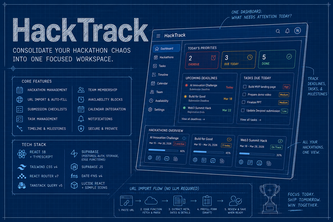
HackTrack is a self-reported productivity tool for hackathon participants, designed to centralize task management, deadline tracking, and progress visibility during hackathons. The project was built by two individuals as part of the OpenAI 2026 hackathon submission. It claims to offer a "centralized workspace" that transforms "hackathon chaos into a clear, daily-priorities dashboard." The author states it helps manage tasks, track deadlines, and ship projects—all in one place.
The description indicates no revenue, customers, or traction beyond the authors' own account. There is no evidence of product-market fit, pricing, or business model beyond self-reported claims. The tool appears to be a prototype built using AI-assisted development tools (Codex, GPT), with integration into Google Calendar.
The single most important open question
Is there any evidence that HackTrack has been used by participants in real hackathons, or that it solves a problem that people actually care about?
What The Product Actually Is
The description states:
- HackTrack is a "centralized workspace" for hackathon participants.
- It aims to "transform hackathon chaos into a clear, daily-priorities dashboard."
- It helps users "track deadlines, manage tasks, and ship your hackathon project—all in one place."
- The tool integrates with Google Calendar.
Inference Based on the author's own write-up, HackTrack appears to be a task management dashboard that aggregates data from hackathon-related activities, particularly those tied to calendar events. It is built using React, Supabase, and AI tools like Codex and GPT.
Not evidenced
- Whether it has a working prototype or a live version.
- What specific features are implemented beyond task tracking and calendar sync.
- How it differs from existing hackathon tools or productivity apps.
Positioning & Claim Evolution
The author states:
- The tool was built to help manage the chaos of multiple hackathons happening at once.
- It aims to reduce last-minute rushes by enabling daily prioritization.
- It is positioned as a solution for people who "couldn't focus on getting things done" and instead "used to do it in the last moment."
Inference The positioning evolved from a personal productivity need into a tool for hackathon participants, with an emphasis on task discipline and time management.
Not evidenced
- Whether this is a new or unique approach.
- How the product differentiates from existing tools (e.g., Notion, Trello, Google Calendar).
- Any market research or user feedback that supports the positioning.
Target Customer & ICP
The description states:
- The tool is for "anyone" registered to hackathons.
- It helps manage tasks and track progress during hackathons.
- It was built by someone who participated in hackathons and wanted better focus.
Inference The target customer is likely hackathon participants, especially those juggling multiple events or struggling with time management.
Not evidenced
- Specific user personas or segmentation.
- Whether the tool targets solo hackers, teams, or organizers.
- Any evidence of customer interviews or usage data.
Business Model & Pricing Evidence
The description states:
- No pricing model is mentioned.
- The project was submitted as part of a hackathon and has no commercialization details.
Inference There is no evidence of any business model or pricing strategy. It appears to be a prototype with no monetization plan.
Not evidenced
- Any revenue streams, pricing tiers, or monetization strategy.
- Whether the tool is intended for free use or paid access.
Technical & Delivery Signals
The description states:
- Built using React, Supabase, and Codex (AI tool).
- The author used GPT 5.6 Terra to assist in development.
- Challenges included scraping data via edge functions and Google OAuth integration.
- The team was able to resolve issues with AI assistance.
Inference The project is technically feasible, built using modern tools, and shows basic integration capabilities (e.g., Google Calendar). It was completed within a hackathon timeframe.
Not evidenced
- Whether the tool is production-ready or scalable.
- How it handles data privacy or security.
- Any performance metrics or scalability tests.
Traction & Maturity Signals
The description states:
- The project was submitted to the OpenAI 2026 hackathon.
- It was built by two people in a short timeframe.
- No evidence of usage, adoption, or user feedback beyond the authors' own account.
Inference There is no traction or maturity signal beyond the prototype phase. It has not been tested in real-world conditions or used by external users.
Not evidenced
- Any user base, customer acquisition, or retention metrics.
- Product usage data or feature adoption rates.
- Evidence of product-market fit or iteration history.
Competitive Context
The description states:
- No direct competitors are named.
- The tool is positioned as a hackathon-specific task manager.
Inference Hackathon productivity tools may include general-purpose apps like Notion, Trello, or Asana, but there is no indication of how HackTrack differentiates from them.
Not evidenced
- Any competitive analysis or market positioning.
- Whether similar tools already exist in the hackathon space.
- How this tool compares to existing solutions.
Open Questions & Risks
The description states:
- It was built by two people in a short timeframe.
- Challenges were encountered with scraping data and OAuth integration.
- No evidence of product-market fit or user feedback.
Inference
- The tool is likely early-stage, possibly non-functional or incomplete.
- Lack of traction suggests no proven demand or adoption.
- Technical challenges may indicate scalability or reliability issues.
Open questions
- No evidence of real-world usage or customer validation.
- No pricing or monetization strategy.
- No indication of long-term roadmap or product vision.
Questions the description leaves open
- How many hackathons have you personally participated in, and how did you identify the need for this tool?
- Have any other hackathon participants used the tool? If so, what feedback did they give?
- What are the key features that distinguish HackTrack from general-purpose task managers like Notion or Trello?
- How do you plan to monetize the tool, and what is your go-to-market strategy?
- Can you demonstrate a working version of the product, or show how it integrates with Google Calendar?
- What are the technical limitations or scalability concerns you've encountered?
Overall Assessment
The description states:
- The project was built as part of a hackathon submission.
- No evidence of traction, revenue, or customer validation.
Inference At this stage, HackTrack is a prototype with no commercial viability or market traction. It lacks evidence of product-market fit, business model, or user adoption.
Assessment Not evidenced as a viable investment or partnership opportunity. The tool is early-stage and self-reported only. Further due diligence would require evidence of usage, customer feedback, or a working prototype with clear value proposition and monetization strategy.
User Stories BotA demo video on every pull request
Get a demo video on every new feature
GitHub App that watches your pull requests and records a narrated, captioned demo.
Save time on demo prep and make informed decisions faster with a video walkthrough of every new feature.
Source
Submitted to the OpenAI 2026 hackathon on Devpost. Project home on Devpost. Back to the full gallery on Devpost.
This competitive analysis was produced by top-founders.com (opens in a new tab)
Generated by a language model from this project's public Devpost page — its tagline, the author's own write-up and any built-with tags listed there — as captured in August 2026. Short quotations are the author's words. It is an opinion on the idea as a business, not on the people behind it, and it reflects the description as published then. If the project has moved on, request a correction below. The analysis is not independent research and contains no verified traction, revenue or customer data.
An independent guide by KFG International LLC — not affiliated with, endorsed by, or connected to Devpost or OpenAI.