

Archive position — measured, not model output
0 likes on Devpost
2,263 of the 7,850 archived projects have more likes, and 5,587 share exactly 0 — so this project's #4,421 place in the like-ranked listing is a tie-break inside that group, not a ranking.
Projects (log scale)
Likes on Devpost. ▲ marks this project's group.
Show the figures
| Likes | Projects | Share of archive |
|---|---|---|
| 0 | 5,587 | 71.2% |
| 1 | 1,758 | 22.4% |
| 2 | 284 | 3.6% |
| 3–4 | 132 | 1.7% |
| 5–9 | 75 | 1.0% |
| 10+ | 14 | 0.2% |
 User Stories BotA demo video on every pull request
Get a demo video on every new feature
GitHub App that watches your pull requests and records a narrated, captioned demo.
Save time on demo prep and make informed decisions faster with a video walkthrough of every new feature.
Executive Summary
What the company appears to be
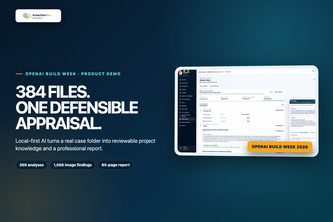
The project described by the author is a desktop application named GutachterPro ImmoWert, built for German real-estate appraisers. It is an offline-first AI workspace that integrates structured data handling, local persistence (SQLite), and AI-assisted analysis into a professional appraisal workflow. The tool supports case-specific document management, expert-controlled valuation modules, and defensible report generation in DOCX/PDF formats.
What changed
As of July 2026, the project had evolved from an initial Tauri-based shell with basic SQLite persistence to a validated Goldcase workflow supporting multiple appraisal approaches (Cost, Income, Sales Comparison), full report generation, and AI-assisted but expert-controlled data processing. The author reports having built an 85-page professional report delivery in DOCX/PDF and implemented features like restart-safe document analysis, source-linked location proposals, and an English interface for demo purposes.
The single most important open question
Is there evidence of real-world adoption or traction beyond the developer's own use case? The description states no revenue, customers, or user data are available — only self-reported development progress and internal validation.
What The Product Actually Is
- The description states that GutachterPro ImmoWert is an offline-first desktop workspace.
- It uses a native Tauri shell, case-specific SQLite persistence, and integrates React, Rust, TypeScript, and OpenAI Codex/GPT-5.6 for development support.
- The tool stores structured professional state in local SQLite while keeping documents and images as project files.
- AI analysis produces schema-validated working knowledge with compact provenance.
- It supports export to DOCX/PDF, driven by one validated report model.
- The app includes a case-grounded Copilot that prioritizes confirmed professional values, and requires explicit decisions before transferring AI suggestions into reports or modules.
Inference: Based on the author’s own write-up, this is not a SaaS product but rather a desktop application for individual professionals, likely used in local environments with strict data sovereignty requirements.
Positioning & Claim Evolution
- The description states that the hard problem is not generating more text, but turning evidence into reviewable case knowledge while preserving professional responsibility.
- It positions itself as an AI-enhanced tool for real estate appraisers, not a general-purpose AI writer or document generator.
- The author claims to have moved from a basic prototype (Tauri shell + SQLite) to a validated Goldcase workflow, including full Cost, Income, and Sales Comparison approaches.
- There is no mention of pricing, market positioning beyond the German real estate sector, or competitive differentiation in the description.
Claim: The tool aims to reduce manual effort in appraisal workflows by integrating AI with expert control.
Inference: This evolution suggests a shift from proof-of-concept to a functional product that supports professional valuation standards.
Target Customer & ICP
- The target customer is German real-estate appraisers.
- The tool supports professional appraisal workflows, including regulated calculations and report generation.
- It handles land-register records, floor-area schedules, market documents, and expert decisions.
- The interface is bilingual: English for demo purposes, German for actual content.
Not evidenced: No explicit customer segments beyond the described use case. No evidence of early adopters or pilot users.
Business Model & Pricing Evidence
- There is no mention of pricing models, monetization strategies, or revenue streams.
- The tool is described as a desktop application, not a SaaS offering.
- It is built for local persistence and offline use, suggesting a one-time purchase or subscription model may be relevant, but this is not stated.
Not evidenced: No indication of how the product will be sold or whether it has any commercial revenue yet.
Technical & Delivery Signals
- The app uses Tauri for desktop UI, Rust for backend logic, React + TypeScript for frontend, and SQLite for local data storage.
- AI is used via OpenAI Codex/GPT-5.6, but the deployed runtime remains provider-separated.
- The system supports restart-safe document analysis, persistent provenance, and source-linked location proposals.
- It includes a Copilot that prioritizes confirmed values, and requires explicit confirmation before AI data enters reports or modules.
Inference: The architecture shows a strong focus on data integrity and expert control, which aligns with professional software needs in regulated industries.
Traction & Maturity Signals
- As of July 2026, the project had:
- A native Tauri shell
- Case-specific SQLite persistence
- First Cost Approach workflow
- Early export proofs (DOCX/PDF)
- An 85-page Goldcase report delivery in DOCX/PDF
- Full Cost, Income, and Sales Comparison workflows
- Restart-safe document and image analysis with persistent provenance
- The author reports having demonstrated:
- 384 project files
- 369 completed analyses
- 11 extracted facts
- 4 structured tables
- 1,066 image findings
- 24 editable area rows across three buildings
- One AI-prepared land-register sheet with two parcels, expert-confirmed
Not evidenced: No evidence of customer adoption, usage metrics, or revenue. The maturity level is inferred from the scope of features and validation shown.
Competitive Context
- The description does not mention competitors.
- It focuses on a niche within the German real estate appraisal industry.
- There is no indication of existing tools in this space, nor how GutachterPro ImmoWert differentiates from them.
Not evidenced: No competitive landscape or market analysis provided.
Open Questions & Risks
- The tool is built for a single developer (Marcel Lammerskitten), raising questions about scalability and long-term maintenance.
- It is a desktop application, which may limit accessibility compared to web-based solutions.
- The author states that the AI runtime remains provider-separated, implying no direct control over AI behavior in production.
- There is no evidence of real-world testing or feedback from actual appraisers, only internal validation.
Inference: Risk of limited adoption due to niche market, lack of external validation, and single-developer dependency.
Questions the description leaves open
- What specific regulatory requirements does the tool address in German real estate appraisal?
- How is data integrity maintained across restarts and AI interactions?
- Are there plans for cloud sync or collaboration features, or is it strictly offline?
- Has the tool been tested by actual appraisers, or is it still in internal validation phase?
- What are the long-term goals for monetization or product expansion beyond the current scope?
Overall Assessment
- The project is self-reported and unverified, built by a single developer with no external traction.
- It shows technical maturity and alignment with professional needs in a niche market.
- There is no evidence of revenue, customers, or commercial viability beyond the author’s own use case.
- The tool appears to be a proof-of-concept turned into a functional prototype, but lacks real-world validation.
Assessment: Not ready for investment or partnership without further evidence of traction, customer feedback, or monetization strategy. The product shows promise in solving a specific professional problem but is not yet proven in the market.
User Stories BotA demo video on every pull request
Get a demo video on every new feature
GitHub App that watches your pull requests and records a narrated, captioned demo.
Save time on demo prep and make informed decisions faster with a video walkthrough of every new feature.
Source
Submitted to the OpenAI 2026 hackathon on Devpost. Project home on Devpost. Back to the full gallery on Devpost.
This competitive analysis was produced by top-founders.com (opens in a new tab)
Generated by a language model from this project's public Devpost page — its tagline, the author's own write-up and any built-with tags listed there — as captured in August 2026. Short quotations are the author's words. It is an opinion on the idea as a business, not on the people behind it, and it reflects the description as published then. If the project has moved on, request a correction below. The analysis is not independent research and contains no verified traction, revenue or customer data.
An independent guide by KFG International LLC — not affiliated with, endorsed by, or connected to Devpost or OpenAI.