

Archive position — measured, not model output
0 likes on Devpost
2,263 of the 7,850 archived projects have more likes, and 5,587 share exactly 0 — so this project's #4,382 place in the like-ranked listing is a tie-break inside that group, not a ranking.
Projects (log scale)
Likes on Devpost. ▲ marks this project's group.
Show the figures
| Likes | Projects | Share of archive |
|---|---|---|
| 0 | 5,587 | 71.2% |
| 1 | 1,758 | 22.4% |
| 2 | 284 | 3.6% |
| 3–4 | 132 | 1.7% |
| 5–9 | 75 | 1.0% |
| 10+ | 14 | 0.2% |
 User Stories BotA demo video on every pull request
Get a demo video on every new feature
GitHub App that watches your pull requests and records a narrated, captioned demo.
Save time on demo prep and make informed decisions faster with a video walkthrough of every new feature.
Executive Summary
What the company appears to be
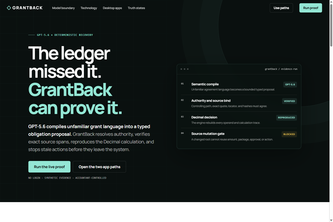
GrantBack is a self-described ChatGPT App and public Closeout Workbench that uses GPT-5.6 to interpret fragmented post-award grant evidence and compile it into a source-verified candidate receivable package. It claims to resolve controlling documents, verify exact source spans, perform monetary calculations with deterministic Decimal arithmetic, and bind accountant approval to the exact source root, amount, recipient, subject, body, attachments, and idempotency key.
What changed
The project description states that GrantBack was built for the OpenAI 2026 hackathon. It includes a synthetic reconstruction of a cross-border R&D closeout workflow and demonstrates how GPT-5.6 interprets unfamiliar professional language to propose a restricted typed obligation program, which is then independently verified by deterministic code.
The single most important open question — the commercial due-diligence read
Is there any evidence that this system has been adopted or used in real-world grant accounting workflows beyond the synthetic examples provided? The description does not indicate any actual customers, revenue, or traction beyond internal testing and demonstration.
What The Product Actually Is
The description states that GrantBack is a ChatGPT App and public Closeout Workbench. It uses GPT-5.6 to interpret fragmented post-award grant evidence and compile it into a source-verified candidate receivable package. This package includes:
- Resolution of the controlling document path;
- Verification of exact source spans, quotes, and hashes;
- Checks for required evidence and contradictions;
- Monetary calculations with deterministic Decimal arithmetic;
- Creation of a candidate receivable package for accountant review;
- Binding of approval to the exact source root, amount, recipient, subject, body, attachments, and idempotency key;
- Separation of provider acceptance, mail-server delivery, recipient observation, and payment;
- Blocking of downstream actions if one character changes in the source.
It is described as a strict TypeScript and pnpm workspace, with modules such as @grantback/compiler, @grantback/verifier, @grantback/evaluator, etc., that handle authority resolution, verification, evaluation, and package creation. The system also integrates with the OpenAI Apps SDK and ChatGPT Work.
Not evidenced: No actual customer data, revenue, or usage metrics are provided.
Positioning & Claim Evolution
The author positions GrantBack as a solution to a pre-ledger gap in grant accounting — where systems typically begin after a receivable has been identified and entered into the ledger. GrantBack addresses the challenge of scattered evidence across multiple documents before an entry exists.
It claims to be a "typed obligation program" that resolves authority through a decision chain involving:
- GPT-5.6 proposal → restricted typed obligation IR;
- Source authority → controlling agreement and amendment path;
- Evidence → document hash, typed locator, exact quote, quote hash, and parser revision;
- Money → server-owned Decimal execution trace;
- Approval → source root, program, amount, recipient, notice, attachments, actor, nonce, and expiry;
- Action → provider acceptance, delivery, observation, and payment remain separate truth states.
The system is described as not owning arithmetic, authority resolution, approval, recipient selection, delivery truth, or payment truth — but rather binding these elements to the source evidence.
Inferred: The positioning implies a niche application in public grants and government-funded R&D, where precision and auditability are critical. However, no claims about market size, adoption, or competitive differentiation beyond its own self-description are made.
Target Customer & ICP
The description states that the author is Sergio, a Washington State CPA, who specializes in public grants and government-funded R&D. The system is built for use in post-award grant closeout workflows.
It targets environments where:
- Evidence is scattered across multiple documents;
- Accountants must determine which source controls;
- Required evidence must be complete;
- Exact amounts must be supported by sources;
- Actions remain authorized only if the evidence does not change.
Not evidenced: No specific customer personas, industries, or use cases beyond the synthetic examples are described. No indication of whether this is intended for large enterprises, small firms, or government agencies.
Business Model & Pricing Evidence
The description does not provide any information about pricing, monetization, or business model. It only describes the technical architecture and functionality of the system.
Not evidenced: No revenue streams, pricing tiers, or customer acquisition strategies are mentioned.
Technical & Delivery Signals
The project is built using:
- OpenAI GPT-5.6
- ChatGPT Work and Apps SDK
- Codex for development and auditing
- TypeScript, Node.js, pnpm, Zod, Decimal.js, Vitest, Vercel, Resend, WebCrypto, Ed25519, GitHub Actions
Modules include:
@grantback/contracts@grantback/compiler@grantback/verifier@grantback/evaluator@grantback/pipeline@grantback/receivable@grantback/actions@grantback/replay@grantback/widget
The system is described as using deterministic code to verify evidence, perform calculations, and bind approvals. It also includes:
- A one-character source-change test that blocks downstream actions;
- A release-gate run with 271 of 271 automated tests passing;
- Zero findings in privacy, Gitleaks, or OSV scans.
Inferred: The system appears to be a prototype or proof-of-concept built for a hackathon. No production deployment details, scalability assumptions, or delivery mechanisms beyond the described synthetic case are provided.
Traction & Maturity Signals
The description states that:
- A public Closeout Workbench was built with 23 synthetic institution cases;
- The system demonstrated a final production MCP advertised 15 tools, and actively exercised the hero and live-model-replay paths;
- A fresh authenticated ChatGPT Work execution was captured against the final production release;
- The system reproduced USD 10,069.57 with exact Decimal arithmetic;
- It proved that a one-character source mutation blocks amount, package, approval reservation, and action;
- All 24 held-out evaluation cases passed (12 exact-calculation, 12 required-abstention);
- The final release scans reported zero public-data privacy findings, zero Gitleaks findings, and zero OSV findings.
Not evidenced: No real-world usage, customer feedback, or adoption metrics are provided. The system is described as synthetic and not connected to any actual customer evidence.
Competitive Context
The description does not mention any competitors or direct market comparisons. It positions itself as solving a gap in grant accounting workflows, particularly where systems fail before ledger entries exist.
Not evidenced: No competitive landscape, pricing, or differentiation from existing tools is described.
Open Questions & Risks
- No real-world adoption: The system is described as synthetic and not connected to any actual customer evidence.
- Unverified claims: The description makes strong technical claims but lacks independent verification or third-party validation.
- Limited scope: It appears to be a hackathon project, not a production-ready product.
- Unclear business model: No monetization strategy or pricing information is provided.
- High technical complexity without traction: The system involves complex integration with AI models and financial systems, but no evidence of operational use.
Inferred: The risk of over-engineering for a niche problem without real-world validation is high. The project may be more of a proof-of-concept than a scalable product.
Questions the description leaves open
- What is the actual use case or customer pain point that this system solves?
- Has it been tested with real grant accountants or in live workflows?
- How does it handle edge cases beyond the synthetic examples provided?
- Is there any plan to integrate with existing accounting systems or ERP platforms?
- What are the legal and compliance implications of binding approvals to source evidence?
- Are there plans for monetization, and how will pricing be structured?
- How does the system scale beyond the current synthetic test cases?
Overall Assessment
The description indicates that GrantBack is a self-contained prototype built for a hackathon, with no evidence of real-world adoption or traction. It demonstrates strong technical execution and a clear understanding of a specific niche in grant accounting.
However, due to the lack of customer data, revenue, or market validation, it is not yet ready for investment or partnership consideration.
Assessment: Not evidenced as a viable commercial product.
The system may be a promising proof-of-concept, but lacks the commercial signals necessary for due-diligence readiness.
User Stories BotA demo video on every pull request
Get a demo video on every new feature
GitHub App that watches your pull requests and records a narrated, captioned demo.
Save time on demo prep and make informed decisions faster with a video walkthrough of every new feature.
Source
Submitted to the OpenAI 2026 hackathon on Devpost. Project home on Devpost. Back to the full gallery on Devpost.
This competitive analysis was produced by top-founders.com (opens in a new tab)
Generated by a language model from this project's public Devpost page — its tagline, the author's own write-up and any built-with tags listed there — as captured in August 2026. Short quotations are the author's words. It is an opinion on the idea as a business, not on the people behind it, and it reflects the description as published then. If the project has moved on, request a correction below. The analysis is not independent research and contains no verified traction, revenue or customer data.
An independent guide by KFG International LLC — not affiliated with, endorsed by, or connected to Devpost or OpenAI.