

Archive position — measured, not model output
0 likes on Devpost
2,263 of the 7,850 archived projects have more likes, and 5,587 share exactly 0 — so this project's #4,336 place in the like-ranked listing is a tie-break inside that group, not a ranking.
Projects (log scale)
Likes on Devpost. ▲ marks this project's group.
Show the figures
| Likes | Projects | Share of archive |
|---|---|---|
| 0 | 5,587 | 71.2% |
| 1 | 1,758 | 22.4% |
| 2 | 284 | 3.6% |
| 3–4 | 132 | 1.7% |
| 5–9 | 75 | 1.0% |
| 10+ | 14 | 0.2% |
 User Stories BotA demo video on every pull request
Get a demo video on every new feature
GitHub App that watches your pull requests and records a narrated, captioned demo.
Save time on demo prep and make informed decisions faster with a video walkthrough of every new feature.
Executive Summary
What the company appears to be
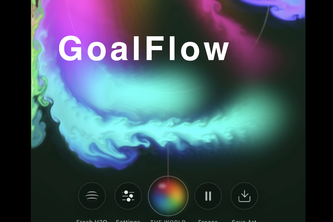
GoalFlow is a self-contained, interactive digital artwork built using AI coding tools (Codex + GPT-5.6) that allows users to paint with national flag colors through fluid dynamics simulations. It is presented as an artistic and experimental project, not a commercial product.
What changed
The author describes this as a creative exploration emerging from prior work ("Living Ink") and the use of AI coding tools during OpenAI Build Week. There is no evidence of prior development or commercial activity beyond this single project.
Single most important open question
Is there any indication that GoalFlow has evolved into a scalable or monetizable product, or whether it remains an isolated artistic experiment?
What The Product Actually Is
The description states that GoalFlow is:
- An interactive digital artwork where users choose one of 48 countries and paint with its national colors.
- Powered by a GPU-accelerated, two-dimensional incompressible Navier–Stokes fluid solver written in WebGL2 and GLSL.
- A browser-based experience with no backend, account, or payment requirements.
- Deployed via OpenAI Sites.
It is described as a "playground for the imagination" and an extension of the author’s artistic practice involving AI, virtual reality, EEG, and space art.
Inference This is not a commercial product but a creative tool or installation built using AI coding agents.
Positioning & Claim Evolution
The description states that GoalFlow:
- Is inspired by the World Cup and aims to offer a "quiet ritual of connection" through play, beauty, and co-creation.
- Emerges from the author’s artistic background in Japanese ink-painting and Zen Buddhist philosophy.
- Uses AI coding tools (Codex + GPT-5.6) to implement fluid physics and interface design.
It is positioned as a meditative, expressive experience rather than a utility or commercial offering.
Inference The positioning reflects an artist-led, experimental approach with no stated intent toward market adoption or monetization.
Target Customer & ICP
The description states that GoalFlow:
- Allows visitors to choose a country and paint with its colors.
- Offers navigation through 48 palettes via search, tournament groups, or knockout bracket.
- Supports mobile devices with native sharing capabilities.
There is no mention of specific personas, buyer roles, or target segments beyond general users engaging in creative interaction.
Inference The audience appears to be broadly curious individuals interested in digital art and interactive experiences, not defined customer types.
Business Model & Pricing Evidence
The description states that:
- No backend, account, payment, or API key is required.
- The interface allows saving artwork as PNGs.
- It was built during a hackathon (OpenAI Build Week).
There is no evidence of pricing, monetization, subscriptions, or revenue streams.
Inference No business model or pricing structure is evident; it appears to be a non-commercial artistic project.
Technical & Delivery Signals
The description states that:
- GoalFlow uses a GPU-accelerated Navier–Stokes fluid solver in WebGL2 and GLSL.
- The system handles velocity, dye, pressure, advection, curl calculation, vorticity confinement, and rendering.
- It supports continuous brush strokes, adaptive resolution for mobile GPUs, and gesture-based force injection.
- All source code was generated through Codex using GPT-5.6.
It is deployed via OpenAI Sites without backend infrastructure.
Inference The technical stack suggests a high-performance browser-based simulation with AI-assisted development, but no evidence of scalability or enterprise-grade delivery.
Traction & Maturity Signals
The description states that:
- The project was submitted to the OpenAI 2026 hackathon.
- It was built during OpenAI Build Week.
- The author has previously created a related project called "Living Ink."
There is no evidence of user engagement, adoption, or growth metrics beyond its creation and deployment.
Inference No traction data exists; the project appears to be an isolated creative experiment with no demonstrated market impact.
Competitive Context
The description states that:
- The author has explored AI, virtual reality, EEG, and space art in prior projects.
- GoalFlow is inspired by Japanese ink-painting traditions and aims to extend their beauty digitally.
There is no mention of competitors or direct market comparisons.
Inference No competitive landscape is described; the project seems to exist in a niche artistic domain without clear peers.
Open Questions & Risks
The description states that:
- The project was built using AI coding tools (Codex + GPT-5.6) and is not a commercial product.
- It is presented as an experimental, artistic endeavor with no monetization strategy.
Inference Key risks include lack of scalability, unclear path to monetization, and absence of any business or growth strategy.
Questions the description leaves open
- What is the intended evolution from this artistic experiment to a potential product or service?
- Are there plans for monetization or commercial use beyond its current form?
- Has the author considered how to scale or adapt this experience for broader audiences or platforms?
- How does the author envision integrating feedback loops or iterative improvements beyond the initial build?
- What is the long-term vision for GoalFlow, and how does it align with any strategic goals?
Overall Assessment
The description states that:
- GoalFlow is a self-contained artistic experience built using AI coding tools.
- It was created during a hackathon and deployed as an experimental project.
- There is no evidence of revenue, customers, or traction beyond its creation.
Inference This is not a commercial venture or investment-ready product. It represents an artistic exploration with no demonstrated business potential or scalability.
User Stories BotA demo video on every pull request
Get a demo video on every new feature
GitHub App that watches your pull requests and records a narrated, captioned demo.
Save time on demo prep and make informed decisions faster with a video walkthrough of every new feature.
Source
Submitted to the OpenAI 2026 hackathon on Devpost. Project home on Devpost. Back to the full gallery on Devpost.
This competitive analysis was produced by top-founders.com (opens in a new tab)
Generated by a language model from this project's public Devpost page — its tagline, the author's own write-up and any built-with tags listed there — as captured in August 2026. Short quotations are the author's words. It is an opinion on the idea as a business, not on the people behind it, and it reflects the description as published then. If the project has moved on, request a correction below. The analysis is not independent research and contains no verified traction, revenue or customer data.
An independent guide by KFG International LLC — not affiliated with, endorsed by, or connected to Devpost or OpenAI.