

Archive position — measured, not model output
0 likes on Devpost
2,263 of the 7,850 archived projects have more likes, and 5,587 share exactly 0 — so this project's #4,334 place in the like-ranked listing is a tie-break inside that group, not a ranking.
Projects (log scale)
Likes on Devpost. ▲ marks this project's group.
Show the figures
| Likes | Projects | Share of archive |
|---|---|---|
| 0 | 5,587 | 71.2% |
| 1 | 1,758 | 22.4% |
| 2 | 284 | 3.6% |
| 3–4 | 132 | 1.7% |
| 5–9 | 75 | 1.0% |
| 10+ | 14 | 0.2% |
 User Stories BotA demo video on every pull request
Get a demo video on every new feature
GitHub App that watches your pull requests and records a narrated, captioned demo.
Save time on demo prep and make informed decisions faster with a video walkthrough of every new feature.
Executive Summary
What the company appears to be
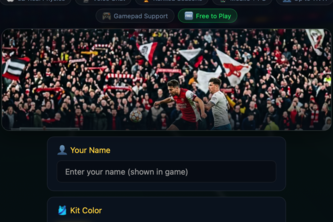
GOAL JOY is a browser-based 3D multiplayer soccer game built by a single developer (Kiwi Kiwi). The author states it uses WebGL via Three.js for rendering, Node.js with Socket.io and Redis for backend synchronization, and WebRTC for voice chat. It supports real-time gameplay with features like matchmaking, voice communication, ranked seasons, and cosmetic customization.
What changed
This is a self-reported project submitted to the OpenAI 2026 hackathon. There is no evidence of prior existence or commercial activity beyond this submission.
Single most important open question
Is there any indication that GOAL JOY has achieved product-market fit, user traction, or monetization at scale? The description contains no data on users, revenue, or adoption — only claims about technical implementation and feature set.
What The Product Actually Is
The description states that GOAL JOY is a browser-based 3D multiplayer soccer game. It runs entirely in the browser using WebGL (via Three.js), with real-time synchronization handled by Node.js, Socket.io, and Redis. Features include:
- Matchmaking (private or quick-match)
- Realistic physics for player movement and ball dynamics
- Broadcast-style presentation with crowd reactions and stadium atmosphere
- Voice chat via WebRTC
- Ranked seasons and Elo-based matchmaking
- Cosmetic customization and VIP bundles
- In-game recording and sharing capabilities
The author describes it as a console-quality experience without downloads, aiming to bridge the gap between console games and web-based play.
Evidence
- The project description explicitly defines GOAL JOY as a browser-based 3D soccer game.
- Technical stack includes: fly.io, node.js, paypalapi, redis, socket.io, three.js, typescript, vercel, vite, webgl, webrtc.
- The write-up details how it was built using a TypeScript monorepo with shared logic, client rendering, and server-side multiplayer handling.
Inference It is inferred that the product targets casual to competitive soccer enthusiasts who prefer playing in browsers over traditional platforms.
Positioning & Claim Evolution
The author positions GOAL JOY as a browser-based 3D soccer game that delivers console-quality experiences without downloads, aiming to fill a gap between existing console games and web-based alternatives. The vision is described as creating something that feels like a broadcast presentation of a real match, not just a mini-game.
Evidence
- The tagline: “Online Multiplayer Soccer”
- The write-up states: “I was inspired by the gap between console-quality soccer games and what's possible in a web browser.”
- The project aims to deliver an immersive, competitive multiplayer experience with real physics, voice chat, and live matchmaking.
Inference The positioning evolved from a personal technical challenge into a broader market opportunity — to bring high-end 3D gaming to the browser.
Target Customer & ICP
The description does not provide explicit customer segments or personas. However, based on the stated features and use case, it appears aimed at:
- Casual gamers who enjoy soccer
- Competitive players seeking ranked matches
- Users interested in browser-based multiplayer experiences
- Fans of broadcast-style sports games
Evidence
- Features such as ranked seasons, voice chat, and customizable kits suggest targeting users who value both social interaction and competitive play.
- The mention of “broadcast-style presentation” implies an audience that enjoys watching live matches.
Inference It is inferred that the target includes soccer fans and online multiplayer gamers who prefer browser-based solutions for convenience and accessibility.
Business Model & Pricing Evidence
There is no evidence of a formal business model or pricing structure in the description. The author mentions:
- VIP bundles
- Cosmetic unlocks
- PayPal integration for purchases
- In-game currency earned through challenges
- AdSense integration with fallback house ads
Evidence
- “Purchase VIP bundles, unlock cosmetics”
- “PayPal payment integration for VIP features”
- “AdSense integration with fallback house ads”
Inference It is inferred that the business model may involve freemium + monetization via cosmetic purchases and advertising, but no data on revenue or pricing exists.
Technical & Delivery Signals
The author reports significant technical development:
- Built as a TypeScript monorepo
- Uses Three.js for 3D rendering
- Implements delta compression for multiplayer sync
- Includes adaptive performance scaling for mobile devices
- Integrates WebRTC voice chat
- Deploys on Fly.io (backend) and Vercel (frontend)
- Supports internationalization, including RTL layouts
Evidence
- The write-up details implementation of:
- Physics engine with three-phase acceleration model
- GPU-instanced crowd members
- Post-processing pipeline (SMAA, Bloom, Color-grade)
- Session tokens and reconnect logic in Redis
- Mobile QA and automated testing harness
Inference It is inferred that the technical architecture reflects a mature engineering effort, though no production deployment or scalability data are provided.
Traction & Maturity Signals
There is no evidence of traction, customers, or user engagement beyond the author’s own account. The project was submitted to a hackathon and has no reported usage metrics, revenue, or user base.
Evidence
- No mention of active users, retention rates, or monetization
- No data on match frequency, player count, or community growth
Inference It is inferred that the product remains in early-stage development or prototype form, with no demonstrated market traction.
Competitive Context
The description does not reference competitors directly. However, it implies a niche in browser-based 3D multiplayer soccer games, which could overlap with:
- Console games like FIFA
- Browser-based mini-games (e.g., those on Kongregate or Steam)
- Web-based sports simulations or esports platforms
Evidence
- The author explicitly states: “I was inspired by the gap between console-quality soccer games and what's possible in a web browser.”
Inference It is inferred that GOAL JOY competes indirectly with traditional console titles and other browser-based games, but no competitive analysis or market positioning data exists.
Open Questions & Risks
Several risks are evident from the self-reported description:
- Single-person development team: The project is built by one developer (Kiwi Kiwi), raising concerns about scalability and long-term maintenance.
- No revenue or monetization evidence: Despite mentions of payments and ads, no data on actual income streams.
- Unproven market traction: No users, adoption, or engagement metrics.
- Technical complexity without validation: The level of technical sophistication suggests a strong engineering effort, but lacks real-world testing or feedback loops.
Evidence
- Team size: 1 member
- No mention of customers, revenue, or monetization beyond claims
Inference It is inferred that the project may be technically impressive but lacks commercial viability or user validation.
Questions the description leaves open
- What specific user feedback have you received so far?
- Have you conducted any usability testing or beta trials?
- How do you plan to scale beyond a single developer?
- Are there any plans for monetization beyond cosmetic purchases and ads?
- What is your strategy for building a community around the game?
- How do you intend to handle mobile optimization at scale?
- Have you considered partnerships with esports organizations or leagues?
Overall Assessment
Not evidenced
There is no evidence of revenue, user traction, or commercial viability beyond the author’s own claims. The project appears to be a technical showcase submitted for a hackathon, not a product ready for investment or partnership.
The description does not support any conclusion about whether GOAL JOY has achieved product-market fit, customer adoption, or sustainable business model. It remains a self-reported prototype with no external validation or data points indicating commercial readiness.
User Stories BotA demo video on every pull request
Get a demo video on every new feature
GitHub App that watches your pull requests and records a narrated, captioned demo.
Save time on demo prep and make informed decisions faster with a video walkthrough of every new feature.
Source
Submitted to the OpenAI 2026 hackathon on Devpost. Project home on Devpost. Back to the full gallery on Devpost.
This competitive analysis was produced by top-founders.com (opens in a new tab)
Generated by a language model from this project's public Devpost page — its tagline, the author's own write-up and any built-with tags listed there — as captured in August 2026. Short quotations are the author's words. It is an opinion on the idea as a business, not on the people behind it, and it reflects the description as published then. If the project has moved on, request a correction below. The analysis is not independent research and contains no verified traction, revenue or customer data.
An independent guide by KFG International LLC — not affiliated with, endorsed by, or connected to Devpost or OpenAI.