

Archive position — measured, not model output
0 likes on Devpost
2,263 of the 7,850 archived projects have more likes, and 5,587 share exactly 0 — so this project's #4,292 place in the like-ranked listing is a tie-break inside that group, not a ranking.
Projects (log scale)
Likes on Devpost. ▲ marks this project's group.
Show the figures
| Likes | Projects | Share of archive |
|---|---|---|
| 0 | 5,587 | 71.2% |
| 1 | 1,758 | 22.4% |
| 2 | 284 | 3.6% |
| 3–4 | 132 | 1.7% |
| 5–9 | 75 | 1.0% |
| 10+ | 14 | 0.2% |
 User Stories BotA demo video on every pull request
Get a demo video on every new feature
GitHub App that watches your pull requests and records a narrated, captioned demo.
Save time on demo prep and make informed decisions faster with a video walkthrough of every new feature.
Executive Summary
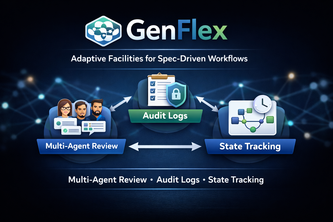
The company appears to be a solo project (1 person) named "genflex", submitted to the OpenAI 2026 hackathon. The author describes it as a flexible SDD companion that integrates AI agents into artifact reviews, maintains audit logs, and tracks user-defined phases without enforcing a workflow.
What changed
The description is a self-reported project submission for a hackathon, not a commercial product or service. It does not indicate any revenue, customers, or operational traction.
The single most important open question
Is this a prototype or proof-of-concept submitted to a hackathon, or is there an intention to develop it into a commercial product? The lack of evidence for any business model, pricing, or customer engagement makes this unclear.
What The Product Actually Is
- The description states that GenFlex is a "flexible SDD companion" — a tool designed to support Spec-Driven Development (SDD).
- It provides three independent capabilities:
- Invokes relevant AI agents to review documents or code changes.
- Keeps ad hoc audit logs for decisions, changes, reviews, and activity.
- Tracks user-defined phases without prescribing their sequence.
- A central
/genflextrigger dispatches each request to the appropriate facility. - It is built as a portable collection of Markdown skills with a golden source and thin pointers for different AI tools.
- Agents, templates, audit logs, and phase tracking are customizable through project files.
Not evidenced No information on actual functionality beyond self-description, no evidence of real-world usage or integration, no demonstration of how the tool works in practice.
Positioning & Claim Evolution
- The author positions GenFlex as a lightweight alternative to rigid AI-assisted development frameworks.
- It is described as a "flexible" SDD companion that adapts to each developer’s own workflow.
- The goal is to avoid imposing new processes while enabling AI collaboration and documentation.
Inferred The positioning reflects an attempt to address the perceived rigidity of existing AI tools in software development, but this is not validated by usage or adoption data.
Not evidenced No evidence of market positioning beyond a hackathon submission. No claims about differentiation from competitors, nor any indication of how it would be marketed or sold.
Target Customer & ICP
- The target customer appears to be developers working in software development environments.
- It is positioned for those who want AI-assisted development but without rigid workflows.
- The tool supports "user-defined phases" and "custom agents", suggesting customization for individual or team needs.
Not evidenced No evidence of specific personas, use cases, or customer segments. No indication of whether the author has engaged with potential users or validated demand.
Business Model & Pricing Evidence
- Not evidenced.
The description does not mention any pricing model, monetization strategy, or business model. It is a hackathon submission and lacks commercial context.
Technical & Delivery Signals
- Built with: ai-assisted-development, cline, markdown, openai-codex, prompt, spec-driven-development, vs-code.
- The system is described as portable, using Markdown skills with thin pointers for different AI tools.
- It supports targeted agent reviews, persistent audit evidence, and custom templates.
- The author mentions challenges around context retention and independent agent execution across AI hosts.
Inferred The tool is built to be lightweight and customizable, possibly intended for integration into existing development workflows.
Not evidenced No information on delivery mechanism, scalability, or technical architecture beyond self-reporting. No evidence of deployment, hosting, or distribution methods.
Traction & Maturity Signals
- Not evidenced.
There is no evidence of revenue, customers, usage metrics, or product maturity beyond a hackathon submission. The project is described as a prototype with no indication of further development or adoption.
Competitive Context
- Not evidenced.
The description does not mention any competitors or how GenFlex compares to existing tools in the AI-assisted development space.
Open Questions & Risks
- Solo team: Only one member (Paul Amazona) is listed, which may limit execution capacity.
- Hackathon submission: The project was submitted to a hackathon and has no commercial traction or evidence of product-market fit.
- No business model: No indication of how the tool would be monetized or sold.
- Unproven adoption: No evidence of real-world usage, customer feedback, or market validation.
Questions the description leaves open
- What is the intended path from this hackathon prototype to a commercial product?
- Have you validated demand for this tool with potential users or teams?
- How do you plan to monetize or distribute GenFlex?
- Are there any existing partnerships, integrations, or early adopters?
- What are the key technical challenges that remain unresolved?
Overall Assessment
- Not evidenced.
There is no evidence of a commercial product, revenue, customers, or traction to support an investment or partnership decision. The project is described as a hackathon submission and lacks any indication of business development beyond its initial concept.
The author states that GenFlex is a "small, dependency-free SDD support layer" but does not provide evidence of adoption, usage, or market validation. It remains unclear whether this is an idea in early-stage prototyping or a product under active development.
Confidence Low — based entirely on self-reported project description with no external corroboration or evidence of traction.
User Stories BotA demo video on every pull request
Get a demo video on every new feature
GitHub App that watches your pull requests and records a narrated, captioned demo.
Save time on demo prep and make informed decisions faster with a video walkthrough of every new feature.
Source
Submitted to the OpenAI 2026 hackathon on Devpost. Project home on Devpost. Back to the full gallery on Devpost.
This competitive analysis was produced by top-founders.com (opens in a new tab)
Generated by a language model from this project's public Devpost page — its tagline, the author's own write-up and any built-with tags listed there — as captured in August 2026. Short quotations are the author's words. It is an opinion on the idea as a business, not on the people behind it, and it reflects the description as published then. If the project has moved on, request a correction below. The analysis is not independent research and contains no verified traction, revenue or customer data.
An independent guide by KFG International LLC — not affiliated with, endorsed by, or connected to Devpost or OpenAI.