

Archive position — measured, not model output
0 likes on Devpost
2,263 of the 7,850 archived projects have more likes, and 5,587 share exactly 0 — so this project's #4,293 place in the like-ranked listing is a tie-break inside that group, not a ranking.
Projects (log scale)
Likes on Devpost. ▲ marks this project's group.
Show the figures
| Likes | Projects | Share of archive |
|---|---|---|
| 0 | 5,587 | 71.2% |
| 1 | 1,758 | 22.4% |
| 2 | 284 | 3.6% |
| 3–4 | 132 | 1.7% |
| 5–9 | 75 | 1.0% |
| 10+ | 14 | 0.2% |
 User Stories BotA demo video on every pull request
Get a demo video on every new feature
GitHub App that watches your pull requests and records a narrated, captioned demo.
Save time on demo prep and make informed decisions faster with a video walkthrough of every new feature.
Executive Summary
What the company appears to be
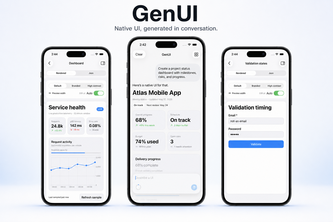
GenUI is a Swift library that translates model-authored JSON into validated, native SwiftUI components. The author describes it as a bridge between generative AI and native app interfaces, enabling models to describe UI without generating executable Swift code or embedding web views.
What changed
This is a follow-up to an earlier prototype built during a previous OpenAI hackathon. The current version is described as a tested library connected to a real agent chat workflow, with improvements in documentation, testing, and integration.
The single most important open question
Is there evidence of any real-world usage or adoption beyond the author's own development work?
What The Product Actually Is
- The description states GenUI is "a Swift library that turns model-authored JSON into validated, adaptive SwiftUI."
- It provides a "bounded document format and 30 native components covering layout, text, forms, controls, tables, charts, images, and feedback states."
- The system supports writable state, conditional visibility, repeated content, application-defined components, and host-owned actions and resources.
- It is described as a Swift 6.3 package for iOS 17 and macOS 14.
- The core components include wire model, decoder, validation rules, state runtime, component registry, renderer, themes, and host-action boundary.
- The system includes a "catalog that is also executable documentation" — the same definitions drive model guidance, validation, gallery, and tests.
Evidence strength Self-reported. No independent verification of product functionality or usage.
Positioning & Claim Evolution
- The description states GenUI is "a follow-up to the first version I built during a previous OpenAI hackathon."
- It positions itself as a middle layer for native app developers, allowing models to choose and configure useful UI while keeping host control over component catalogs, actions, resources, sensitive data, and final presentation.
- The author claims GenUI addresses the choice between rigid prebuilt screens and unbounded generated code in agent interfaces.
- It is described as enabling "models can choose and configure useful UI" while maintaining "host-controlled actions and resources."
Evidence strength Self-reported. No evidence of market positioning or customer feedback.
Target Customer & ICP
- The description states GenUI is for "native app developers."
- It is positioned to help models describe UI without generating executable Swift code.
- The system supports integration with agent chat workflows, where a conversational model decides to generate UI and calls
generate_ui(description)tool. - Host-controlled actions and resources are emphasized, suggesting the target includes developers who need control over sensitive data or app interaction models.
Evidence strength Self-reported. No evidence of actual customers or user personas.
Business Model & Pricing Evidence
- Not evidenced. The description does not mention any pricing model, monetization strategy, or commercial arrangements.
Evidence strength Not evidenced.
Technical & Delivery Signals
- Built with Swift 6.3 for iOS 17 and macOS 14.
- Uses bun, TypeScript, Codex, GPT-5.6, Hugging Face, Xcode.
- The system includes a "guarded compiler-evaluation and corpus-generation pipeline."
- Includes a "GenUI Compiler Corpus" with 5,000 accepted synthetic examples (4,000 description-to-UI, 1,000 diagnostic-guided repair).
- The author states 211/211 Swift package tests passing, 82/82 compiler and data-generation tests passing, 22/22 iOS compiler and chat tests passing.
- Includes deterministic snapshot baselines (25) and corpus records accepted with final verification passing (5,000/5,000).
Evidence strength Self-reported. No evidence of product delivery to customers or real-world deployment.
Traction & Maturity Signals
- Not evidenced. The description does not mention any revenue, customers, user adoption, or usage metrics beyond the author's own development work.
- The project is described as a "follow-up" to an earlier prototype, but no evidence of prior traction or product-market fit is provided.
Evidence strength Not evidenced.
Competitive Context
- Not evidenced. No mention of competitors or market positioning in relation to other generative UI tools or frameworks.
Evidence strength Not evidenced.
Open Questions & Risks
- The project is described as a single-person effort (team size: 1).
- No evidence of revenue, customers, or product-market fit.
- The description states the system is "not dependent on a fine-tuned model" but mentions that fine-tuning is the next step — suggesting it's not yet production-ready.
- The author notes challenges in defining a safe contract for UI with state and behavior, indicating complexity in implementation.
- No evidence of any commercial or user-facing product beyond the author’s own development.
Evidence strength Inferred from self-reported description. Not independently verified.
Questions the description leaves open
- What is the current status of the GenUI library — is it available for developers to use, and has it been tested in real-world applications?
- How does GenUI handle security concerns, particularly around resource loading and preventing sensitive data leaks into generated actions?
- Are there any plans or early signs of adoption by other developers or teams beyond your own?
- What are the specific use cases you've identified for GenUI beyond the example agent chat workflow?
- What is the roadmap for moving from the current prototype to a production-ready product?
Evidence strength Inferences based on self-reported description.
Overall Assessment
- Not evidenced. No information about valuation, funding rounds, or investment interest.
- The project is described as a single-person effort with no evidence of traction or commercial viability.
- It appears to be an experimental prototype built during a hackathon, not yet a product with market validation.
Evidence strength Inferred from self-reported description. Not independently verified.
User Stories BotA demo video on every pull request
Get a demo video on every new feature
GitHub App that watches your pull requests and records a narrated, captioned demo.
Save time on demo prep and make informed decisions faster with a video walkthrough of every new feature.
Source
Submitted to the OpenAI 2026 hackathon on Devpost. Project home on Devpost. Back to the full gallery on Devpost.
This competitive analysis was produced by top-founders.com (opens in a new tab)
Generated by a language model from this project's public Devpost page — its tagline, the author's own write-up and any built-with tags listed there — as captured in August 2026. Short quotations are the author's words. It is an opinion on the idea as a business, not on the people behind it, and it reflects the description as published then. If the project has moved on, request a correction below. The analysis is not independent research and contains no verified traction, revenue or customer data.
An independent guide by KFG International LLC — not affiliated with, endorsed by, or connected to Devpost or OpenAI.