

Archive position — measured, not model output
0 likes on Devpost
2,263 of the 7,850 archived projects have more likes, and 5,587 share exactly 0 — so this project's #4,279 place in the like-ranked listing is a tie-break inside that group, not a ranking.
Projects (log scale)
Likes on Devpost. ▲ marks this project's group.
Show the figures
| Likes | Projects | Share of archive |
|---|---|---|
| 0 | 5,587 | 71.2% |
| 1 | 1,758 | 22.4% |
| 2 | 284 | 3.6% |
| 3–4 | 132 | 1.7% |
| 5–9 | 75 | 1.0% |
| 10+ | 14 | 0.2% |
 User Stories BotA demo video on every pull request
Get a demo video on every new feature
GitHub App that watches your pull requests and records a narrated, captioned demo.
Save time on demo prep and make informed decisions faster with a video walkthrough of every new feature.
Executive Summary
What the company appears to be
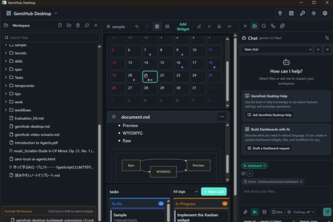
GemiHub Desktop is a self-reported local-first desktop workspace that integrates reading, annotation, AI interaction, automation, and extension capabilities into a single app. It positions itself as an AI knowledge hub that turns documents into context Codex can act on.
What changed
The author states this project emerged from three separate tools they used daily — one for reading, one for note-taking, and one for AI coding agents — which were fragmented in workflow. The goal was to unify these into a single app using build-time AI assistance (Codex) and local-first architecture.
Single most important open question
Is there evidence of traction or commercial adoption beyond the author's own use case?
What The Product Actually Is
The description states that GemiHub Desktop is:
- A local-first desktop workspace
- Designed to turn reading into AI-ready context
- Built with a single self-contained binary under 20 MB, no runtime required
- Capable of opening and viewing PDFs, EPUBs, Markdown, HTML, and images side-by-side as movable widgets
- Supports semantic search across documents
- Allows users to capture highlights into source-linked memos
- Enables AI interaction through right-click actions, without needing prompt syntax or copy-paste
- Offers workflow automation using YAML-based workflows
- Provides an extension model for plugins that abstract AI access from plugin authors
It is described as a tool built with Codex both at runtime and development time, and it supports multiple platforms (Windows, macOS, Linux).
Claim: GemiHub Desktop is a local-first desktop app integrating reading, annotation, AI interaction, automation, and extensibility.
Evidence: Self-reported in the project write-up.
Positioning & Claim Evolution
The author states:
- The product starts with what you're reading — not a chat box
- It aims to make AI context-aware by turning documents into reusable knowledge
- It reframes Codex from a coding assistant to a knowledge-work engine
- It is positioned as an app that “builds instead of buys” using AI (e.g., Codex helped build a PDF library in one hour)
- The UI is designed to avoid syntax — “The best interface to an AI isn’t syntax. It’s intent.”
Claim: GemiHub Desktop positions itself as a local-first, AI-integrated knowledge workspace that avoids traditional prompt syntax.
Evidence: Self-reported in the project write-up.
Target Customer & ICP
The description states:
- The app is built for individuals who read and annotate documents
- It supports workflows involving reading, memos, and AI agents
- It is designed to be used by someone who wants to keep their knowledge local, without needing an account or API keys
- It supports personal documentation and knowledge management
Claim: The target customer is a self-contained individual user focused on personal knowledge management.
Evidence: Self-reported in the project write-up.
Business Model & Pricing Evidence
The description states:
- No pricing information is provided
- No revenue model or monetization strategy is described
- The app is open-source and available for download as a binary
- It supports local-first operation, with no cloud or subscription requirements
Claim: There is no evidence of a business model or pricing structure.
Evidence: Not evidenced.
Technical & Delivery Signals
The description states:
- Built using Go + Wails, Deno + Vite + React, and pdf.js
- A single self-contained binary under 20 MB with no runtime dependencies
- Supports Windows (amd64/arm64), macOS (arm64), and Linux (amd64/arm64)
- Uses Codex for both development and runtime
- Includes sandboxing, versioning, and deletion safety features
- Has a plugin architecture that abstracts AI access from plugin authors
Claim: GemiHub Desktop is a cross-platform, local-first desktop app built with modern tech stack and sandboxed AI interaction.
Evidence: Self-reported in the project write-up.
Traction & Maturity Signals
The description states:
- The app was built during a hackathon (OpenAI 2026)
- It is described as a production-ready desktop app
- It supports zero runtime dependencies, and ships with one binary
- It has been tested across multiple platforms
- It includes features like semantic search, plugin architecture, and timeline-based chronology
However, there is no mention of:
- Users or customer base
- Revenue or monetization
- Adoption metrics
- Customer feedback or usage data
Claim: There is no evidence of traction or user adoption.
Evidence: Not evidenced.
Competitive Context
The description states:
- The app aims to unify reading, annotation, and AI interaction into one workflow
- It contrasts with tools that require manual context transfer between apps
- It positions itself as an alternative to tools like Obsidian, Codex, and others in the AI knowledge space
Claim: GemiHub Desktop competes in the AI-powered knowledge management space.
Evidence: Self-reported positioning.
Open Questions & Risks
The description states:
- The app is built by a single developer (takeshy Morita)
- It is described as a solo project with no external team or funding
- It is not clear how it will scale beyond the author’s own use case
- No mention of security, privacy, or data governance features beyond sandboxing
Claim: Risks include lack of team, scalability concerns, and unclear long-term strategy.
Evidence: Self-reported in the project write-up.
Questions the description leaves open
- What is your plan for scaling beyond a solo developer?
- How do you intend to monetize or generate revenue from this tool?
- Are there any plans for cloud sync or collaboration features?
- How do you plan to ensure long-term maintenance and updates?
- Have you considered how the app will evolve with AI provider changes (e.g., OpenAI API shifts)?
- What is your roadmap beyond the current features?
Inference: These are key questions that would help assess viability, scalability, and commercial potential.
Overall Assessment
The description states:
- The project is a solo developer effort
- It has no revenue or customer data
- It is open-source and available for download
- No funding or investment history is mentioned
Claim: There is no evidence of a viable business model, traction, or commercial readiness.
Evidence: Not evidenced.
User Stories BotA demo video on every pull request
Get a demo video on every new feature
GitHub App that watches your pull requests and records a narrated, captioned demo.
Save time on demo prep and make informed decisions faster with a video walkthrough of every new feature.
Source
Submitted to the OpenAI 2026 hackathon on Devpost. Project home on Devpost. Back to the full gallery on Devpost.
This competitive analysis was produced by top-founders.com (opens in a new tab)
Generated by a language model from this project's public Devpost page — its tagline, the author's own write-up and any built-with tags listed there — as captured in August 2026. Short quotations are the author's words. It is an opinion on the idea as a business, not on the people behind it, and it reflects the description as published then. If the project has moved on, request a correction below. The analysis is not independent research and contains no verified traction, revenue or customer data.
An independent guide by KFG International LLC — not affiliated with, endorsed by, or connected to Devpost or OpenAI.