

Archive position — measured, not model output
0 likes on Devpost
2,263 of the 7,850 archived projects have more likes, and 5,587 share exactly 0 — so this project's #4,274 place in the like-ranked listing is a tie-break inside that group, not a ranking.
Projects (log scale)
Likes on Devpost. ▲ marks this project's group.
Show the figures
| Likes | Projects | Share of archive |
|---|---|---|
| 0 | 5,587 | 71.2% |
| 1 | 1,758 | 22.4% |
| 2 | 284 | 3.6% |
| 3–4 | 132 | 1.7% |
| 5–9 | 75 | 1.0% |
| 10+ | 14 | 0.2% |
 User Stories BotA demo video on every pull request
Get a demo video on every new feature
GitHub App that watches your pull requests and records a narrated, captioned demo.
Save time on demo prep and make informed decisions faster with a video walkthrough of every new feature.
Executive Summary
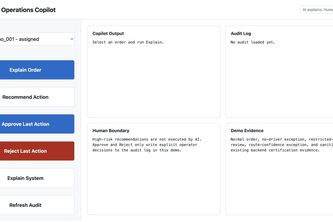
The description states that GBA Go Operations Copilot is an operator-facing AI tool for reservation mobility platforms. It presents a synthetic-data demo console with an API, designed to explain operational decisions, recommend actions, and require human approval for high-risk moves. The system uses Codex and OpenAI models, integrates with a centralized OpenAI Responses API, and logs all AI explanations and human approvals separately. The author claims this is a safe, human-in-the-loop solution that avoids production credential exposure or real user data.
The project appears to be a hackathon submission (Devpost entry for OpenAI 2026) with no evidence of revenue, customers, or operational traction beyond the demo. It is self-reported and unverified, built by one person using open-source tools and synthetic data only. The author states that this is a "safe standalone slice" that avoids production credentials and real user data.
The single most important open question
Is there any evidence of prior development or integration with a live reservation mobility system beyond the demo? If not, what is the path to production readiness?
What The Product Actually Is
- The description states GBA Go Operations Copilot is an operator-facing API and browser-based demo console for reservation mobility operations.
- It takes an order ID as input.
- It reads synthetic order, fare, dispatch, driver, risk, and stability evidence.
- It explains what happened, recommends the next operational action, and requires a human operator to approve or reject high-risk actions.
- Each explanation is grounded in structured demo evidence, not model-invented facts.
- AI recommendations and human decisions are logged separately.
- Approval records the operator's decision in the demo audit flow, but does not mutate any production mobility system.
The author states: “Given an order id, the Copilot reads synthetic order, fare, dispatch, driver, risk, and stability evidence. It explains what happened, recommends the next operational action, and requires a human operator to approve or reject high-risk actions.”
Positioning & Claim Evolution
- The description positions GBA Go as an AI operations copilot for reservation mobility.
- It emphasizes explainable decision-making, safer dispatch decisions, and human-approved interventions.
- The author claims the system is built to avoid production credential exposure or real user data.
- It is framed as a human-in-the-loop governance boundary rather than an autonomous system.
- The project is described as part of a larger GBA Go system, but the demo is a standalone slice for Build Week.
The author states: “GBA Go explores how Codex and OpenAI models can turn those operational signals into clear, auditable decisions.”
Target Customer & ICP
- The target customer is operators of reservation mobility platforms, such as ride-hailing or shared mobility services.
- The system is designed for operator-facing use — not end-users (passengers or drivers).
- It is built to support dispatch decisions, fare explanations, and incident review.
- The demo is intended for internal operational workflows, not external customer-facing tools.
The author states: “GBA Go Operations Copilot provides an operator-facing API and browser-based demo console for reservation mobility operations.”
Business Model & Pricing Evidence
- Not evidenced. No pricing, monetization or business model details are provided in the description.
The description does not state any business model, pricing strategy, or revenue mechanism.
Technical & Delivery Signals
- Built with FastAPI, OpenAI API integration, Codex assistance, and Python-based tools.
- Uses a centralized OpenAI Responses API integration module with environment-based secret handling.
- Includes browser-based demo console, audit logging, and synthetic sample data.
- The system is designed to be safe, avoiding production credentials, real user data, or high-risk AI execution.
- The demo includes TEST_REPORT.md, SECURITY_SCAN_REPORT.md, and CODEX_CONTRIBUTIONS.md as supporting evidence.
The author states: “The demo is a FastAPI service with synthetic sample data, a browser-based operator console, audit logging, and a centralized OpenAI Responses API integration module.”
Traction & Maturity Signals
- Not evidenced. No customer data, revenue, usage metrics, or adoption signals are provided.
- The project is described as a hackathon submission (Devpost entry for OpenAI 2026).
- It is a standalone demo slice, not a production-ready system.
- The author mentions that the broader GBA Go system existed before Build Week but does not state whether it has been deployed or used.
The description states: “This submission uses synthetic data only. It excludes production databases, Redis URLs, Railway variables, API keys, Apple signing files, real passenger or driver information…”
Competitive Context
- Not evidenced. No mention of existing competitive products or market positioning.
- The author does not reference competitors or similar tools in the reservation mobility space.
The description does not state any competitive landscape or prior product comparisons.
Open Questions & Risks
- The system is not production-ready, as it is a demo using synthetic data and isolated from real systems.
- It is built by one person (Qian Calvin), with no indication of team size beyond that.
- There is no evidence of prior traction, customers or revenue.
- The project is described as a hackathon submission, which may indicate limited commercial viability or maturity.
- The system avoids production credentials and real data — this may be a feature for safety but also a limitation in demonstrating real-world applicability.
The author states: “GBA Go is a larger mobility system, but a hackathon submission needs a crisp story and a safe demo.”
Questions the description leaves open
- What is the relationship between this demo and the broader GBA Go system? Is there any evidence of prior development or integration with a live platform?
- Has this system been tested in real-world operations, or is it purely a demo?
- What are the plans for integrating this into a production system beyond the demo?
- How does the team plan to scale beyond a single-person development effort?
- Are there any existing partnerships or early adopters in the mobility space?
Overall Assessment
- Not evidenced. No financial data, valuation, funding rounds, or investment interest are provided.
- The project is described as a hackathon submission, with no evidence of traction or commercial viability.
- It is built by one person and uses synthetic data only — not indicative of a mature product or business.
The description states: “This submission uses synthetic data only. It excludes production databases, Redis URLs, Railway variables, API keys…”
User Stories BotA demo video on every pull request
Get a demo video on every new feature
GitHub App that watches your pull requests and records a narrated, captioned demo.
Save time on demo prep and make informed decisions faster with a video walkthrough of every new feature.
Source
Submitted to the OpenAI 2026 hackathon on Devpost. Project home on Devpost. Back to the full gallery on Devpost.
This competitive analysis was produced by top-founders.com (opens in a new tab)
Generated by a language model from this project's public Devpost page — its tagline, the author's own write-up and any built-with tags listed there — as captured in August 2026. Short quotations are the author's words. It is an opinion on the idea as a business, not on the people behind it, and it reflects the description as published then. If the project has moved on, request a correction below. The analysis is not independent research and contains no verified traction, revenue or customer data.
An independent guide by KFG International LLC — not affiliated with, endorsed by, or connected to Devpost or OpenAI.