

Archive position — measured, not model output
0 likes on Devpost
2,263 of the 7,850 archived projects have more likes, and 5,587 share exactly 0 — so this project's #3,926 place in the like-ranked listing is a tie-break inside that group, not a ranking.
Projects (log scale)
Likes on Devpost. ▲ marks this project's group.
Show the figures
| Likes | Projects | Share of archive |
|---|---|---|
| 0 | 5,587 | 71.2% |
| 1 | 1,758 | 22.4% |
| 2 | 284 | 3.6% |
| 3–4 | 132 | 1.7% |
| 5–9 | 75 | 1.0% |
| 10+ | 14 | 0.2% |
 User Stories BotA demo video on every pull request
Get a demo video on every new feature
GitHub App that watches your pull requests and records a narrated, captioned demo.
Save time on demo prep and make informed decisions faster with a video walkthrough of every new feature.
Executive Summary
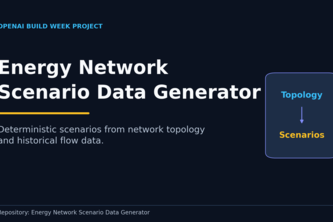
The description states that Energy Network Scenario Data Generator is a self-contained prototype for generating synthetic operating scenarios for energy-network engineering review. The author reports building an end-to-end workflow using AI-assisted development tools (Codex, GPT-5.6) and a structured engineering process. It includes Python processing pipelines, FastAPI backend, React dashboard, and deterministic scenario generation with validation checks.
The project appears to be a proof-of-concept built as part of a hackathon submission. No evidence of revenue, customers, or traction is provided. The author emphasizes reproducibility, validation, and human oversight in AI-assisted development but does not describe any commercial deployment or use beyond the prototype.
Most important open question
Is there any evidence that this system has been adopted or used by engineers outside of the prototype phase?
What The Product Actually Is
The description states that Energy Network Scenario Data Generator is a system that:
- Transforms network topology and historical flow information into synthetic operating scenarios.
- Includes:
- A Python processing pipeline for graph transformation, profiling, scenario generation, and reproducibility tracking.
- A FastAPI backend exposing processed data.
- A React dashboard for topology inspection, scenario visualization, subnetwork review, and validation.
- Supports deterministic generation using fixed seeds and documented configuration.
- Provides validation covering balance, nodal bounds, structural consistency, and scenario coverage.
The system is described as an end-to-end workflow for producing and reviewing synthetic network operating scenarios.
Inference The product is a software prototype designed to support engineering review of energy networks through synthetic data generation. It is not described as a commercial product or service.
Positioning & Claim Evolution
The description states that the project was built to address:
- Manual creation of datasets for energy-network planning, testing, and ML workflows.
- Challenges with speed, validation difficulty, and distribution of historical network data.
It positions itself as a reproducible workflow that transforms network data into synthetic scenarios while maintaining visibility for engineers to inspect, validate, and review results.
The author also frames it as an experiment in AI-assisted software engineering, using ChatGPT and Codex across planning, architecture, implementation, testing, documentation, and demo preparation.
Inference The positioning evolved from a technical challenge (manual data creation) to a solution that combines synthetic data generation with AI-assisted development. It does not claim to be a commercial product or platform for widespread adoption.
Target Customer & ICP
The description states that the system is intended for engineers working in energy-network planning, testing, and machine-learning workflows.
It supports:
- Inspection of original and transformed network structures.
- Comparison of generated distributions.
- Review of subnetworks.
- Verification of engineering checks before downstream use.
No specific customer segments or personas are named. The system is described as a tool for engineering review, not end-users or consumers.
Inference The target customer is likely energy-network engineers or planners who require synthetic datasets for simulation, testing, and ML training. However, no evidence of actual users or customer engagement exists.
Business Model & Pricing Evidence
There is no evidence in the description of a business model or pricing structure.
The project is described as a prototype, built for a hackathon, with no mention of monetization, licensing, or commercial use.
Inference No business model or pricing is evident. The system is not described as a product for sale or subscription.
Technical & Delivery Signals
The description states that the system includes:
- A Python processing pipeline.
- A FastAPI backend.
- A React dashboard with WebGL-based topology views.
- Deterministic generation using fixed seeds and documented configuration.
- Validation covering balance, nodal bounds, structural consistency, and scenario coverage.
- Automated tests for frontend and backend.
- Playwright-based browser automation for demo production.
- FFmpeg-based video assembly and technical validation.
The author reports using Codex with GPT-5.6 as a development assistant across the full software lifecycle.
Inference The system is built with modern engineering practices (CI/CD, testing, documentation) and uses AI tools to support development. It is not described as scalable or production-ready.
Traction & Maturity Signals
The description states that this was a hackathon submission, and the project is described as a complete working prototype.
It includes:
- A reproducible scenario-generation pipeline.
- A documented FastAPI service.
- An interactive React dashboard.
- Automated tests.
- Deterministic generation with validation.
- A repeatable demo-production workflow.
However, there is no evidence of adoption, revenue, or customer traction beyond the prototype phase.
Inference The system is at a prototype stage, not a product or platform. No evidence of real-world usage or market traction exists.
Competitive Context
The description does not mention any competitors or direct market context.
It focuses on the use case (energy-network scenario generation) and technical approach (AI-assisted development, deterministic synthetic data), but no reference is made to existing tools or platforms in this domain.
Inference No competitive landscape is described. The project appears to be a novel prototype without known competitors in its stated scope.
Open Questions & Risks
- No commercial traction: The system is described as a prototype, with no evidence of adoption or revenue.
- AI-assisted development only: While the author claims AI support, there is no evidence that this has been scaled into production or used by others.
- Limited scope: The system is built for specific engineering use cases and does not appear to be designed for broader market application.
- No validation beyond prototype: The project does not claim to perform full hydraulic or pressure-feasibility analysis, but it also does not describe how this limitation is addressed in practice.
Inference The main risk is that the system remains a proof-of-concept, not a product with commercial viability or traction.
Questions the description leaves open
- What specific energy-network engineering workflows will this be used for?
- Has anyone outside of the team tested or reviewed the synthetic scenarios?
- Are there any plans to expand beyond the current prototype into a production-ready system?
- How is the validation process defined and maintained over time?
- What are the limitations of the current synthetic data generation approach?
- Is there any interest from energy-network engineers in adopting this tool?
Overall Assessment
The description states that Energy Network Scenario Data Generator is a prototype built for a hackathon, with no evidence of commercial use, revenue, or traction.
It is described as an AI-assisted engineering tool for generating synthetic energy network scenarios, but it does not appear to be a product or platform for sale or deployment.
Inference This is a pre-product prototype. There is no basis for investment or partnership at this stage. It may evolve into a product in the future, but current evidence supports only its status as a proof-of-concept.
User Stories BotA demo video on every pull request
Get a demo video on every new feature
GitHub App that watches your pull requests and records a narrated, captioned demo.
Save time on demo prep and make informed decisions faster with a video walkthrough of every new feature.
Source
Submitted to the OpenAI 2026 hackathon on Devpost. Project home on Devpost. Back to the full gallery on Devpost.
This competitive analysis was produced by top-founders.com (opens in a new tab)
Generated by a language model from this project's public Devpost page — its tagline, the author's own write-up and any built-with tags listed there — as captured in August 2026. Short quotations are the author's words. It is an opinion on the idea as a business, not on the people behind it, and it reflects the description as published then. If the project has moved on, request a correction below. The analysis is not independent research and contains no verified traction, revenue or customer data.
An independent guide by KFG International LLC — not affiliated with, endorsed by, or connected to Devpost or OpenAI.