

Archive position — measured, not model output
0 likes on Devpost
2,263 of the 7,850 archived projects have more likes, and 5,587 share exactly 0 — so this project's #4,253 place in the like-ranked listing is a tie-break inside that group, not a ranking.
Projects (log scale)
Likes on Devpost. ▲ marks this project's group.
Show the figures
| Likes | Projects | Share of archive |
|---|---|---|
| 0 | 5,587 | 71.2% |
| 1 | 1,758 | 22.4% |
| 2 | 284 | 3.6% |
| 3–4 | 132 | 1.7% |
| 5–9 | 75 | 1.0% |
| 10+ | 14 | 0.2% |
 User Stories BotA demo video on every pull request
Get a demo video on every new feature
GitHub App that watches your pull requests and records a narrated, captioned demo.
Save time on demo prep and make informed decisions faster with a video walkthrough of every new feature.
Executive Summary
What the company appears to be
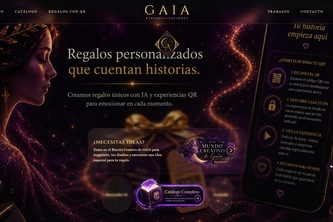
GAIA – Every Gift Tells a Story is a self-reported project submitted to the OpenAI 2026 hackathon. The description states it aims to turn personalized gifts into emotional journeys using QR codes that unlock evolving memories, stories and surprises.
What changed
The project was submitted to a hackathon — this is the only change evidenced in the description.
The single most important open question
Is there any evidence of product-market fit, customer traction or revenue generation? Not evidenced.
What The Product Actually Is
The description states that GAIA "turns personalized gifts into emotional journeys" and uses "a single QR code" to unlock "evolving memories, stories and surprises." It is described as a tool for creating "lasting experiences instead of one-time gifts."
Evidence The author describes the product as enabling gift-givers to create "emotional journeys" through QR codes that reveal evolving content. No further detail on how this works technically or what the actual product interface looks like.
Inference Based on the technology stack (e.g., GPT, Supabase, Netlify), it may involve a web-based platform with AI-driven content generation and cloud storage for memories/stories.
Positioning & Claim Evolution
The author states that GAIA "turns personalized gifts into emotional journeys" and helps people "create lasting experiences instead of one-time gifts."
Evidence The tagline and description position the product as a tool to enhance gift-giving with emotional storytelling, using QR codes as a delivery mechanism.
Inference This positioning suggests an emotional or experiential value proposition rather than functional utility. It is unclear whether this is a new category or a repositioning of existing gift technologies.
Target Customer & ICP
The description does not identify specific customer segments or target personas.
Evidence No mention of who the intended users are, whether they are gift-givers, recipients, event planners, or others.
Inference Based on the claim that it's for "personalized gifts," it may be aimed at individuals or businesses involved in gifting — but no evidence supports this inference.
Business Model & Pricing Evidence
There is no evidence of a business model or pricing structure described.
Evidence The description does not mention monetization, subscriptions, transaction fees, or any commercial framework.
Inference If the product is web-based and uses cloud services (e.g., Supabase, OpenAI), it may be built with a freemium or usage-based model — but this is speculative.
Technical & Delivery Signals
The project was built using several technologies including:
- API
- Cloudflare
- CSS
- Functions
- Gemini
- GPT
- HTML
- Image processing
- JavaScript
- Netlify
- OpenAI
- Resend
- Supabase
- Three.js
- Turnstile
- Vite
Evidence The author lists these as the technologies used in building the product.
Inference The use of AI (GPT, Gemini), cloud infrastructure (Supabase, Netlify), and frontend frameworks (Vite, Three.js) suggests a modern web application with some AI integration. However, no evidence of delivery or production systems is provided.
Traction & Maturity Signals
There is no evidence of traction, customers, or product maturity.
Evidence The project was submitted to a hackathon and has no mention of users, revenue, or adoption.
Inference As a hackathon submission, it likely represents an early-stage prototype or concept, not a developed product.
Competitive Context
No competitive analysis is provided in the description.
Evidence No mention of competitors, market positioning, or differentiation from existing gift or storytelling platforms.
Inference If this is a gift experience platform, it may compete with services like personalized photo books, digital memory journals, or event-based gift experiences — but no evidence supports this.
Open Questions & Risks
- No traction or revenue: The project is described only as a hackathon submission.
- Unproven market fit: No evidence of customer validation or demand.
- Limited team size: Only one member listed, which may limit execution capacity.
- Unclear monetization: No business model or pricing structure provided.
- No product demo or user interface details: The description is abstract and lacks concrete product signals.
Questions the description leaves open
- What problem are you solving with GAIA, and how did you validate that it's a real need?
- Who are your target users, and what evidence do you have of their interest or willingness to pay?
- How does the product work technically — can you walk us through a user journey?
- Are there any existing competitors in this space? What is your differentiation?
- What is your go-to-market strategy, and how are you planning to acquire users?
- Have you built a minimum viable product (MVP) or prototype that users have tested?
Overall Assessment
Not evidenced.
The description provides no evidence of revenue, customers, traction, or business model. It is a self-reported hackathon submission with no indication of commercial viability or market validation.
This project does not meet the criteria for due-diligence evaluation as a potential investment or partnership target at this stage. It is an early-stage idea or prototype, not a product in development or operation.
User Stories BotA demo video on every pull request
Get a demo video on every new feature
GitHub App that watches your pull requests and records a narrated, captioned demo.
Save time on demo prep and make informed decisions faster with a video walkthrough of every new feature.
Source
Submitted to the OpenAI 2026 hackathon on Devpost. Project home on Devpost. Back to the full gallery on Devpost.
This competitive analysis was produced by top-founders.com (opens in a new tab)
Generated by a language model from this project's public Devpost page — its tagline and any built-with tags listed there, since the author published no write-up — as captured in August 2026. Short quotations are the author's words. It is an opinion on the idea as a business, not on the people behind it, and it reflects the description as published then. If the project has moved on, request a correction below. The analysis is not independent research and contains no verified traction, revenue or customer data.
An independent guide by KFG International LLC — not affiliated with, endorsed by, or connected to Devpost or OpenAI.