

Archive position — measured, not model output
0 likes on Devpost
2,263 of the 7,850 archived projects have more likes, and 5,587 share exactly 0 — so this project's #4,201 place in the like-ranked listing is a tie-break inside that group, not a ranking.
Projects (log scale)
Likes on Devpost. ▲ marks this project's group.
Show the figures
| Likes | Projects | Share of archive |
|---|---|---|
| 0 | 5,587 | 71.2% |
| 1 | 1,758 | 22.4% |
| 2 | 284 | 3.6% |
| 3–4 | 132 | 1.7% |
| 5–9 | 75 | 1.0% |
| 10+ | 14 | 0.2% |
 User Stories BotA demo video on every pull request
Get a demo video on every new feature
GitHub App that watches your pull requests and records a narrated, captioned demo.
Save time on demo prep and make informed decisions faster with a video walkthrough of every new feature.
Executive Summary
What the company appears to be
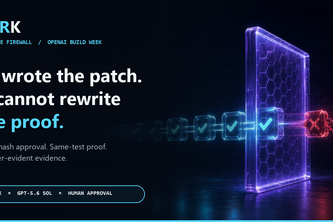
FORK is a self-reported tool that operates as a "code agent firewall" for AI coding agents. It is described as a plugin for Codex that enforces a strict permission boundary between AI-generated code changes and human approval, ensuring that only explicitly reviewed patches are applied to a Git repository.
What changed
The project description indicates that FORK was developed during the OpenAI 2026 hackathon (Build Week). It is presented as a proof-of-concept with a live demo showing how it integrates AI-generated tests and repairs within a deterministic workflow, while maintaining human control over final patch application.
Single most important open question
Is there any evidence of real-world usage or integration beyond the hackathon demo? The description states that FORK is a plugin for Codex but does not indicate whether it has been adopted by users or integrated into production workflows outside of this demonstration.
What The Product Actually Is
The description states that FORK is a deterministic local verifier designed to run inside an actual Git repository as a Codex plugin. It operates through a staged workflow including:
- Initialization (
init) - Locking the test (
lock-test) - Proposing a repair (
propose) - Human approval (
approve) - Applying the patch (
apply) - Verification (
verify)
It uses SHA-256 hashes, Git unified diffs, and strict path parsing to ensure that only approved changes are applied. The system also includes a browser-based viewer that validates evidence artifacts using JSON structures and hash comparisons.
The product is described as being built with TypeScript, React, Node.js, and integrates with OpenAI APIs (specifically GPT-5.6 Sol).
Claim: FORK is a plugin for Codex that enforces deterministic workflows between AI authorship and human approval.
Inferred from the description: The system uses Git-based identity checks, SHA-256 hashes, and structured model outputs to maintain evidence integrity.
Positioning & Claim Evolution
The project positions itself as a solution to the credibility gap in AI coding agents, where models can both write tests and fixes but may alter or obscure their own work. The authors state that they wanted something more than an agent that simply says “I fixed it.” Instead, FORK enforces a narrow permission boundary between AI-generated content and human decision-making.
It is described as a code agent firewall, aiming to prevent models from changing the evidence used to judge their own work.
Claim: FORK addresses the problem of AI agents weakening or altering tests they create.
Inferred from the description: The tool introduces a structured, deterministic workflow that separates intelligence (Codex) from authority (human approval).
Target Customer & ICP
The description does not explicitly name target customers. However, it implies usage by developers working in Git-based environments, particularly those using AI coding agents like Codex. The tool is described as a plugin for Codex and designed to work within real repositories, suggesting its primary audience includes:
- Developers or teams using AI-assisted development tools
- Organizations concerned with auditability and traceability of code changes
Claim: FORK targets developers who use AI coding agents in Git-based workflows.
Inferred from the description: The tool is built for integration into existing CI/CD pipelines via Codex, suggesting a developer-focused ICP.
Business Model & Pricing Evidence
There is no mention of pricing or business model in the provided description. No revenue streams, monetization strategies, or customer acquisition plans are described.
Not evidenced
Technical & Delivery Signals
FORK is built using:
- TypeScript
- React 19
- Node.js
- Git integration
- OpenAI API (GPT-5.6 Sol)
- Vite
- SHA-256 hashing
- Deterministic command execution
It uses a staged workflow with independent failure points, and includes:
- A local browser validator
- Structured JSON schema output from GPT-5.6 Sol
- Strict path parsing and Git diff handling
- Verification of patch hashes and test states
Claim: FORK is implemented as a deterministic CLI tool and web viewer with strict validation mechanisms.
Inferred from the description: The system enforces determinism through command contracts, hash identities, and controlled execution paths.
Traction & Maturity Signals
There is no evidence of traction or adoption beyond the hackathon submission. No customers, users, or real-world deployments are mentioned.
Not evidenced
Competitive Context
The description does not reference competitors or existing tools in this space. It focuses on the unique value proposition of separating AI intelligence from authority, rather than comparing itself to other solutions.
Not evidenced
Open Questions & Risks
- No real-world usage: The tool is only demonstrated in a hackathon setting.
- Limited scope: Designed for use within Codex and Git repositories; unclear if it supports broader CI/CD or IDE integrations.
- Unclear scalability: No indication of how the system would scale beyond a single developer workflow.
- Dependency on Codex: The tool is tightly coupled with Codex, limiting its applicability to other AI coding platforms.
Inferred from the description: The lack of real-world deployment and limited integration points raise concerns about long-term viability.
Questions the description leaves open
- Has FORK been tested or used in any production environments beyond the demo?
- What are the plans for expanding beyond Codex and Git-based workflows?
- How does FORK handle edge cases like merge conflicts, complex dependency changes, or multi-file patches?
- Is there a roadmap for integrating with other AI coding platforms or CI/CD systems?
- What is the long-term vision for the tool—will it evolve into a commercial product?
Overall Assessment
At this stage, FORK appears to be a proof-of-concept developed during a hackathon. While the idea of enforcing deterministic workflows between AI and human approval is compelling, there is no evidence of traction, revenue, or real-world adoption.
Claim: FORK is a prototype tool for AI code agent auditing.
Inferred from the description: The tool shows potential but lacks commercial viability or scalability indicators.
User Stories BotA demo video on every pull request
Get a demo video on every new feature
GitHub App that watches your pull requests and records a narrated, captioned demo.
Save time on demo prep and make informed decisions faster with a video walkthrough of every new feature.
Source
Submitted to the OpenAI 2026 hackathon on Devpost. Project home on Devpost. Back to the full gallery on Devpost.
This competitive analysis was produced by top-founders.com (opens in a new tab)
Generated by a language model from this project's public Devpost page — its tagline, the author's own write-up and any built-with tags listed there — as captured in August 2026. Short quotations are the author's words. It is an opinion on the idea as a business, not on the people behind it, and it reflects the description as published then. If the project has moved on, request a correction below. The analysis is not independent research and contains no verified traction, revenue or customer data.
An independent guide by KFG International LLC — not affiliated with, endorsed by, or connected to Devpost or OpenAI.