

Archive position — measured, not model output
0 likes on Devpost
2,264 of the 7,856 archived projects have more likes, and 5,592 share exactly 0 — so this project's #4,159 place in the like-ranked listing is a tie-break inside that group, not a ranking.
Projects (log scale)
Likes on Devpost. ▲ marks this project's group.
Show the figures
| Likes | Projects | Share of archive |
|---|---|---|
| 0 | 5,592 | 71.2% |
| 1 | 1,758 | 22.4% |
| 2 | 285 | 3.6% |
| 3–4 | 132 | 1.7% |
| 5–9 | 75 | 1.0% |
| 10+ | 14 | 0.2% |
Executive Summary
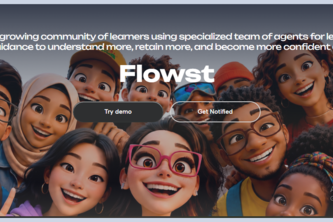
What the company appears to be: Flowst - Flowstate for Learning is a self-reported multi-agent AI learning platform designed to help users understand, retain, and vocalize knowledge through specialized AI agents that support different aspects of learning such as planning, clarity, voice interaction, and assessment. It is described as an immersive, personalized learning experience built around the Feynman Technique and aimed at visual learners.
What changed: The author states that this project evolved from personal frustration with traditional online learning methods and a desire to build a more inclusive, adaptive platform for learners. It began as a hackathon submission but has since been conceptualized as a long-term platform with ambitions to include community features, AI literacy education, and integration into classroom settings.
Single most important open question: Is there any evidence of actual user engagement or learning outcomes beyond the author's self-reported experience? The description lacks any data on usage, retention, or performance metrics that would indicate whether the platform delivers on its claims.
Analysis basis: This report is based entirely on the self-reported project description provided by the author. No external verification, historical data, or third-party sources are available. All statements reflect the author's own account and should be treated as claims, not facts.
What The Product Actually Is
The description states that Flowst is a multi-agent AI learning platform that adapts to individual learning styles by using a team of specialized AI agents. These agents include:
- Miro (planner and memory agent)
- Sofia (clarity agent for creating mental models)
- Amira (voice agent for conversational interaction and communication gap identification)
- Kia (assessor agent for evaluating interactions)
Each agent is designed to support a different part of the learning process, such as structuring concepts, reinforcing memory, reflecting on knowledge, and adapting explanations based on progress.
The platform also includes:
- A structured learning framework
- Time-based learning sessions with breaks
- Multiple explanation styles and simplified interfaces
- Future plans for an image generation agent for cognitive exercises
Inference: The platform appears to be built around the idea of using multiple AI agents to simulate human-like tutoring behaviors, aiming to reduce cognitive load and improve retention.
Positioning & Claim Evolution
The author positions Flowst as:
- A personalized learning experience that supports different learning styles
- An immersive learning environment that helps users truly understand, retain, and vocalize what they learn
- A platform for AI-native learning communities, where students can earn achievements, document journeys, and collaborate with others
The platform is described as:
- Inspired by the Feynman Technique
- Designed to make learning more engaging and easier to apply in real life
- Built with a focus on accessibility and reducing cognitive load
- Intended to become a home for next-generation learners, integrating AI into education
Inference: The positioning has evolved from a personal solution to a scalable platform with broader educational ambitions, including community building and classroom integration.
Target Customer & ICP
The description states that Flowst is intended for:
- Learners who struggle to connect ideas and confidently explain what they know (especially during interviews or projects)
- Visual learners who benefit from seeing how concepts connect to real-life experiences
- Students who want a more engaging, personalized learning experience
- Educators looking for tools to assess student understanding and tailor instruction
It also mentions:
- A goal to support neurodivergent learners and those needing flexibility in explanations
- Future inclusion of AI literacy education for early learners
- Potential use in both classroom and out-of-class settings
Inference: The primary ICP seems to be students and educators seeking personalized, inclusive learning experiences that adapt to individual cognitive needs.
Business Model & Pricing Evidence
There is no evidence provided about:
- Revenue streams
- Pricing models
- Monetization strategy
- Customer acquisition costs
- Unit economics
The description focuses on the platform’s design and functionality but does not mention any commercial aspects or business plans beyond a 30-day pilot.
Inference: No information exists to determine how Flowst intends to generate revenue or sustain its operations.
Technical & Delivery Signals
The author reports that Flowst was built using:
- Alibaba Cloud
- Caddy
- ChatGPT, Codex, GPT-5.6, Qwen
- Docker, Firebase, Firestore, Google ADK, Node.js, Nuxt.js, TypeScript, Vue.js
Agents are described as having:
- Names, personalities, and skills
- Structured learning frameworks
- Text-based interaction with voice transcription (Eleven Labs)
- Integration of time-based sessions and breaks
Inference: The technical stack suggests a modern, cloud-native approach using LLMs and AI agents. However, no evidence exists regarding scalability, performance, or delivery mechanisms beyond the hackathon prototype.
Traction & Maturity Signals
There is no evidence of:
- Users or customer base
- Revenue or ARR
- Product usage metrics
- Customer feedback or testimonials
- Product iteration history or versioning
- Market validation or pilot programs
The only mention of traction is a 30-day pilot with students and educators, which is described as a future milestone.
Inference: No measurable traction or maturity signals are evident. The project remains in early conceptualization or prototype stage.
Competitive Context
There is no evidence provided about:
- Competitors
- Market size or segmentation
- Competitive advantages or differentiation
- Industry trends or adoption patterns
The author does not reference existing platforms like Coursera, Khan Academy, Duolingo, or other AI-enhanced learning tools.
Inference: No competitive landscape analysis is available. The project appears to be positioned in a space without clear market context or benchmarking.
Key Risks & Red Flags
Key risks and red flags include:
- Lack of traction or validation: No evidence of users, customers, or learning outcomes
- Unproven business model: No indication of monetization or revenue streams
- Overreliance on self-reported claims: All descriptions are unverified and lack external corroboration
- Unclear scalability: The platform is described as a prototype with limited technical details on how it would scale
- No data on effectiveness: No evidence that the multi-agent approach improves learning outcomes
- Founder-only team: Only one member listed, which may limit execution capacity
Inference: Without external validation or user engagement, the platform remains unproven as a viable product or business.
Diligence Questions To Ask The Founders
- What specific learning outcomes have you observed from users during your 30-day pilot?
- How do you plan to monetize this platform, and what is your go-to-market strategy?
- Can you provide evidence of how the multi-agent system improves retention or comprehension compared to traditional methods?
- What are the key technical challenges in scaling this platform beyond a prototype?
- Have you identified any specific educational institutions or partners interested in piloting Flowst?
- How do you intend to differentiate Flowst from existing AI learning platforms?
- What is your roadmap for building out the image generation agent and other future features?
Note: These questions are intended to probe beyond self-reported claims and uncover actual traction, product-market fit, and execution capability.
Investment/Partnership Verdict
There is no evidence of:
- Revenue or ARR
- Customer base or user engagement
- Product-market fit or traction
- Financial viability or business model maturity
The project is described as a self-initiated hackathon submission that has evolved into a longer-term vision. It lacks any verified commercial or technical milestones.
Verdict: Not evidenced. This is an early-stage idea with no demonstrated traction, revenue, or validated product-market fit. Any investment or partnership decision should be based on further validation through pilots, user testing, and market research before proceeding.
Source
Submitted to the OpenAI 2026 hackathon on Devpost. Project home on DevPost.
The analysis above was generated by a language model from the project's own one-line description. It is not independent research and contains no verified traction, revenue or customer data.