

Archive position — measured, not model output
0 likes on Devpost
2,263 of the 7,850 archived projects have more likes, and 5,587 share exactly 0 — so this project's #4,156 place in the like-ranked listing is a tie-break inside that group, not a ranking.
Projects (log scale)
Likes on Devpost. ▲ marks this project's group.
Show the figures
| Likes | Projects | Share of archive |
|---|---|---|
| 0 | 5,587 | 71.2% |
| 1 | 1,758 | 22.4% |
| 2 | 284 | 3.6% |
| 3–4 | 132 | 1.7% |
| 5–9 | 75 | 1.0% |
| 10+ | 14 | 0.2% |
 User Stories BotA demo video on every pull request
Get a demo video on every new feature
GitHub App that watches your pull requests and records a narrated, captioned demo.
Save time on demo prep and make informed decisions faster with a video walkthrough of every new feature.
Executive Summary
What the company appears to be
FlowPulse is a self-reported incident management tool for software engineering teams. It claims to build a shared, inspectable workspace from live telemetry and agent-driven investigation during production incidents.
What changed
The project description indicates this was built as part of an OpenAI 2026 hackathon submission. No prior version or evolution is described; it appears to be a new development effort.
Single most important open question
Is there evidence that FlowPulse has been used in real production environments, or does it remain a proof-of-concept?
What The Product Actually Is
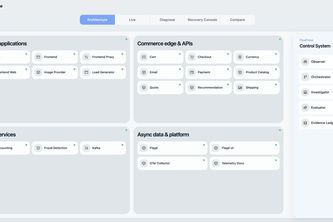
The description states that FlowPulse is a Node.js application with a single server and shared event stream for live telemetry, agent chat, diagnosis, recovery, and comparison. It uses OpenTelemetry for traces, metrics, and logs, and SQLite to store evidence, agent activity, decisions, approvals, execution records, and verification results.
It connects to running systems and builds a live view of services, dependencies, health signals, and incident evidence. The interface is designed for engineering managers or incident owners, showing what is happening, what agents know, which evidence supports the diagnosis, and which decision still needs a human.
The system includes roles like Observer, Investigator, Evaluator, and Orchestrator, with Codex and GPT-5.6 used as part of its agent framework. It enforces structured contracts for AI responses and requires owner approval before consequential changes.
Evidence The author describes the architecture and functionality in detail, including technical stack (Node.js, OpenTelemetry, SQLite) and operational design elements such as role boundaries, evidence citations, adversarial evaluation, and verification steps.
Inference Based on the description, FlowPulse appears to be a tool that attempts to automate parts of incident response while maintaining human oversight. It is not described as a commercial product or platform with customers.
Positioning & Claim Evolution
The author states that production incidents are hard because evidence is split across multiple tools and services. They claim FlowPulse gives the whole incident one shared, inspectable workspace.
They describe it as turning live telemetry into an incident workspace where agents find causes, propose fixes, and prove recovery — implying a shift from fragmented troubleshooting to integrated workflow.
Evidence The author's own write-up frames the problem and solution clearly. It positions FlowPulse as a tool for engineering teams managing production incidents.
Inference This is a self-positioned product aiming to reduce fragmentation in incident response workflows, but no external validation or market positioning beyond the hackathon submission exists.
Target Customer & ICP
The description indicates that FlowPulse is designed for engineering managers or incident owners. It shows what is happening, what agents know, which evidence supports the diagnosis, and which decision still needs a human.
It also mentions that the interface is tailored to those who need to make decisions during an incident, not just observe it.
Evidence The description explicitly identifies the target user as engineering managers or incident owners.
Inference This suggests a B2B SaaS or internal tool use case for software teams managing production systems. No specific industry or size of organization is mentioned.
Business Model & Pricing Evidence
Not evidenced.
The description does not mention any pricing model, monetization strategy, or business model. There is no indication whether FlowPulse intends to be sold as a SaaS product, offered as an open-source tool, or used internally by teams.
Evidence None provided.
Technical & Delivery Signals
FlowPulse is built with Node.js and uses OpenTelemetry for telemetry data. It stores all evidence in an append-only SQLite ledger. The system maintains a single canonical run and event stream across interfaces.
It includes explicit agent roles (Observer, Investigator, Evaluator, Orchestrator), structured contracts for AI responses, and deterministic remediation paths with allowlisting.
Codex is used both as the main engineering environment and as part of the agent interface. GPT-5.6 is also used but fails closed if it does not meet structured requirements.
The demo uses a controlled runtime configuration change to simulate an incident in the OpenTelemetry Astronomy Shop.
Evidence The author describes the technical stack, architecture, and operational design elements including role boundaries, evidence handling, and AI integration.
Traction & Maturity Signals
Not evidenced.
There is no mention of users, customers, revenue, or adoption. The project was submitted to a hackathon and is described as a prototype or proof-of-concept. No traction data or maturity indicators are present.
Evidence None provided.
Competitive Context
Not evidenced.
No information is given about existing tools in the incident management space, competitive landscape, or how FlowPulse compares to other solutions.
Evidence None provided.
Open Questions & Risks
- Unproven commercial viability: The project is described as a hackathon submission with no evidence of traction, revenue, or customer base.
- Limited scalability assumptions: The system uses SQLite for storage and appears designed for small-scale use cases (e.g., demo environment).
- AI dependency without clear governance: While Codex and GPT-5.6 are used, the description suggests a fail-closed approach when responses don’t meet structured contracts — but it's unclear how this scales or integrates into broader workflows.
- No integration with external systems: The description mentions future plans to integrate with incident management, source control, data platforms, and workflow systems, but no such integrations exist yet.
Evidence These are inferred from the lack of real-world usage, limited architecture details, and absence of commercial or operational evidence.
Questions the description leaves open
- What is the current status of FlowPulse beyond the hackathon submission? Is it being used internally by any team?
- How does FlowPulse handle large-scale telemetry data from complex distributed systems?
- Can you explain how the structured contract enforcement works in practice, especially when AI responses are ambiguous or incomplete?
- What are the plans for integrating with existing incident management platforms (e.g., PagerDuty, Opsgenie)?
- How do you plan to monetize FlowPulse if it's intended for internal use by engineering teams?
Overall Assessment
Not evidenced.
There is no evidence of funding rounds, valuation, or investment interest in FlowPulse. No indication exists whether the founders are seeking investment or partnership opportunities.
Evidence None provided.
User Stories BotA demo video on every pull request
Get a demo video on every new feature
GitHub App that watches your pull requests and records a narrated, captioned demo.
Save time on demo prep and make informed decisions faster with a video walkthrough of every new feature.
Source
Submitted to the OpenAI 2026 hackathon on Devpost. Project home on Devpost. Back to the full gallery on Devpost.
This competitive analysis was produced by top-founders.com (opens in a new tab)
Generated by a language model from this project's public Devpost page — its tagline, the author's own write-up and any built-with tags listed there — as captured in August 2026. Short quotations are the author's words. It is an opinion on the idea as a business, not on the people behind it, and it reflects the description as published then. If the project has moved on, request a correction below. The analysis is not independent research and contains no verified traction, revenue or customer data.
An independent guide by KFG International LLC — not affiliated with, endorsed by, or connected to Devpost or OpenAI.