

Archive position — measured, not model output
0 likes on Devpost
2,263 of the 7,850 archived projects have more likes, and 5,587 share exactly 0 — so this project's #4,151 place in the like-ranked listing is a tie-break inside that group, not a ranking.
Projects (log scale)
Likes on Devpost. ▲ marks this project's group.
Show the figures
| Likes | Projects | Share of archive |
|---|---|---|
| 0 | 5,587 | 71.2% |
| 1 | 1,758 | 22.4% |
| 2 | 284 | 3.6% |
| 3–4 | 132 | 1.7% |
| 5–9 | 75 | 1.0% |
| 10+ | 14 | 0.2% |
 User Stories BotA demo video on every pull request
Get a demo video on every new feature
GitHub App that watches your pull requests and records a narrated, captioned demo.
Save time on demo prep and make informed decisions faster with a video walkthrough of every new feature.
Executive Summary
What the company appears to be
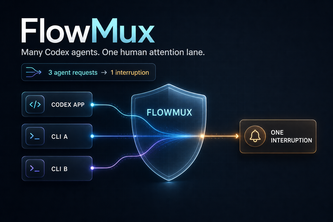
FlowMux is a self-reported local Node.js prototype built for the OpenAI 2026 hackathon. It is described as a "local semantic interrupt controller" that coordinates multiple parallel Codex agents, each generating independent decision contracts, and then uses an isolated GPT-5.6 compiler to propose a canonical choice if semantic equivalence can be proven.
What changed
The author states this was built for a hackathon and is not yet a product with revenue or customers. It is described as a prototype with no production deployment or commercial traction.
The single most important open question
Is there any evidence of real-world usage, customer feedback, or product-market fit beyond the hackathon submission? The description contains no data on adoption, revenue, or user behavior.
What The Product Actually Is
The description states that FlowMux is a local Node.js prototype built with Codex and GPT-5.6. It functions as a "local semantic interrupt controller" that:
- Collects bounded decision contracts from 2–3 trusted Codex Sessions
- Discloses exact compiler-bound bytes and SHA
- Asks an isolated GPT-5.6 compiler to propose an equivalence mapping
- Lets the human confirm one choice for the exact calls
- Each original turn receives its own declared local answer
It is described as a dependency-free tool composed of:
- A Codex plugin with route-human-blockers Skill, typed ask_human MCP contract, and native lifecycle/permission Hooks
- An immutable allowlist for 2–3 trusted, live Codex Sessions
- Deterministic exact-byte disclosure, conservative field scanning, proposal validation, scope/revision/hash consent, and atomic per-origin delivery
- An isolated subscription-backed GPT-5.6-sol compiler in a fresh empty directory with read-only sandboxing
- A loopback-only Workspace that keeps compiler mappings and delivery evidence visible to the human
The system is local, in-memory, and uses nonce-bound HMAC challenges and same-origin checks for security.
Positioning & Claim Evolution
The author states that FlowMux treats human judgment as the scarce resource. It aims to reduce duplicate semantic interruptions without suppressing uncertainty or weakening Codex's permission boundary.
It is positioned as a solution to the problem of "when several agents ask differently worded versions of the same owner question, the human repeats one decision while reconstructing each local consequence."
The project claims to:
- Allow parallel coding agents to reach the same product decision through different local tasks
- Reduce human repetition in decision-making
- Maintain deterministic validation and permission boundaries
- Operate without a hosted backend or API key
It is described as a "local semantic interrupt controller" that organizes interruptions but does not prove that three questions mean the same thing — it instead proposes equivalence mapping.
Target Customer & ICP
The description states that FlowMux is built for developers who work with parallel Codex agents, particularly those who need to supervise several agents without answering the same owner decision repeatedly.
It is described as a tool for:
- Developers working in parallel agent environments
- Teams managing multiple Codex Sessions
- Users who want to reduce human repetition in decision-making
No specific customer segments, personas, or use cases beyond this general description are provided. The author does not state whether the tool targets enterprise users, open-source developers, or individual contributors.
Business Model & Pricing Evidence
There is no evidence of any business model or pricing structure in the description.
The project is described as a hackathon submission, and no mention is made of monetization, licensing, or commercialization plans.
Technical & Delivery Signals
The system is built with:
- Codex app and CLI
- GPT-5.6 sol
- Codex plugins, MCP, hooks
- Node.js, TypeScript, HTML, CSS, JavaScript
It uses:
- Immutable allowlist for 2–3 trusted Codex Sessions
- Deterministic exact-byte disclosure
- Isolated GPT-5.6 compiler in a sandboxed environment
- Loopback-only Workspace
- Nonce-bound HMAC challenges and signed responses
- Same-origin checks
It is described as:
- Local and in-memory
- Dependency-free
- No hosted backend or general-purpose API key required
- Native permissions remain separate and higher priority
Traction & Maturity Signals
The description states that FlowMux was built for the OpenAI 2026 hackathon. It is described as a prototype, not a product.
There is no evidence of:
- Revenue
- Customers
- Adoption
- Product-market fit
- Any form of traction beyond the hackathon submission
The author notes that the project has no production deployment or commercial traction.
Competitive Context
The description does not provide any information about competitive landscape, existing tools, or market positioning. It does not mention competitors or how FlowMux compares to other solutions in the space of parallel agent coordination or decision-making.
Open Questions & Risks
- No evidence of real-world usage or adoption
- Prototype-only status — no production deployment
- Self-reported only — no third-party verification
- No commercialization plan or business model
- No mention of scalability, reliability, or performance beyond a single demo
- No customer feedback or user data
Questions the description leaves open
- What is the actual use case that prompted this tool? Is it solving a real problem in your workflow?
- Has anyone else used FlowMux outside of the hackathon context?
- Are there any plans to commercialize this beyond the hackathon submission?
- How does FlowMux handle edge cases or failures in production-like environments?
- What are the limitations of the current prototype that would need to be addressed for a production version?
Overall Assessment
Not evidenced.
There is no evidence of:
- Revenue
- Customers
- Traction
- Product-market fit
- Commercial viability
The project is described as a hackathon submission, and the author states that it is not yet a product with any commercial or operational data.
This is a self-reported prototype with no verified commercial signals. It cannot be evaluated for investment or partnership potential at this stage.
User Stories BotA demo video on every pull request
Get a demo video on every new feature
GitHub App that watches your pull requests and records a narrated, captioned demo.
Save time on demo prep and make informed decisions faster with a video walkthrough of every new feature.
Source
Submitted to the OpenAI 2026 hackathon on Devpost. Project home on Devpost. Back to the full gallery on Devpost.
This competitive analysis was produced by top-founders.com (opens in a new tab)
Generated by a language model from this project's public Devpost page — its tagline, the author's own write-up and any built-with tags listed there — as captured in August 2026. Short quotations are the author's words. It is an opinion on the idea as a business, not on the people behind it, and it reflects the description as published then. If the project has moved on, request a correction below. The analysis is not independent research and contains no verified traction, revenue or customer data.
An independent guide by KFG International LLC — not affiliated with, endorsed by, or connected to Devpost or OpenAI.