

Archive position — measured, not model output
1 like on Devpost
505 of the 7,850 archived projects have more likes, and 1,758 share exactly 1 — so this project's #1,081 place in the like-ranked listing is a tie-break inside that group, not a ranking.
Projects (log scale)
Likes on Devpost. ▲ marks this project's group.
Show the figures
| Likes | Projects | Share of archive |
|---|---|---|
| 0 | 5,587 | 71.2% |
| 1 | 1,758 | 22.4% |
| 2 | 284 | 3.6% |
| 3–4 | 132 | 1.7% |
| 5–9 | 75 | 1.0% |
| 10+ | 14 | 0.2% |
 User Stories BotA demo video on every pull request
Get a demo video on every new feature
GitHub App that watches your pull requests and records a narrated, captioned demo.
Save time on demo prep and make informed decisions faster with a video walkthrough of every new feature.
Executive Summary
What the company appears to be
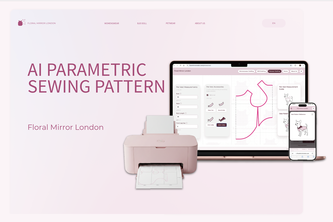
Floral Mirror London — Parametric Pattern Customisation is a self-reported project that claims to enable users to generate adjustable, made-to-measure petwear patterns using GPT-5.6 and deterministic parametric drafting. It is described as a tool for customising pet clothing through an interactive digital interface, with focus on interchangeable collar options.
What changed
The submission was part of the OpenAI Build Week 2026 hackathon. The project builds upon an existing platform and demonstrates a modular workflow for pattern customization using AI-assisted formalisation (via GPT-5.6) and deterministic software implementation (via Codex). It focuses on improving user experience in customising garment components like collars.
Single most important open question
Is there evidence of traction, revenue, or customer adoption beyond the author’s own description?
What The Product Actually Is
The description states that Floral Mirror London is a parametric petwear pattern platform. It allows users to:
- Enter pet body measurements;
- Select a base garment style;
- Choose design options (e.g., collar styles);
- Adjust fitting and design parameters;
- Review the generated pattern on an interactive canvas;
- Export the result for printing or further development.
It supports interchangeable collars as part of a modular system, where changing measurements or design choices updates related geometry deterministically. The tool is built using technologies such as React, TypeScript, Node.js, OpenAI API, and others.
The system uses GPT-5.6 during development to formalise drafting instructions but does not use it at runtime for pattern generation. Final patterns are generated through deterministic browser-based geometry.
Inference The product is a software prototype aimed at enabling non-expert users to create custom petwear patterns by combining human-defined rules with AI-assisted specification translation and deterministic implementation.
Positioning & Claim Evolution
The author positions the tool as a way to make personalised petwear more accessible, especially for those without pattern-cutting expertise. It aims to automate repetitive drafting operations while keeping creative direction and final approval in human hands.
Key claims include:
- The system supports adjustable, made-to-measure petwear.
- It uses AI-assisted formalisation (GPT-5.6) during development.
- It maintains a human-led, AI-assisted workflow, where humans define the drafting logic and approve results.
- It bridges traditional pattern-cutting knowledge with computational design.
There is no evidence of prior commercial positioning or branding beyond this submission.
Inference The project appears to be a proof-of-concept for an AI-enhanced design tool targeting niche markets like petwear customization, with potential scalability into broader fashion or industrial design domains.
Target Customer & ICP
The description states that the product targets users who want to make customised pet clothing, particularly those seeking better fit than standard sizes offer. It is implied that these users may include:
- Pet owners looking for custom-made garments;
- Small-scale designers or artisans working with pets;
- Individuals interested in personalising petwear without professional help.
The tool focuses on interchangeable collar styles and assumes a user base familiar with basic garment design concepts but not necessarily skilled in patternmaking.
There is no evidence of segmentation beyond this general audience.
Inference The ICP likely includes DIY enthusiasts, small-scale designers, or hobbyists interested in custom petwear. No clear indication of enterprise or B2B customers.
Business Model & Pricing Evidence
No information is provided about pricing models, monetisation strategies, or business structure.
The description does not mention any revenue streams, subscription plans, licensing fees, or sales channels.
Inference The project is currently a prototype submitted for a hackathon and lacks any indication of commercial viability or monetisation strategy.
Technical & Delivery Signals
The system uses:
- GPT-5.6 during development to formalise drafting instructions.
- Codex to implement approved specifications into working software.
- A deterministic geometry engine for runtime pattern generation.
- Technologies include React, TypeScript, Node.js, Express.js, Konva, Vercel, OpenAI API, PDF-lib, SVG, DXF-writer.
It supports:
- Interactive canvas preview;
- Export to PDF and vector formats;
- Measurement-responsive updates;
- Pattern validation;
- Modular component replacement (e.g., collars).
The project is built as a browser-based application, not a SaaS platform or API service.
Inference The technical stack suggests a lightweight, web-based prototype. It leverages AI for specification clarity rather than pattern generation itself, indicating a hybrid human-AI workflow.
Traction & Maturity Signals
There is no evidence of:
- Revenue;
- Customers;
- User adoption;
- Product usage metrics;
- Market traction;
- Prior funding or investor interest.
The project was submitted to the OpenAI Build Week 2026 hackathon and described as a prototype. The author notes that it builds on an existing platform but does not provide data on its prior performance or user base.
Inference This is a pre-commercial prototype, likely in early-stage development, with no demonstrated traction or maturity.
Competitive Context
No mention of competitors or competitive landscape is provided in the description. The author does not reference similar tools or platforms in the petwear or pattern-making space.
Inference There is insufficient evidence to assess competitive positioning or market differentiation.
Open Questions & Risks
- Unproven commercial viability: No revenue, customers, or monetisation strategy.
- Limited scope of use case: Focuses only on collars and a narrow set of garment components.
- Dependency on human authorship: The system relies heavily on human-defined rules and validation — not scalable without significant manual effort.
- AI role is limited to development, not runtime: GPT-5.6 does not generate patterns at runtime, limiting AI's utility in the final product.
- No evidence of scalability or production readiness: The tool appears to be a demonstration-level prototype.
Inference The project lacks commercial traction and may not yet be ready for large-scale deployment or monetisation.
Questions the description leaves open
- What is the current stage of development beyond this hackathon submission?
- Has there been any user testing or feedback from potential customers?
- Are there plans to expand beyond collars and into other garment components?
- How does the team intend to monetise this product if at all?
- What are the key assumptions about user behavior and adoption that underpin the design?
- Is there a plan for integrating more advanced AI capabilities beyond formalisation?
- What is the long-term vision for scaling the platform or moving from prototype to product?
Overall Assessment
Not evidenced.
The project is described as a hackathon submission and lacks any evidence of traction, revenue, or customer adoption. It is presented as a proof-of-concept with no indication of commercial readiness or strategic value beyond its demonstration.
Inference Based on the self-reported description alone, there is insufficient basis to recommend investment or partnership. The project shows promise in concept but lacks validation and scalability indicators.
User Stories BotA demo video on every pull request
Get a demo video on every new feature
GitHub App that watches your pull requests and records a narrated, captioned demo.
Save time on demo prep and make informed decisions faster with a video walkthrough of every new feature.
Source
Submitted to the OpenAI 2026 hackathon on Devpost. Project home on Devpost. Back to the full gallery on Devpost.
This competitive analysis was produced by top-founders.com (opens in a new tab)
Generated by a language model from this project's public Devpost page — its tagline, the author's own write-up and any built-with tags listed there — as captured in August 2026. Short quotations are the author's words. It is an opinion on the idea as a business, not on the people behind it, and it reflects the description as published then. If the project has moved on, request a correction below. The analysis is not independent research and contains no verified traction, revenue or customer data.
An independent guide by KFG International LLC — not affiliated with, endorsed by, or connected to Devpost or OpenAI.