

Archive position — measured, not model output
0 likes on Devpost
2,263 of the 7,850 archived projects have more likes, and 5,587 share exactly 0 — so this project's #4,081 place in the like-ranked listing is a tie-break inside that group, not a ranking.
Projects (log scale)
Likes on Devpost. ▲ marks this project's group.
Show the figures
| Likes | Projects | Share of archive |
|---|---|---|
| 0 | 5,587 | 71.2% |
| 1 | 1,758 | 22.4% |
| 2 | 284 | 3.6% |
| 3–4 | 132 | 1.7% |
| 5–9 | 75 | 1.0% |
| 10+ | 14 | 0.2% |
 User Stories BotA demo video on every pull request
Get a demo video on every new feature
GitHub App that watches your pull requests and records a narrated, captioned demo.
Save time on demo prep and make informed decisions faster with a video walkthrough of every new feature.
Executive Summary
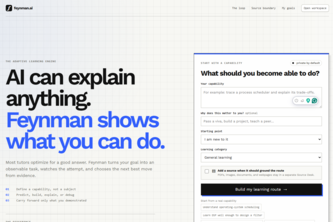
What the company appears to be: Feynman AI is a self-reported adaptive learning system that positions itself as an "evidence-first" runtime for academic learning. The product is described as a tool that turns learning goals into observable practice and evidence, using techniques like retrieval practice, self-explanation, and scaffolding problem-solving before instruction.
What changed: The project description indicates a shift from traditional AI tutoring models (which may rely on chat history or completed content as proof of learning) to one that emphasizes learner actions—such as prediction, explanation, and application—as evidence of understanding. It introduces structured elements like "learning contracts", "active tasks", and an "Evidence Rail" to track observable attempts.
Single most important open question: Does the described system actually function as claimed in its current alpha state, or is it a conceptual prototype that has not yet been validated through real-world use?
Note: This analysis is based entirely on the self-reported description provided by the authors. No independent verification, traction data, revenue figures, customer names, or third-party sources are available.
What The Product Actually Is
The description states that Feynman AI is an "evidence-first adaptive learning runtime". It consists of three main surfaces:
- Source Desk: Where users upload documents (PDFs, images, webpages, etc.) and these become structured, bounded source memory.
- Activity Canvas: One active task at a time, including specialized workbenches for domains like Operating Systems, Computer Graphics, AI/ML, and academic medical mechanisms.
- Evidence Rail: A durable record of learner attempts, confidence levels, citations, feedback, and next actions.
It also includes:
- A "Source Desk pipeline" that validates and extracts content from uploaded files.
- An adaptive route engine that tracks goal progress, attempt outcomes, rubric results, and decision-making.
- Integration with Codex for backend logic and browser automation testing.
Claim: The system is designed to make learner evidence visible and correctable before it matters.
Inference: It aims to avoid "unproductive success" by requiring observable attempts rather than just showing answers.
Not evidenced: Whether this functionality works in practice or has been tested beyond the alpha stage.
Positioning & Claim Evolution
The description frames Feynman AI as a response to the problem of "unproductive success"—where learners believe they understand something after seeing an explanation, but cannot actually reproduce or apply it independently. The core claim is that:
- AI should not be confused with learning.
- Learning is demonstrated through observable action, not fluent output.
- The system makes overconfidence visible and correctable.
It positions itself as different from:
- NotebookLM (which makes sources searchable),
- ChatGPT Study Mode (which guides thinking with questions),
- Coursera (which distributes expert instruction),
- LeetCode (which evaluates code attempts).
Claim: Feynman is built on research principles such as retrieval practice, self-explanation, and scaffolded problem-solving.
Inference: These are intended to improve retention and transfer of knowledge.
Not evidenced: Whether these principles have been implemented successfully or validated in real-world use.
Target Customer & ICP
The description does not explicitly name target customers. However, it implies a focus on learners engaged in academic or technical education, particularly those studying computer science, engineering, or medicine.
It mentions support for:
- Operating Systems scheduling traces,
- DSP (Digital Signal Processing),
- Computer Graphics,
- AI/ML,
- Academic medical mechanisms.
The demo focuses on OS scheduling because it makes active reasoning visible—process states change, decisions have consequences, and wrong answers produce observable failures.
Claim: The system targets learners who want to understand concepts deeply and demonstrate mastery through practice.
Inference: It is aimed at students or professionals in STEM fields where deep conceptual understanding matters.
Not evidenced: Specific customer segments, usage patterns, or adoption metrics.
Business Model & Pricing Evidence
There is no mention of pricing, monetization strategy, or business model in the description. The project is presented as a hackathon submission and an alpha product.
Claim: No explicit business model or pricing structure is described.
Inference: Likely early-stage, possibly non-commercial or experimental.
Not evidenced: Revenue streams, customer acquisition costs, or monetization plans.
Technical & Delivery Signals
The project was built using:
- Codex
- CSS
- HTML
- Python
- TypeScript
It includes:
- A backend test suite (151 tests)
- Frontend test suite (58 tests)
- Production build checks
- Browser acceptance testing across sign-in, sources, goal creation, remediation, evidence persistence, and mobile flows
The system uses:
- Mistral OCR for image processing
- Stable page/block/visual anchors
- Source-scoped knowledge packs
- Server-side authentication with provider neutrality
- Browser automation for integration testing
Claim: The system has undergone technical validation via regression tests and browser acceptance.
Inference: It is a functional prototype, not just a concept.
Not evidenced: Full production readiness, scalability, or long-term maintainability.
Traction & Maturity Signals
The description states that the local alpha has passed:
- 151 backend tests
- 58 frontend tests
- Production build checks
- Browser acceptance across various flows
It references an "acceptance report" but does not provide data on user engagement, retention, or adoption.
Claim: The system is in an early alpha stage with internal testing completed.
Inference: It may be suitable for limited pilot use or further development.
Not evidenced: Real-world usage, customer feedback, or market traction.
Competitive Context
The description contrasts Feynman AI with:
- NotebookLM (searchable sources)
- ChatGPT Study Mode (guided thinking)
- Coursera (expert instruction)
- LeetCode (code evaluation)
It claims to be unique in its emphasis on learner-owned records of what the learner actually did, rather than model outputs or page views.
Claim: It differentiates itself by focusing on observable learner behavior.
Inference: This could appeal to educators or learners seeking deeper understanding over surface-level engagement.
Not evidenced: Market positioning, competitive advantages, or market share.
Open Questions & Risks
- Unproven functionality: The system is described as an alpha with limited external validation.
- Lack of traction data: No evidence of users, customers, or adoption.
- High technical complexity: Requires integration of source anchoring, adaptive routing, and browser automation—challenging to implement correctly.
- Unclear scalability: No indication of how the system would scale beyond a small team or prototype.
- Research vs. product gap: The description mentions research foundations but does not confirm whether these have been translated into effective product features.
Claim: The project is in early development with no commercial traction.
Inference: It may require significant investment and time to reach market viability.
Not evidenced: Risk mitigation strategies or roadmap beyond the current alpha.
Questions the description leaves open
- What specific learning outcomes have you observed from users during alpha testing?
- How does the system handle edge cases where learners submit incorrect or incomplete attempts?
- Can you provide examples of how the "Evidence Rail" is used in practice?
- What are the plans for integrating with existing educational platforms or LMS systems?
- How do you plan to validate that the system improves actual learning retention and transfer?
- Are there any known limitations in source anchoring, particularly for complex visual assets or multi-language documents?
- What is your roadmap for moving from alpha to beta or production?
- How will you ensure data privacy and security, especially when handling learner-generated content?
Overall Assessment
Confidence Level: Low
The description presents a compelling conceptual framework for an adaptive learning system that emphasizes observable learner behavior over passive consumption. However, there is no evidence of traction, revenue, or customer adoption beyond the authors' own account.
While the technical implementation shows some sophistication (e.g., source anchoring, browser automation), the lack of real-world validation and commercial viability makes it difficult to assess its potential impact or scalability.
Assessment: This appears to be an early-stage prototype with strong theoretical underpinnings but no demonstrated market readiness or proven performance. Further due diligence would require access to actual user data, testing results, and a clearer path to monetization or institutional adoption.
User Stories BotA demo video on every pull request
Get a demo video on every new feature
GitHub App that watches your pull requests and records a narrated, captioned demo.
Save time on demo prep and make informed decisions faster with a video walkthrough of every new feature.
Source
Submitted to the OpenAI 2026 hackathon on Devpost. Project home on Devpost. Back to the full gallery on Devpost.
This competitive analysis was produced by top-founders.com (opens in a new tab)
Generated by a language model from this project's public Devpost page — its tagline, the author's own write-up and any built-with tags listed there — as captured in August 2026. Short quotations are the author's words. It is an opinion on the idea as a business, not on the people behind it, and it reflects the description as published then. If the project has moved on, request a correction below. The analysis is not independent research and contains no verified traction, revenue or customer data.
An independent guide by KFG International LLC — not affiliated with, endorsed by, or connected to Devpost or OpenAI.