

Archive position — measured, not model output
0 likes on Devpost
2,263 of the 7,850 archived projects have more likes, and 5,587 share exactly 0 — so this project's #4,074 place in the like-ranked listing is a tie-break inside that group, not a ranking.
Projects (log scale)
Likes on Devpost. ▲ marks this project's group.
Show the figures
| Likes | Projects | Share of archive |
|---|---|---|
| 0 | 5,587 | 71.2% |
| 1 | 1,758 | 22.4% |
| 2 | 284 | 3.6% |
| 3–4 | 132 | 1.7% |
| 5–9 | 75 | 1.0% |
| 10+ | 14 | 0.2% |
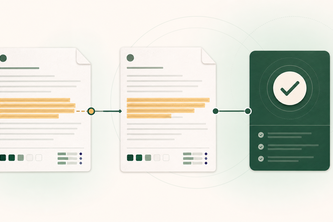
 User Stories BotA demo video on every pull request
Get a demo video on every new feature
GitHub App that watches your pull requests and records a narrated, captioned demo.
Save time on demo prep and make informed decisions faster with a video walkthrough of every new feature.
Executive Summary
What the company appears to be
Feedback Auditor is a self-reported tool designed for educators to review and validate feedback consistency in anonymous student assessments. It uses GPT-5.6 to extract structured evidence from submissions, then applies deterministic rules to flag potential inconsistencies. The system does not automate grading or make decisions; it presents review questions to teachers.
What changed
The author states that the tool was built as part of an OpenAI 2026 hackathon submission. It evolved from a concept involving AI re-grading into a workflow that separates model extraction, rule-based detection, and human decision-making.
Single most important open question
Is there any evidence of real-world usage or adoption by educators beyond the author’s own demonstration?
What The Product Actually Is
The description states that Feedback Auditor is a tool for teachers to review feedback consistency in anonymous student work. It uses GPT-5.6 to extract structured evidence from submissions and applies four deterministic rules (R1–R4) to flag inconsistencies. These signals are presented to the teacher for inspection, confirmation, or dismissal.
The system includes:
- A frontend built with Next.js, React, TypeScript, Zod
- Use of OpenAI Responses API and Structured Outputs
- Separation of model extraction, rule engine, and human decision-making
- Public demo site with no API key exposure
- Two demo paths: a narrated video fixture and a precomputed Codex audit
Inference The tool is not an automated grader but a consistency-checking assistant.
Positioning & Claim Evolution
The author claims that Feedback Auditor was built to address the need for a final consistency check in assessment workflows where anonymous student work and multiple marking passes are used. It aims to reduce token usage and avoid automating grades, instead focusing on helping teachers review feedback.
Inference The positioning evolved from an idea of AI re-grading to one that emphasizes human control and transparency.
Target Customer & ICP
The description states that Feedback Auditor is intended for teachers who use anonymous student work and rubric-based marking. It is designed for educators working in assessment environments where consistency checks are needed before results are released.
Inference The target customer is a teacher or instructional designer in an educational setting, likely at the secondary or post-secondary level.
Business Model & Pricing Evidence
Not evidenced. The description does not mention any pricing model, monetization strategy, or business model.
Technical & Delivery Signals
The system uses:
- GPT-5.6 for structured evidence extraction
- TypeScript rules for review pattern detection
- React and Next.js for frontend
- GitHub Pages for public demo
- Zod for schema validation
- OpenAI Responses API and Structured Outputs
It is described as having two demo paths:
- A narrated video fixture with fixed workflow
- A precomputed Codex audit that does not call the API
The author states that a self-hosted deployment can run live GPT-5.6 extraction using the owner’s own key.
Inference The tool is built for educational use and has a clear separation between model processing, rule enforcement, and human review.
Traction & Maturity Signals
Not evidenced. There is no mention of actual users, customers, revenue, or adoption beyond the author's own demonstration.
Competitive Context
Not evidenced. No information is provided about competitors or market positioning.
Open Questions & Risks
- The tool is described as a hackathon submission with no evidence of real-world usage.
- It is not clear whether the author has tested it in actual classrooms or gathered feedback from educators.
- The public demo does not involve live API calls, which may limit understanding of its real-world utility.
- The lack of any mention of monetization, customers, or traction raises questions about scalability or commercial viability.
Questions the description leaves open
- Has the tool been tested in real classrooms or with actual educators?
- What is the source of the rubric and student data used in the demo? Are they representative of real-world use cases?
- How does the author plan to scale beyond a single-person development effort?
- Is there any interest from educational institutions or platforms (e.g., LMS providers) in adopting this tool?
- What are the actual limitations of the current rule engine, and how might it evolve?
Overall Assessment
Not evidenced. There is no indication of funding, valuation, or investment interest. The project appears to be a prototype or proof-of-concept submitted for a hackathon.
User Stories BotA demo video on every pull request
Get a demo video on every new feature
GitHub App that watches your pull requests and records a narrated, captioned demo.
Save time on demo prep and make informed decisions faster with a video walkthrough of every new feature.
Source
Submitted to the OpenAI 2026 hackathon on Devpost. Project home on Devpost. Back to the full gallery on Devpost.
This competitive analysis was produced by top-founders.com (opens in a new tab)
Generated by a language model from this project's public Devpost page — its tagline, the author's own write-up and any built-with tags listed there — as captured in August 2026. Short quotations are the author's words. It is an opinion on the idea as a business, not on the people behind it, and it reflects the description as published then. If the project has moved on, request a correction below. The analysis is not independent research and contains no verified traction, revenue or customer data.
An independent guide by KFG International LLC — not affiliated with, endorsed by, or connected to Devpost or OpenAI.