

Archive position — measured, not model output
0 likes on Devpost
2,263 of the 7,850 archived projects have more likes, and 5,587 share exactly 0 — so this project's #4,053 place in the like-ranked listing is a tie-break inside that group, not a ranking.
Projects (log scale)
Likes on Devpost. ▲ marks this project's group.
Show the figures
| Likes | Projects | Share of archive |
|---|---|---|
| 0 | 5,587 | 71.2% |
| 1 | 1,758 | 22.4% |
| 2 | 284 | 3.6% |
| 3–4 | 132 | 1.7% |
| 5–9 | 75 | 1.0% |
| 10+ | 14 | 0.2% |
 User Stories BotA demo video on every pull request
Get a demo video on every new feature
GitHub App that watches your pull requests and records a narrated, captioned demo.
Save time on demo prep and make informed decisions faster with a video walkthrough of every new feature.
Executive Summary
Company: FamilyFreely
Self-reported basis: The analysis is based entirely on the author-supplied project description from Devpost, including the name, tagline, write-up, and technology stack. No external verification or historical data is available.
What it appears to be: A private, shared household finance application designed for families. It includes budgeting tools, a points-and-rewards system for children, and AI-assisted guidance, with an emphasis on transparency, safety, and role-based permissions.
What changed: The project was submitted as part of the OpenAI 2026 hackathon. No prior version or evolution is evidenced.
Single most important open question: Is there sufficient evidence of a real-world need for this product, or is it a speculative solution to a problem not yet proven to exist at scale?
What The Product Actually Is
The description states that FamilyFreely is a responsive household finance PWA built with Next.js and TypeScript. It supports:
- Income, budgets, transactions, accounts, goals, recurring finances
- Shared decision-making
- Review-first CSV imports
- Offline-safe transaction capture
- Role-based permissions
- Account activity history
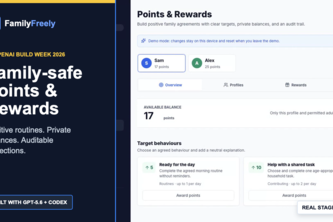
It also includes a family-safe Points & Rewards system, where children receive points for positive behaviors and can redeem rewards through a catalog. The system supports:
- Private point histories
- Reward requests and approvals
- Reversal of mistakes
- Questions about individual point entries
AI is used via GPT-5.6 to draft ideas or explain workflows, but it cannot modify financial data or permissions.
Inference: The product is a hybrid of personal finance management and behavioral economics for families. It is not a traditional budgeting app but one that attempts to gamify financial responsibility in a child-safe way.
Positioning & Claim Evolution
The description states:
- FamilyFreely aims to improve transparency without punitive controls.
- It is designed as a private, shared workspace.
- The product avoids placing one person in the role of “money police”.
- It supports positive reinforcement through a points system, not punishment.
Inference: The positioning is that FamilyFreely is a family-oriented financial tool with a behavioral design twist, aiming to make money management more collaborative and child-friendly. It is not positioned as a general-purpose finance app but as a niche solution for households seeking shared, safe, and educational financial tools.
Target Customer & ICP
The description states:
- The product targets families.
- It is designed to improve transparency in household money challenges, where family members understand income, spending, responsibilities, and progress differently.
- It supports children with age-appropriate point balances and a private history.
Inference: The ICP appears to be parents or guardians managing households with children, particularly those seeking tools that promote positive financial behaviors without punitive measures. The target is not individual users but households as units.
Business Model & Pricing Evidence
The description does not state anything about:
- Revenue model
- Pricing structure
- Monetization strategy
- Paid features or subscriptions
Not evidenced: No evidence of a business model or pricing structure is provided.
Technical & Delivery Signals
The description states:
- Built with Next.js, TypeScript, React, Fastify API, Cloudflare Workers, PostgreSQL, IndexedDB
- Uses GPT-5.6 via OpenAI Responses API for drafting and explanation
- Supports offline financial writes using IndexedDB and idempotency keys
- Database changes use additive migrations
- AI is used in a guarded way, not allowed to modify data or permissions
Inference: The technical stack suggests a modern, responsive PWA with offline capabilities and a focus on data integrity and safety. The use of additive migrations and idempotency keys indicates an attempt at robustness and backward compatibility.
Traction & Maturity Signals
The description states:
- It was submitted to the OpenAI 2026 hackathon
- The team size is 1 person
- No revenue, customers, or adoption data are provided
- The project is in a pre-pilot phase, with plans for structured pilots and localization
Not evidenced: There is no evidence of traction, revenue, or customer adoption. The product is described as a prototype or early-stage solution.
Competitive Context
The description does not mention:
- Competitors
- Market positioning relative to existing tools
- How it differs from other family budgeting apps
Not evidenced: No competitive context is provided in the self-reported description.
Open Questions & Risks
- Single-person team: The project is built by one person, which may limit scalability and execution.
- No revenue or traction: There is no evidence of monetization or customer adoption.
- Unproven market need: The problem it solves (family financial transparency with behavioral incentives) is not validated in the description.
- AI safety constraints: While AI is limited to drafting and explanation, there is no indication that this is sufficient for a production-grade product.
- Hackathon project: The fact that it was submitted to a hackathon suggests it is an experimental or prototype solution.
Questions the description leaves open
- What specific household financial challenges are you trying to solve, and how do you know families care about this?
- How did you validate the need for this product with real families?
- What is your plan for scaling beyond a single-person team?
- Are there any existing family budgeting tools that you believe this product will displace or complement?
- How do you intend to monetize this product, and what are your assumptions about pricing?
- What are the key technical challenges you expect to face in moving from prototype to production?
Overall Assessment
Not evidenced: There is no evidence of a business model, traction, or customer validation to support an investment or partnership decision.
Confidence level: Low. The project is described as a hackathon submission with no external validation, revenue, or adoption data. It is a speculative solution to a problem not yet proven at scale.
Inference: This is a preliminary concept, likely in early-stage development, and not ready for investment or partnership without further evidence of market need, traction, or scalability.
User Stories BotA demo video on every pull request
Get a demo video on every new feature
GitHub App that watches your pull requests and records a narrated, captioned demo.
Save time on demo prep and make informed decisions faster with a video walkthrough of every new feature.
Source
Submitted to the OpenAI 2026 hackathon on Devpost. Project home on Devpost. Back to the full gallery on Devpost.
This competitive analysis was produced by top-founders.com (opens in a new tab)
Generated by a language model from this project's public Devpost page — its tagline, the author's own write-up and any built-with tags listed there — as captured in August 2026. Short quotations are the author's words. It is an opinion on the idea as a business, not on the people behind it, and it reflects the description as published then. If the project has moved on, request a correction below. The analysis is not independent research and contains no verified traction, revenue or customer data.
An independent guide by KFG International LLC — not affiliated with, endorsed by, or connected to Devpost or OpenAI.