

Archive position — measured, not model output
0 likes on Devpost
2,263 of the 7,850 archived projects have more likes, and 5,587 share exactly 0 — so this project's #6,016 place in the like-ranked listing is a tie-break inside that group, not a ranking.
Projects (log scale)
Likes on Devpost. ▲ marks this project's group.
Show the figures
| Likes | Projects | Share of archive |
|---|---|---|
| 0 | 5,587 | 71.2% |
| 1 | 1,758 | 22.4% |
| 2 | 284 | 3.6% |
| 3–4 | 132 | 1.7% |
| 5–9 | 75 | 1.0% |
| 10+ | 14 | 0.2% |
 User Stories BotA demo video on every pull request
Get a demo video on every new feature
GitHub App that watches your pull requests and records a narrated, captioned demo.
Save time on demo prep and make informed decisions faster with a video walkthrough of every new feature.
Executive Summary
What the company appears to be
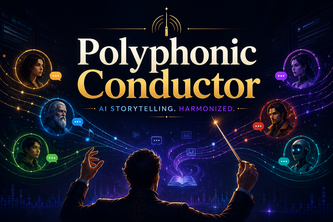
Polyphonic-Conductor is a self-reported local software prototype for multi-character AI storytelling, designed to allow users to manage multiple AI characters in role-play scenarios while maintaining human control over narrative authority. It separates character performance from AI execution and enforces approval gates before story advancement.
What changed
The project evolved from an author’s personal creative exploration into a technical prototype using AI-assisted development tools (Codex), with the goal of enabling collaborative, multi-character storytelling without automated canon changes or context leakage.
Single most important open question
Is there evidence that this concept has traction beyond the author's own use case, and whether it can scale beyond a single-user local tool?
What The Product Actually Is
The description states that Polyphonic-Conductor is:
- A local control surface for multi-character AI storytelling
- Designed to separate the character from the AI performing that character
- To control what each character is allowed to know
- To leave the human in charge of what becomes true
- To generate responses for every participant, which remain as Drafts until approved
- To automate performance without automating authority
- Capable of preparing visibility-filtered packets for GPT-5.6 and staging them inside ChatGPT
- Uses a write-only browser helper that does not send messages or overwrite text
It is described as an early prototype built with Codex, using Python and JavaScript, and currently has 24 passing automated tests.
Evidence
- The author describes the tool’s functionality in detail.
- It is explicitly stated to be a local application, not cloud-based.
- It uses supervised browser staging rather than direct API control.
- It enforces approval gates for narrative progression.
- It supports private information filtering between characters.
Inference The tool appears to support multi-agent AI roleplay with a focus on narrative control and context management.
Positioning & Claim Evolution
The author positions Polyphonic-Conductor as:
- A prototype of a future role-playing system, where each character could be performed by an independent AI
- An interface that allows human authority over story canon
- A tool for creative writing enhancement rather than automation
- A personal project driven by the author’s own experience with AI and health challenges
It is framed as:
- A local, non-cloud solution, avoiding reliance on paid APIs
- A low-effort, high-accessibility tool for people without formal programming backgrounds
- A creative exploration rooted in fantasy storytelling and character voice development
Evidence
- The author describes the inspiration from childhood reading and AI roleplay.
- It is positioned as a prototype of a larger vision, not a finished product.
- The author emphasizes personal use cases, not commercial adoption.
Inference The positioning suggests this is a personal creative tool with potential for broader application, but no evidence of market traction or commercial intent exists.
Target Customer & ICP
The description states:
- The tool was built by one person (Elwood Thomas)
- It is intended to support multi-character storytelling
- It is designed for writers and creators who want to explore character dynamics
- It is meant for users with chronic fatigue or limited technical skills, who value accessibility
There is no mention of:
- Specific customer segments beyond the author
- Target industries or use cases beyond creative writing
- Any existing user base or market research
Evidence
- The author describes personal motivation and health-related constraints.
- It is framed as a tool for writers, not a commercial product.
Inference The ICP appears to be individual creators or hobbyists, possibly with accessibility needs, but no evidence of defined customer personas or market segmentation.
Business Model & Pricing Evidence
The description does not include:
- Any mention of pricing
- Revenue streams
- Monetization strategy
- Subscription model or licensing
- Commercial use cases beyond personal development
Evidence
- The tool is described as a personal prototype, not a commercial offering.
- It is built for local use only, with no indication of cloud-based services.
Inference No business model or pricing evidence is provided. It appears to be a non-commercial, personal project.
Technical & Delivery Signals
The description states:
- The application is built using Python and JavaScript
- Uses the Python standard library only
- Has 24 passing automated tests
- Was developed with Codex, an AI-assisted development tool
- Includes a write-only browser helper that does not send or overwrite messages
- Implements private information filtering
- Supports approval-gated ensemble generation
It also mentions:
- The author used Codex to inspect, extend, and test the prototype
- It was built through extensive collaboration with GPT-5.6
- It is a local application, not cloud-based
Evidence
- Technical stack is specified (Python, JS).
- Automated tests are referenced.
- AI tools used in development are named (Codex, GPT-5.6).
Inference The tool is technically feasible and built with accessible tools. It shows strong author-driven development, but lacks evidence of scalability or enterprise-grade infrastructure.
Traction & Maturity Signals
The description states:
- The project was submitted to the OpenAI 2026 hackathon
- It is a prototype (not a production-ready product)
- It has 24 passing automated tests
- It was built by one person, with no mention of team or external contributors
- No revenue, customers, or adoption data are provided
Evidence
- The project is a hackathon submission.
- It is described as an early prototype.
- It has automated testing, but no user feedback or usage metrics.
Inference There is no evidence of traction or market adoption. The tool is in early development and not yet deployed for public use.
Competitive Context
The description does not mention:
- Competitors
- Existing tools in the AI storytelling space
- Market positioning relative to other platforms or products
Evidence
- No references to existing tools, platforms, or market players.
- The author focuses on personal inspiration and vision, not competitive analysis.
Inference No competitive context is provided. It is unclear whether similar tools exist or how this would fit into a broader ecosystem.
Open Questions & Risks
Key risks and open questions based on the description:
- Single-person development: No team, no external contributors, no scalability.
- Prototype only: Not a production-ready product.
- No commercial traction or monetization: No evidence of revenue, customers, or market demand.
- Limited scope: Designed for local use, not cloud-based or multi-user environments.
- Unverified claims: All statements are self-reported and unverified.
Evidence
- The project is described as a personal prototype, not a commercial product.
- It has no external validation or user data.
Inference The tool may be technically interesting but lacks commercial viability without further development, traction, or team support.
Questions the description leaves open
- What is the intended path from prototype to market-ready product?
- Are there any users beyond yourself who are testing or using this tool?
- How do you plan to scale beyond a single-user local application?
- What would be the key differentiators in a competitive marketplace?
- Have you considered how to monetize or commercialize this concept?
- What are the technical limitations of the current prototype that would need to be addressed for broader adoption?
Overall Assessment
Not evidenced
The description provides no evidence of:
- Revenue
- Customers
- Traction
- Market demand
- Commercial viability
- Team or funding
It is a self-reported, unverified personal prototype, not a product with demonstrated commercial potential.
Confidence level Very low. The project is described as a personal creative exploration, not a scalable business or product.
Inference This is a conceptual and technical demonstration, not a commercial opportunity. It may be of interest for future development or partnership, but it does not meet the criteria for investment or strategic partnership at this stage.
User Stories BotA demo video on every pull request
Get a demo video on every new feature
GitHub App that watches your pull requests and records a narrated, captioned demo.
Save time on demo prep and make informed decisions faster with a video walkthrough of every new feature.
Source
Submitted to the OpenAI 2026 hackathon on Devpost. Project home on Devpost. Back to the full gallery on Devpost.
This competitive analysis was produced by top-founders.com (opens in a new tab)
Generated by a language model from this project's public Devpost page — its tagline, the author's own write-up and any built-with tags listed there — as captured in August 2026. Short quotations are the author's words. It is an opinion on the idea as a business, not on the people behind it, and it reflects the description as published then. If the project has moved on, request a correction below. The analysis is not independent research and contains no verified traction, revenue or customer data.
An independent guide by KFG International LLC — not affiliated with, endorsed by, or connected to Devpost or OpenAI.