

Archive position — measured, not model output
0 likes on Devpost
2,263 of the 7,850 archived projects have more likes, and 5,587 share exactly 0 — so this project's #4,028 place in the like-ranked listing is a tie-break inside that group, not a ranking.
Projects (log scale)
Likes on Devpost. ▲ marks this project's group.
Show the figures
| Likes | Projects | Share of archive |
|---|---|---|
| 0 | 5,587 | 71.2% |
| 1 | 1,758 | 22.4% |
| 2 | 284 | 3.6% |
| 3–4 | 132 | 1.7% |
| 5–9 | 75 | 1.0% |
| 10+ | 14 | 0.2% |
 User Stories BotA demo video on every pull request
Get a demo video on every new feature
GitHub App that watches your pull requests and records a narrated, captioned demo.
Save time on demo prep and make informed decisions faster with a video walkthrough of every new feature.
Executive Summary
What the company appears to be: FabShop is a self-reported, single-developer project that builds a multi-role e-commerce marketplace using JavaScript, Node.js, Supabase, and AI-assisted development tools like OpenAI Codex. The platform allows users to switch roles (buyer, seller, admin) under one unified account and includes features such as dispute prevention workflows and dynamic theming.
What changed: The project is described as a prototype built during a hackathon, with no evidence of prior development or commercial traction. It has not been independently verified for functionality, scalability, or market fit.
The single most important open question: Is there any evidence that this platform will scale beyond a single developer’s prototype, or that it addresses real market needs in a way that can be monetized?
What The Product Actually Is
The description states that FabShop is a responsive full-stack marketplace built with JavaScript and Node.js. It includes:
- A multi-role user system, where one email account can function as a buyer, seller, or administrator.
- A light/dark theme toggle implemented via HTML5, CSS variables, and JavaScript.
- Use of Supabase for database management, with SQL schemas and relational tables.
- Integration with AI tools like OpenAI Codex to assist in development.
- A dispute resolution workflow that requires photos and videos for refund or return requests.
It is described as a prototype, not a production-ready product. The author notes that it was built during a hackathon, and no revenue, customers, or live deployment are mentioned.
Inference: This appears to be a proof-of-concept built by one person, likely for demonstration purposes rather than commercial use.
Positioning & Claim Evolution
The project is self-described as:
- A dark & light-themed e-commerce ecosystem.
- Built with OpenAI Codex, suggesting an AI-assisted development approach.
- Designed to connect buyers, verified sellers, and administrators.
- Emphasizes secure multi-role workflows and high-integrity delivery tracking.
The author’s positioning is:
- To challenge themselves by building a flexible, multi-role marketplace.
- To create a platform where users can seamlessly switch roles under one profile.
- To prevent disputes through structured workflows.
Claim: The product is positioned as a secure, role-based e-commerce platform with AI-enhanced development.
Not evidenced: No claims about market demand, competitive advantage, or user adoption.
Target Customer & ICP
The description states that the platform supports three roles:
- Buyers
- Sellers
- Administrators
It is implied that these users are all part of a single unified system, using one email account to manage multiple roles.
Inference: The target customer appears to be individuals or small teams who want to operate a marketplace with flexible role-switching.
Not evidenced: No specific buyer personas, customer segments, or ICP defined beyond the role-based access model.
Business Model & Pricing Evidence
The description does not mention:
- Any pricing structure
- Revenue streams
- Monetization strategy
- Payment gateway integration
- Subscription plans or fees
It only states that the author plans to integrate an active payment gateway in the future.
Inference: The business model is unclear and likely not yet defined.
Not evidenced: No evidence of any revenue model, pricing, or monetization strategy.
Technical & Delivery Signals
The project was built using:
- JavaScript / Node.js
- HTML5 / CSS3
- SQL (via Supabase)
- OpenAI Codex
- Markdown, GPT-5.6-Terra (author-declared tech stack)
Key technical details include:
- A responsive UI with dynamic theming
- Use of Supabase for database management
- Handling of asynchronous backend requests
- Debugging of server timeouts to fix database sync issues
Inference: The platform is built with modern web development tools and shows some understanding of backend architecture.
Not evidenced: No evidence of scalability, security audits, or production deployment.
Traction & Maturity Signals
The description states:
- This is a hackathon project.
- It was built by a single developer (Fabrice Niyonzima).
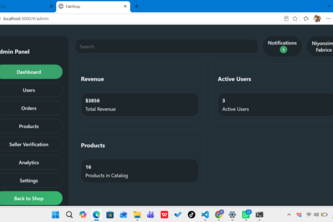
- It includes local placeholder images, and only 16 live products after fixing a timeout bug.
- The author notes that it’s a prototype, not a live product.
Not evidenced: No evidence of users, customers, revenue, or product-market fit.
Inference: The project is in early development and lacks any measurable traction.
Competitive Context
The description does not mention:
- Competitors
- Market size
- Existing solutions in the marketplace space
- Differentiation from other platforms
Not evidenced: No competitive analysis or positioning against existing players.
Inference: The project is likely a niche prototype, with no clear indication of how it would compete in a crowded marketplace market.
Open Questions & Risks
Key risks and open questions based on the description:
- Single developer — no team, no support structure.
- Prototype only — no live product or user base.
- No monetization strategy — unclear how it will generate revenue.
- AI-assisted development — may not scale or be reliable in production.
- Limited technical depth — the author notes challenges with backend debugging and SQL schema design.
- Unverified claims — no independent validation of product functionality or performance.
Inference: The project is at a very early stage, with high risk of failure due to lack of team, traction, and monetization strategy.
Questions the description leaves open
- What is the actual user demand for this kind of multi-role marketplace?
- How does the platform plan to attract and retain verified sellers?
- Has the founder tested the dispute resolution workflow with real users?
- What are the plans for scaling beyond a single developer prototype?
- Is there any intention to integrate with existing payment gateways or e-commerce platforms?
- What is the long-term vision for FabShop, and how does it differ from existing marketplace solutions?
Overall Assessment
Assessment: Not ready for investment or partnership.
Reasoning: The project is described as a single-developer hackathon prototype, with no evidence of traction, revenue, or customer adoption. It lacks clarity on monetization, scalability, and competitive positioning. The author has not demonstrated any commercial viability or market validation beyond personal experimentation.
Inference: This is an early-stage idea, not a product ready for investment or partnership.
Not evidenced: No evidence of product-market fit, team strength, or financials.
User Stories BotA demo video on every pull request
Get a demo video on every new feature
GitHub App that watches your pull requests and records a narrated, captioned demo.
Save time on demo prep and make informed decisions faster with a video walkthrough of every new feature.
Source
Submitted to the OpenAI 2026 hackathon on Devpost. Project home on Devpost. Back to the full gallery on Devpost.
This competitive analysis was produced by top-founders.com (opens in a new tab)
Generated by a language model from this project's public Devpost page — its tagline, the author's own write-up and any built-with tags listed there — as captured in August 2026. Short quotations are the author's words. It is an opinion on the idea as a business, not on the people behind it, and it reflects the description as published then. If the project has moved on, request a correction below. The analysis is not independent research and contains no verified traction, revenue or customer data.
An independent guide by KFG International LLC — not affiliated with, endorsed by, or connected to Devpost or OpenAI.