

Archive position — measured, not model output
0 likes on Devpost
2,263 of the 7,850 archived projects have more likes, and 5,587 share exactly 0 — so this project's #3,986 place in the like-ranked listing is a tie-break inside that group, not a ranking.
Projects (log scale)
Likes on Devpost. ▲ marks this project's group.
Show the figures
| Likes | Projects | Share of archive |
|---|---|---|
| 0 | 5,587 | 71.2% |
| 1 | 1,758 | 22.4% |
| 2 | 284 | 3.6% |
| 3–4 | 132 | 1.7% |
| 5–9 | 75 | 1.0% |
| 10+ | 14 | 0.2% |
 User Stories BotA demo video on every pull request
Get a demo video on every new feature
GitHub App that watches your pull requests and records a narrated, captioned demo.
Save time on demo prep and make informed decisions faster with a video walkthrough of every new feature.
Executive Summary
What the company appears to be
Evidence Gate is a self-reported proof-of-concept application that uses AI (specifically GPT-5.6) to analyze project documentation and detect conflicts between old and new hardware instructions, but prevents automatic execution or approval of actions unless confirmed by a human. It is built as a rule-based system with an audit trail, designed for use in technical environments where outdated information could lead to incorrect physical actions.
What changed
The author reports that this project emerged from a personal problem involving smart irrigation hardware, where AI was used to identify mismatches between old and new controller instructions. The system is described as a working demo with deterministic behavior, human confirmation steps, and structured evidence validation.
Single most important open question
Is there any evidence of real-world adoption or traction beyond the author’s own use case? The description does not indicate whether this has been tested in production environments or scaled beyond a single-person demo.
What The Product Actually Is
The description states that Evidence Gate is an application that:
- Checks whether there is enough evidence to approve one specific instruction.
- Uses GPT-5.6 to read sources, extract claims, and identify conflicts.
- Applies fixed rules to block instructions if the sources do not match.
- Requires a human to confirm physical measurements before allowing action.
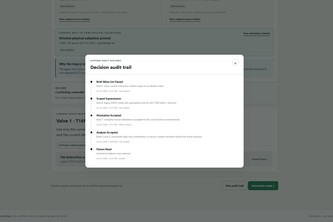
- Maintains an audit trail of decisions and changes.
- Is built using Node.js, JavaScript, HTML, CSS, and integrates with OpenAI API.
It is described as a proof-of-concept demo for a hackathon project, not a commercial product. The system does not automatically approve anything; it only allows action after human confirmation.
Inference The application functions as a hybrid of AI-assisted analysis and rule-based decision control, intended to prevent incorrect physical actions due to outdated or mismatched technical documentation.
Positioning & Claim Evolution
The author states that Evidence Gate:
- Was inspired by a real-world hardware problem in their own smart irrigation project.
- Aims to stop AI from giving hardware instructions when facts are unclear.
- Only allows action when there is enough evidence and a person has confirmed it.
- Prevents AI from making final decisions, even if it helps find contradictions.
It positions itself as a tool for safe technical decision-making, not an autonomous system. The author emphasizes that the goal is to maintain transparency in evidence and human responsibility, rather than to automate safety.
Inference The positioning reflects a cautious approach to AI integration in physical systems — using AI for insight but not for authority.
Target Customer & ICP
The description does not state any specific customer segments or target industries. It is described as a solution for:
- Hardware development
- Maintenance work
- Manufacturing changes
- Laboratory procedures
- Technical instructions
It is implied to be useful in environments where outdated or conflicting technical documentation could lead to physical errors.
Inference The ICP likely includes engineers, technicians, or makers working with hardware systems that require precise instruction following and risk mitigation. However, no explicit customer profile or segmentation is provided.
Business Model & Pricing Evidence
There is no evidence of a business model or pricing structure in the description. The project is presented as a hackathon demo with no indication of monetization, licensing, or subscription plans.
Inference The project has not yet developed a commercial framework. It remains a proof-of-concept.
Technical & Delivery Signals
The author states:
- Built with Node.js, JavaScript, HTML, CSS.
- Uses GPT-5.6 for language and analysis work.
- OpenAI API key stays on the server.
- AI responses must follow a fixed structure before being accepted.
- Includes deterministic tests (21 out of 21 passed).
- Has a working public deployment.
- Demonstrates a live GPT-5.6 analysis.
Inference The technical stack is standard for web-based applications, and the system uses structured AI responses to enforce control logic. The demo includes test coverage and production-ready build artifacts.
Traction & Maturity Signals
The description states:
- It is a working public application.
- Includes 21 out of 21 deterministic tests passed.
- Has a live GPT-5.6 integration.
- Was submitted to the OpenAI 2026 hackathon.
- Demonstrates one focused hardware case.
There is no evidence of revenue, customers, or adoption beyond the author’s own use case and demo.
Inference The project has reached a functional prototype stage but lacks any signs of traction or commercial deployment.
Competitive Context
No competitive landscape is described. The author does not mention similar tools or platforms in the market. The focus is on solving a specific problem (conflicting hardware instructions) rather than positioning against competitors.
Inference There is no evidence of existing products addressing this exact use case, but the lack of competitive data makes it difficult to assess market opportunity or differentiation.
Open Questions & Risks
- No commercial traction: The project is described as a demo with no evidence of real-world usage.
- Limited scope: It only addresses one specific hardware case and does not scale beyond that.
- Self-reported nature: All claims are unverified, and there is no third-party validation.
- Single-person team: The entire system was built by one individual (Gábor Juhász), which raises questions about scalability or long-term maintenance.
- No pricing or monetization model: No indication of how the product would be monetized if developed further.
Inference The project is in early-stage development and lacks commercial viability or market validation.
Questions the description leaves open
- What specific hardware environments or industries are you targeting for expansion?
- How would you scale this beyond a single-person demo?
- Are there any plans to integrate with existing project management or documentation tools?
- Has the system been tested in real-world settings outside of your own use case?
- What is the long-term vision for monetization or commercial deployment?
Overall Assessment
The description presents Evidence Gate as a proof-of-concept hackathon demo with limited evidence of traction, revenue, or customer adoption. It is not a commercial product but a prototype that explores how AI can be used to support safe technical decision-making while retaining human oversight.
Confidence Level Low This analysis is based entirely on self-reported information and lacks any independent verification or data on usage, customers, or financials. The project shows potential for future development but currently has no demonstrated commercial viability or market traction.
Assessment Not ready for investment or partnership at this stage. It may be a useful idea to explore further if the team can demonstrate real-world application and scalability.
User Stories BotA demo video on every pull request
Get a demo video on every new feature
GitHub App that watches your pull requests and records a narrated, captioned demo.
Save time on demo prep and make informed decisions faster with a video walkthrough of every new feature.
Source
Submitted to the OpenAI 2026 hackathon on Devpost. Project home on Devpost. Back to the full gallery on Devpost.
This competitive analysis was produced by top-founders.com (opens in a new tab)
Generated by a language model from this project's public Devpost page — its tagline, the author's own write-up and any built-with tags listed there — as captured in August 2026. Short quotations are the author's words. It is an opinion on the idea as a business, not on the people behind it, and it reflects the description as published then. If the project has moved on, request a correction below. The analysis is not independent research and contains no verified traction, revenue or customer data.
An independent guide by KFG International LLC — not affiliated with, endorsed by, or connected to Devpost or OpenAI.